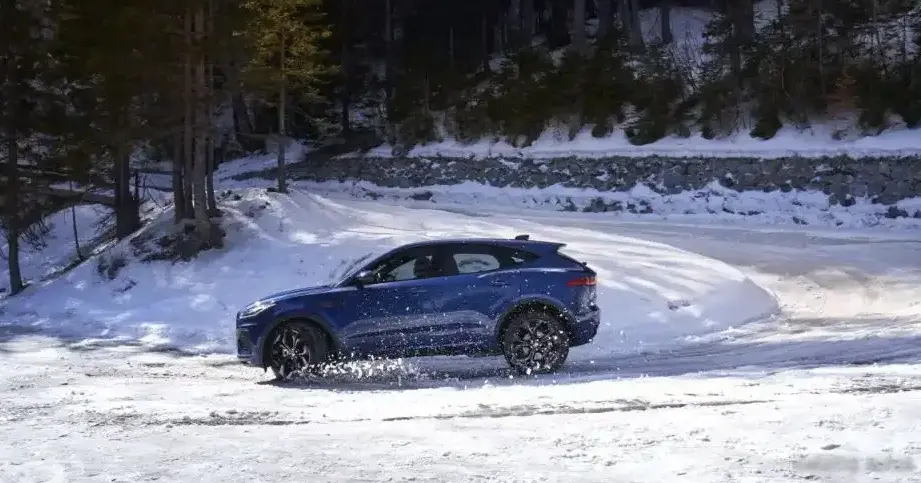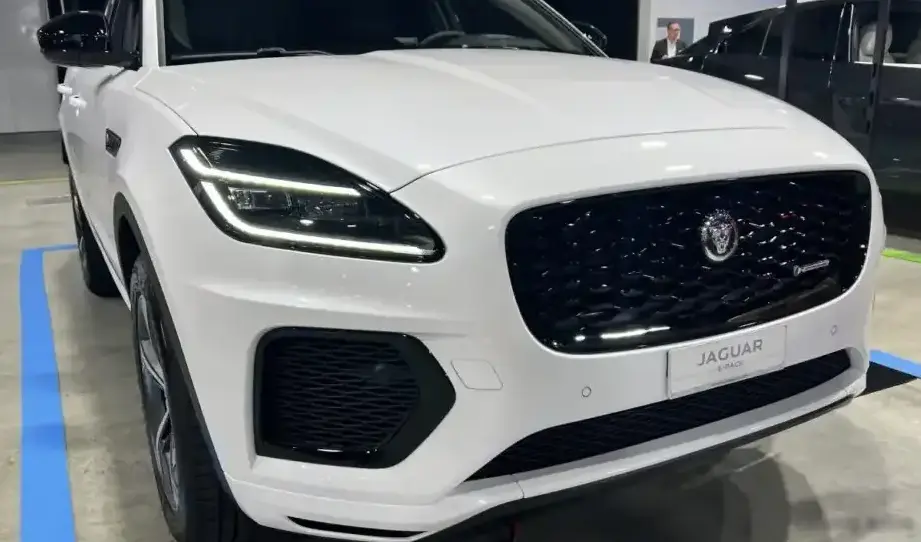
The Jaguar E-Pace P300e, introduced with the 2020 facelift and produced through April 2024, represents Jaguar’s entry into the premium compact SUV plug-in hybrid market. This variant combines a 1.5-liter turbocharged three-cylinder gasoline engine with an electric motor, delivering a combined output of 269 horsepower. Positioned as a mid-range offering within the E-Pace lineup, the P300e aimed to provide a balance between performance, efficiency, and all-weather capability through its standard all-wheel-drive system. It was a key model in Jaguar’s strategy to electrify its range and appeal to environmentally conscious buyers.
Technical Specifications
| Brand | Jaguar |
| Model | E-Pace |
| Generation | E-Pace (facelift 2020) |
| Type (Engine) | 1.5i P300e (269 Hp) Plug-in Hybrid AWD Automatic |
| Start of production | October, 2023 |
| End of production | April, 2024 |
| Powertrain Architecture | PHEV (Plug-in Hybrid Electric Vehicle) |
| Body type | SUV |
| Seats | 5 |
| Doors | 5 |
| Combined fuel consumption (WLTP) | 1.4 l/100 km (168 US mpg, 201.8 UK mpg, 71.4 km/l) |
| CO2 emissions (WLTP) | 31 g/km |
| Fuel Type | Petrol / electricity |
| Acceleration 0 – 100 km/h | 7.3 sec |
| Acceleration 0 – 62 mph | 7.3 sec |
| Acceleration 0 – 60 mph | 6.9 sec |
| Maximum speed | 190 km/h (118.06 mph) |
| Emission standard | Euro 6e |
| Weight-to-power ratio | 7.8 kg/Hp, 128.2 Hp/tonne |
| Weight-to-torque ratio | 3.9 kg/Nm, 257.4 Nm/tonne |
| Gross battery capacity | 15 kWh |
| Net (usable) battery capacity | 11.975 kWh |
| Battery technology | Lithium-ion (Li-Ion) |
| Battery location | Below the floor, under the rear seats |
| All-electric range (WLTP) | 65 km (40.39 mi) |
| Average Energy consumption (WLTP) | 19.9 kWh/100 km (32.03 kWh/100 mi, 105 MPGe, 5 km/kWh, 3.1 mi/kWh) |
| Max speed (electric) | 135 km/h (83.89 mph) |
| Electric motor power | 109 Hp |
| Electric motor location | Rear axle, Transverse |
| System power | 269 Hp @ 5500 rpm |
| System torque | 540 Nm @ 1600-4500 rpm (398.28 lb.-ft. @ 1600-4500 rpm) |
| Power | 200 Hp |
| Power per litre | 133.5 Hp/l |
| Engine layout | Front, Transverse |
| Engine Model/Code | Ingenium / AJ20P3 |
| Engine displacement | 1498 cm3 (91.41 cu. in.) |
| Number of cylinders | 3 |
| Engine configuration | Inline |
| Cylinder Bore | 83 mm (3.27 in.) |
| Piston Stroke | 92.29 mm (3.63 in.) |
| Compression ratio | 10.5:1 |
| Number of valves per cylinder | 4 |
| Fuel injection system | Direct injection |
| Engine aspiration | Turbocharger, Intercooler |
| Valvetrain | DOHC |
| Engine oil capacity | 5.9 l (6.23 US qt | 5.19 UK qt) |
| Kerb Weight | 2098 kg (4625.3 lbs.) |
| Max. weight | 2670 kg (5886.34 lbs.) |
| Max load | 572 kg (1261.04 lbs.) |
| Trunk (boot) space – minimum | 494 l (17.45 cu. ft.) |
| Trunk (boot) space – maximum | 1170 l (41.32 cu. ft.) |
| Fuel tank capacity | 57.6 l (15.22 US gal | 12.67 UK gal) |
| Permitted trailer load with brakes (12%) | 1600 kg (3527.4 lbs.) |
| Permitted trailer load without brakes | 750 kg (1653.47 lbs.) |
| Length | 4395 mm (173.03 in.) |
| Width with mirrors folded | 1984 mm (78.11 in.) |
| Width including mirrors | 2088 mm (82.2 in.) |
| Height | 1648 mm (64.88 in.) |
| Wheelbase | 2681 mm (105.55 in.) |
| Front track | 1625 mm (63.98 in.) |
| Rear (Back) track | 1624 mm (63.94 in.) |
| Front overhang | 882 mm (34.72 in.) |
| Rear overhang | 832 mm (32.76 in.) |
| Ride height (ground clearance) | 212 mm (8.35 in.) |
| Minimum turning circle (turning diameter) | 12 m (39.37 ft.) |
| Drivetrain Architecture | The Internal combustion engine (ICE) permanently drives the front wheels of the vehicle, the electric motor drives the rear wheels of the vehicle, capable of running in full electric mode, only by the Internal combustion engine (ICE) or in mixed mode. |
| Drive wheel | All wheel drive (4×4) |
| Number of gears and type of gearbox | 8 gears, automatic transmission |
| Front suspension | Independent, type McPherson with coil spring and anti-roll bar |
| Rear suspension | Independent multi-link spring suspension with stabilizer |
| Front brakes | Ventilated discs |
| Rear brakes | Ventilated discs |
| Steering type | Steering rack and pinion |
| Power steering | Electric Steering |
| Tires size | 235/60 R18; 235/55 R19; 235/50 R20 |
| Wheel rims size | 18; 19; 20 |
INTRODUCTION
The Jaguar E-Pace P300e, launched as part of the 2020 facelift, is a compact luxury SUV that blends Jaguar’s signature styling with a plug-in hybrid powertrain. Built on the PTA (Premium Transverse Architecture) platform, shared with the Land Rover Discovery Sport, the P300e was designed to appeal to buyers seeking a more efficient and environmentally friendly option without sacrificing the driving experience associated with the Jaguar brand. Production spanned from October 2023 to April 2024, representing a relatively short production run for this specific variant. It aimed to compete with rivals like the BMW X1 xDrive30e and the Volvo XC40 Recharge.
Powertrain & Engine Architecture
At the heart of the E-Pace P300e lies Jaguar’s Ingenium engine family. Specifically, it utilizes a 1.5-liter, three-cylinder turbocharged gasoline engine (code AJ20P3) producing 200 horsepower. This engine features direct fuel injection and a single twin-scroll turbocharger. The engine is paired with an 8-speed automatic transmission, sending power to the front wheels. Supplementing the gasoline engine is a rear-mounted electric motor, generating 109 horsepower. The combined system output is 269 horsepower and 540 Nm (398 lb-ft) of torque. The 15 kWh lithium-ion battery pack, located under the rear seats, provides an all-electric range of up to 65 km (40.39 miles) under WLTP testing. The P300e’s powertrain allows for various driving modes, including EV mode for all-electric driving, Hybrid mode for automatic switching between engine and motor, and Sport mode for maximum performance.
Driving Characteristics
The E-Pace P300e offers a unique driving experience compared to its gasoline-only counterparts. The instant torque from the electric motor provides brisk acceleration, with a 0-60 mph time of around 6.9 seconds. The eight-speed automatic transmission is well-tuned, offering smooth and responsive gear changes. In electric mode, the vehicle is near-silent and provides a relaxed driving experience, ideal for urban commutes. When the gasoline engine engages, the transition is generally seamless. The all-wheel-drive system provides excellent traction in various weather conditions. While the added weight of the battery pack slightly impacts handling agility compared to lighter E-Pace models, the P300e still delivers a composed and engaging driving experience.
Equipment & Trim Levels
The E-Pace P300e typically came well-equipped, reflecting its position as a premium model. Standard features included leather upholstery, a touchscreen infotainment system with Apple CarPlay and Android Auto compatibility, navigation, automatic climate control, and a suite of advanced driver-assistance systems (ADAS) such as lane keep assist and emergency braking. Optional extras included a panoramic sunroof, premium audio system, adaptive cruise control, and upgraded interior trim materials. Trim levels varied by market, but generally offered increasing levels of luxury and technology. The P300e was often available in SE, HSE, and R-Dynamic HSE trims, with the latter offering a sportier aesthetic.
Chassis & Braking
The E-Pace P300e utilizes an independent suspension system, with McPherson struts at the front and a multi-link setup at the rear. The suspension is tuned to provide a balance between comfort and handling. Stabilizer bars are fitted to both axles to reduce body roll. Braking duties are handled by ventilated discs on all four wheels. The P300e incorporates regenerative braking, which helps to recapture energy during deceleration and recharge the battery. The steering is electrically assisted, providing a precise and responsive feel.
Market Reception & Comparison
The E-Pace P300e received generally positive reviews from automotive critics. Praised for its blend of performance, efficiency, and luxury, it was seen as a compelling alternative to other premium compact plug-in hybrid SUVs. However, some reviewers noted that the all-electric range was slightly shorter than some competitors. Compared to the standard E-Pace models, the P300e offered significantly improved fuel economy and lower emissions. Against the 2.0-liter four-cylinder gasoline versions, the P300e provided similar acceleration but with the added benefit of electric driving capability. The 1.5L engine, while efficient, was sometimes criticized for being less refined than the larger engines in the lineup.
Legacy
The Jaguar E-Pace P300e represents an important step in Jaguar’s transition towards electrification. While its production run was relatively short, it demonstrated Jaguar’s commitment to offering sustainable luxury vehicles. On the used car market, the P300e holds its value reasonably well, appealing to buyers seeking a premium plug-in hybrid SUV. The Ingenium powertrain, known for its reliability, is generally considered durable, although regular maintenance is crucial for optimal performance. The P300e’s combination of Jaguar’s brand appeal, plug-in hybrid technology, and all-wheel-drive capability ensures its continued relevance in the used car market for years to come.