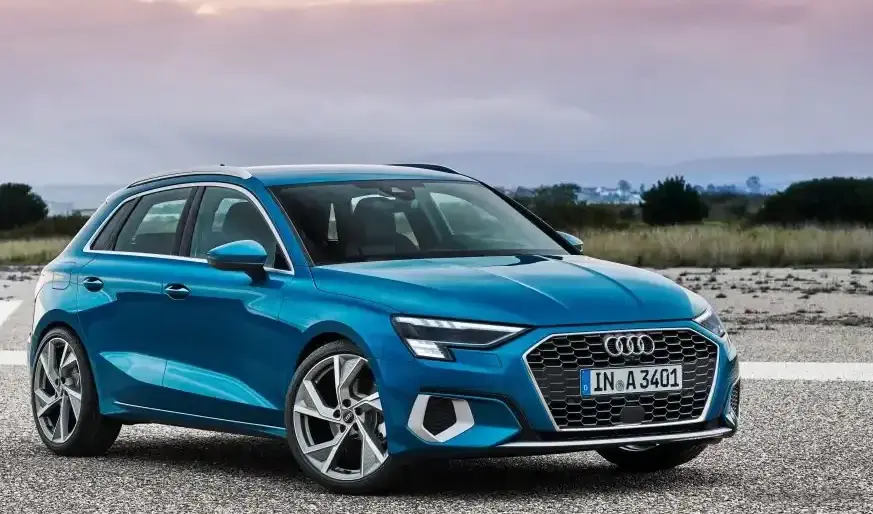
The Audi A3 Sportback (8Y) 30 g-tron, produced from October 2020 to 2023, represents a unique offering within the fourth generation (8Y) A3 Sportback lineup. This variant distinguishes itself through its bi-fuel capability, designed to run on both gasoline and Compressed Natural Gas (CNG), catering to markets with established CNG infrastructure and incentives. Positioned as a fuel-efficient and environmentally conscious option, the 30 g-tron utilizes a 1.5-liter turbocharged engine paired with a seven-speed S tronic dual-clutch transmission. It aimed to appeal to buyers seeking a balance between practicality, moderate performance, and reduced emissions, particularly in European markets where alternative fuel vehicles are favored.
Technical Specifications
| Brand | Audi |
| Model | A3 |
| Generation | A3 Sportback (8Y) |
| Type (Engine) | 30 g-tron (131 Hp) S tronic |
| Start of production | October, 2020 |
| End of production | 2023 |
| Powertrain Architecture | Internal Combustion engine |
| Body type | Hatchback |
| Seats | 5 |
| Doors | 5 |
| Fuel consumption at Low speed (WLTP) (CNG) | 5.9 kg/100 km |
| Fuel consumption at Medium speed (WLTP) (CNG) | 4.1 kg/100 km |
| Fuel consumption at high speed (WLTP) (CNG) | 3.5 kg/100 km |
| Fuel consumption at very high speed (WLTP) (CNG) | 3.9 kg/100 km |
| Combined fuel consumption (WLTP) (CNG) | 4.1 kg/100 km |
| CO2 emissions (WLTP) | 112 g/km |
| Fuel consumption (economy) – urban (CNG) (NEDC) | 4.5 kg/100 km |
| Fuel consumption (economy) – extra urban (CNG) (NEDC) | 3.1 kg/100 km |
| Fuel consumption (economy) – combined (CNG) (NEDC) | 3.6 kg/100 km |
| CO2 emissions (NEDC) | 99 g/km |
| Fuel Type | Petrol / CNG |
| Acceleration 0 – 100 km/h | 9.7 sec |
| Acceleration 0 – 62 mph | 9.7 sec |
| Acceleration 0 – 60 mph | 9.2 sec |
| Maximum speed | 211 km/h (131.11 mph) |
| Emission standard | Euro 6d-ISC-FCM |
| Weight-to-power ratio | 10.9 kg/Hp, 91.6 Hp/tonne |
| Weight-to-torque ratio | 7.2 kg/Nm, 139.9 Nm/tonne |
| Power | 131 Hp @ 5000-6000 rpm |
| Power per litre | 87.4 Hp/l |
| Torque | 200 Nm @ 1400-3400 rpm (147.51 lb.-ft. @ 1400-3400 rpm) |
| Engine layout | Front, Transverse |
| Engine displacement | 1498 cm3 (91.41 cu. in.) |
| Number of cylinders | 4 |
| Engine configuration | Inline |
| Fuel injection system | Direct injection |
| Engine aspiration | Turbocharger, Intercooler |
| Kerb Weight | 1430 kg (3152.61 lbs.) |
| Max. weight | 1885 kg (4155.71 lbs.) |
| Max load | 455 kg (1003.1 lbs.) |
| Trunk (boot) space – minimum | 280 l (9.89 cu. ft.) |
| Trunk (boot) space – maximum | 1100 l (38.85 cu. ft.) |
| Fuel tank capacity | 9 l (2.38 US gal | 1.98 UK gal) |
| CNG cylinder capacity | 17.3 kg |
| Max. roof load | 75 kg (165.35 lbs.) |
| Permitted trailer load with brakes (8%) | 1700 kg (3747.86 lbs.) |
| Permitted trailer load with brakes (12%) | 1400 kg (3086.47 lbs.) |
| Permitted trailer load without brakes | 710 kg (1565.28 lbs.) |
| Permitted towbar download | 80 kg (176.37 lbs.) |
| Drag coefficient (Cd) | 0.31 |
| Minimum turning circle (turning diameter) | 11.1 m (36.42 ft.) |
| Drivetrain Architecture | The Internal combustion engine (ICE) drives the front wheels of the vehicle. |
| Drive wheel | Front wheel drive |
| Number of gears and type of gearbox | 7 gears, automatic transmission S tronic |
| Front suspension | Independent type McPherson |
| Rear suspension | Threaded twist beam |
| Front brakes | Ventilated discs |
| Rear brakes | Disc |
| Assisting systems | ABS (Anti-lock braking system) |
| Steering type | Steering rack and pinion |
| Power steering | Electric Steering |
| Tires size | 205/55 R16; 225/40 R18 |
| Wheel rims size | 7J x 16; 8J x 18 |
Powertrain & Engine Architecture
At the heart of the A3 30 g-tron lies the EA211 family 1.5-liter inline-four cylinder gasoline engine. This engine, designated with engine codes such as DNV, utilizes direct fuel injection and a single turbocharger with an intercooler to achieve a balance of efficiency and performance. The engine is specifically tuned for bi-fuel operation, capable of seamlessly switching between gasoline and CNG. When running on CNG, the engine management system adjusts parameters to optimize combustion for the different fuel characteristics. The S tronic seven-speed dual-clutch transmission provides quick and smooth gear changes, contributing to a more engaging driving experience compared to a traditional automatic. This transmission is known for its efficiency and responsiveness, further enhancing the vehicle’s fuel economy.
Driving Characteristics
The 131 horsepower and 200 Nm (147.51 lb-ft) of torque delivered by the 30 g-tron powertrain result in a 0-60 mph acceleration time of around 9.2 seconds and a top speed of 211 km/h (131.11 mph). While not a performance-oriented variant, the A3 30 g-tron offers adequate power for everyday driving situations. The S tronic transmission helps to keep the engine in its optimal power band, providing responsive acceleration. Compared to the more powerful 40 TFSI models, the 30 g-tron feels less eager to accelerate, but it compensates with significantly improved fuel economy when running on CNG. The gear ratios are tuned for efficiency, prioritizing fuel savings over outright performance. The switch between gasoline and CNG is generally seamless, with minimal noticeable difference in power delivery.
Equipment & Trim Levels
The A3 30 g-tron typically came equipped with a respectable level of standard features, including Audi’s MMI infotainment system with a touchscreen display, automatic climate control, and a suite of safety features such as ABS, electronic stability control, and multiple airbags. Interior upholstery was generally cloth, with options for leather upgrades. Trim levels varied by market, but generally included ‘Sport’ and ‘S line’ packages offering enhanced styling and additional features like sport seats, upgraded wheels, and a lowered suspension. Optional extras included a panoramic sunroof, a premium sound system, and advanced driver-assistance systems like adaptive cruise control and lane-keeping assist.
Chassis & Braking
The A3 30 g-tron utilizes a McPherson strut front suspension and a threaded twist beam rear suspension. This setup provides a comfortable ride quality while maintaining reasonable handling characteristics. The front brakes are ventilated discs, while the rear brakes are solid discs. The suspension is tuned to prioritize comfort and stability, rather than sporty handling. The steering is an electric power-assisted rack and pinion system, providing precise and responsive steering feel. The vehicle’s weight, around 1430 kg (3152.61 lbs), is relatively moderate, contributing to its manageable handling characteristics.
Market Reception & Comparison
The A3 30 g-tron was generally well-received by critics as a practical and environmentally conscious option. Its ability to run on CNG offered significant fuel cost savings in markets where CNG was readily available and competitively priced. Compared to the gasoline-only A3 variants, the 30 g-tron offered similar levels of comfort and refinement, but with a slightly reduced performance. Its main competitors included other bi-fuel vehicles and diesel-powered A3 models. Fuel economy was a key selling point, with the 30 g-tron achieving significantly lower CO2 emissions when running on CNG.
Legacy
The Audi A3 30 g-tron represents an important step in Audi’s development of alternative fuel vehicles. While CNG infrastructure remains limited in some regions, the 30 g-tron demonstrated Audi’s commitment to reducing emissions and offering consumers more sustainable transportation options. On the used car market, these models are often sought after by environmentally conscious buyers and those looking to benefit from lower fuel costs. The EA211 engine family is known for its reliability, and the S tronic transmission, while requiring regular maintenance, is generally durable. The 30 g-tron’s long-term reliability is considered good, making it a viable option for buyers seeking a fuel-efficient and environmentally friendly compact hatchback.