Technical Specifications
| Brand | Jaguar |
| Model | E-Pace |
| Generation | E-Pace (facelift 2020) |
| Type (Engine) | 2.0d (204 Hp) Mild Hybrid AWD Automatic |
| Start of production | October, 2020 |
| End of production | 2024 |
| Powertrain Architecture | MHEV (Mild Hybrid Electric Vehicle) |
| Body type | SUV |
| Seats | 5 |
| Doors | 5 |
| Combined fuel consumption (WLTP) | 6.4-7 l/100 km (36.8 – 33.6 US mpg, 44.1 – 40.4 UK mpg, 15.6 – 14.3 km/l) |
| CO2 emissions (WLTP) | 169-185 g/km |
| Fuel Type | Diesel |
| Acceleration 0 – 100 km/h | 8.4 sec |
| Acceleration 0 – 62 mph | 8.4 sec |
| Acceleration 0 – 60 mph | 7.9 sec |
| Maximum speed | 211 km/h (131.11 mph) |
| Emission standard | Euro 6d |
| Weight-to-power ratio | 9.2 kg/Hp, 108.7 Hp/tonne |
| Weight-to-torque ratio | 4.4 kg/Nm, 229.1 Nm/tonne |
| Power | 204 Hp @ 3750 rpm |
| Power per litre | 102.2 Hp/l |
| Torque | 430 Nm @ 1750-2500 rpm (317.15 lb.-ft. @ 1750-2500 rpm) |
| Engine layout | Front, Transverse |
| Engine Model/Code | Ingenium / AJ20D4 |
| Engine displacement | 1997 cm3 (121.86 cu. in.) |
| Number of cylinders | 4 |
| Engine configuration | Inline |
| Cylinder Bore | 83 mm (3.27 in.) |
| Piston Stroke | 92.31 mm (3.63 in.) |
| Compression ratio | 16.5:1 |
| Number of valves per cylinder | 4 |
| Fuel injection system | Diesel Commonrail |
| Engine aspiration | Turbocharger, Intercooler |
| Engine oil capacity | 6.5 l (6.87 US qt | 5.72 UK qt) |
| Coolant | 11.2 l (11.83 US qt | 9.85 UK qt) |
| Kerb Weight | 1877 kg (4138.08 lbs.) |
| Trunk (boot) space – minimum | 601 l (21.22 cu. ft.) |
| Trunk (boot) space – maximum | 1386 l (48.95 cu. ft.) |
| Fuel tank capacity | 65 l (17.17 US gal | 14.3 UK gal) |
| AdBlue tank | 17 l (4.49 US gal | 3.74 UK gal) |
| Permitted trailer load with brakes (12%) | 1800 kg (3968.32 lbs.) |
| Permitted trailer load without brakes | 750 kg (1653.47 lbs.) |
| Length | 4395 mm (173.03 in.) |
| Width with mirrors folded | 1984 mm (78.11 in.) |
| Height | 1648 mm (64.88 in.) |
| Wheelbase | 2681 mm (105.55 in.) |
| Front track | 1625 mm (63.98 in.) |
| Rear (Back) track | 1624 mm (63.94 in.) |
| Front overhang | 882 mm (34.72 in.) |
| Rear overhang | 832 mm (32.76 in.) |
| Ride height (ground clearance) | 212 mm (8.35 in.) |
| Drag coefficient (Cd) | 0.32 |
| Minimum turning circle (turning diameter) | 11.63 m (38.16 ft.) |
| Approach angle | 22° |
| Departure angle | 28° |
| Ramp-over (brakeover) angle | 20.7° |
| Wading depth | 500 mm (19.69 in.) |
| Drivetrain Architecture | ICE and electric motor drive rear wheels, with front wheel engagement via clutch. |
| Drive wheel | All wheel drive (4×4) |
| Number of gears and type of gearbox | 9 gears, automatic transmission |
| Front suspension | Independent, McPherson with coil spring and anti-roll bar |
| Rear suspension | Independent multi-link spring suspension with stabilizer |
| Front brakes | Ventilated discs, 349 mm |
| Rear brakes | Disc, 300 mm |
| Assisting systems | ABS (Anti-lock braking system) |
| Steering type | Steering rack and pinion |
| Power steering | Electric Steering |
| Wheel rims size | 18 |
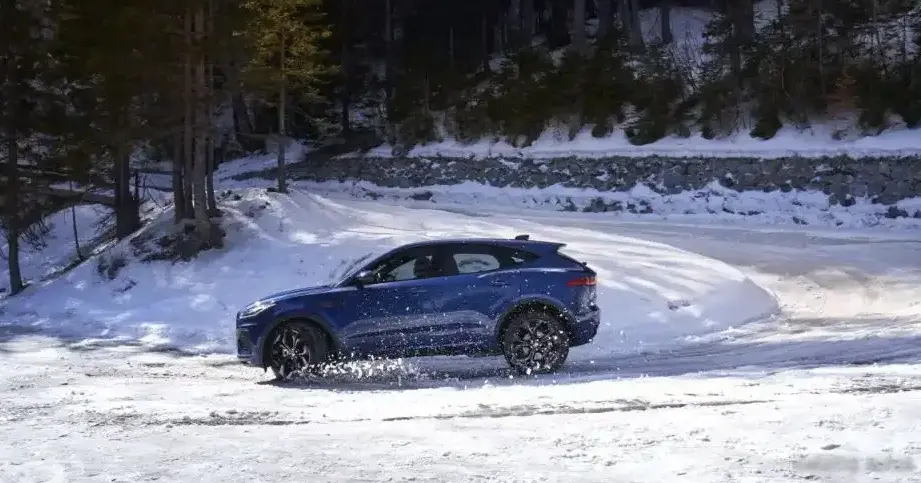
The 2020 facelift of the Jaguar E-Pace brought a more refined and technologically advanced package to the compact SUV segment. The 2.0d (204 Hp) Mild Hybrid AWD Automatic variant occupied a central position in the E-Pace range, offering a balance between performance, fuel economy, and price. It was designed to appeal to buyers who wanted the prestige of the Jaguar brand with the practicality of an all-wheel-drive SUV, without the higher cost of the more powerful engine options. Built on the PTA (Premium Transverse Architecture) platform, shared with the Land Rover Discovery Sport, the E-Pace aimed to deliver a dynamic driving experience and a luxurious interior.
Powertrain & Engine Architecture
At the heart of this E-Pace variant lies Jaguar Land Rover’s Ingenium engine family, specifically the AJ20D4 2.0-liter four-cylinder diesel. This engine utilizes a sophisticated turbocharger and direct injection system to produce 204 horsepower at 3750 rpm and 430 Nm (317 lb-ft) of torque between 1750 and 2500 rpm. The “Mild Hybrid” designation refers to a 48-volt electrical system that incorporates a Belt-integrated Starter Generator (BiSG). This system assists the engine during acceleration, allowing for smoother starts and improved fuel efficiency. The BiSG also enables a more responsive stop/start system. The engine features a cast aluminum block and head, and a relatively high compression ratio of 16.5:1. The engine is transversely mounted, driving all four wheels through a ZF-sourced nine-speed automatic transmission. This transmission is known for its smooth shifts and wide gear ratio spread, contributing to both fuel economy and performance.
Driving Characteristics
The 204 hp and 430 Nm of torque provide adequate performance for everyday driving. Acceleration from 0-60 mph takes around 7.9 seconds, making it competitive within its class. While not as quick as the higher-powered E-Pace variants (like the P300), the 2.0d offers a more relaxed and fuel-efficient driving experience. The nine-speed automatic transmission is generally smooth and responsive, although some drivers have noted occasional hesitation during downshifts. The all-wheel-drive system provides excellent traction in various weather conditions. The E-Pace’s suspension is tuned for a balance between comfort and handling, offering a reasonably compliant ride without feeling overly soft in corners. Compared to the manual transmission versions (which were less common in the US market), the automatic provides greater convenience, especially in urban driving.
Equipment & Trim Levels
The 2.0d Mild Hybrid AWD Automatic was available in several trim levels, including S, SE, and HSE. Standard equipment on the base S trim typically included leather upholstery, a touchscreen infotainment system with Apple CarPlay and Android Auto compatibility, automatic climate control, and a suite of safety features such as lane keep assist and emergency braking. Higher trims like the SE and HSE added features such as premium leather, heated seats, a panoramic sunroof, and a more advanced sound system. Optional extras included adaptive cruise control, a head-up display, and various cosmetic enhancements.
Chassis & Braking
The E-Pace utilizes an independent suspension system all around, with McPherson struts at the front and a multi-link setup at the rear. This configuration provides a good balance of ride comfort and handling precision. The front brakes consist of ventilated discs measuring 349mm, while the rear brakes are solid discs measuring 300mm. Anti-lock braking system (ABS) and electronic stability control (ESC) are standard features. The E-Pace’s chassis is relatively lightweight, contributing to its agile handling characteristics. The all-wheel-drive system is primarily rear-biased, enhancing the driving experience.
Market Reception & Comparison
The Jaguar E-Pace 2.0d Mild Hybrid AWD Automatic was generally well-received by automotive critics. It was praised for its stylish design, luxurious interior, and comfortable ride. However, some reviewers noted that the infotainment system could be complex to use and that the rear seat space was somewhat limited. Compared to rivals such as the Audi Q3, BMW X1, and Mercedes-Benz GLA, the E-Pace offered a more distinctive design and a more engaging driving experience. Fuel economy was competitive, with combined figures ranging from 6.4 to 7.0 l/100 km (36.8 to 33.6 US mpg). Reliability reports have been mixed, with some owners reporting minor issues with the infotainment system and electrical components.
Legacy
The Jaguar E-Pace 2.0d Mild Hybrid AWD Automatic has established itself as a popular choice in the premium compact SUV segment. The Ingenium engine has proven to be relatively reliable, although regular maintenance is essential. On the used car market, these models offer a good value proposition, combining luxury, performance, and fuel efficiency. The introduction of mild hybrid technology demonstrated Jaguar Land Rover’s commitment to improving fuel economy and reducing emissions. As a result, well-maintained examples of this E-Pace variant continue to be sought after by buyers looking for a stylish and capable compact SUV.