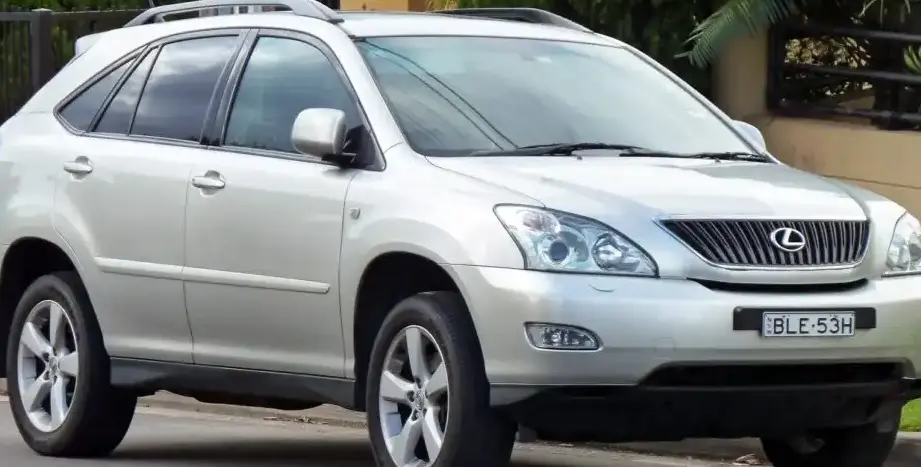
The Lexus RX 400h, produced from 2004 to 2009, represented Lexus’s initial foray into the luxury hybrid SUV market. Part of the second generation RX (RX II, chassis code MCU38), the 400h distinguished itself with a sophisticated full hybrid powertrain, offering a blend of fuel efficiency and performance uncommon in its class at the time. Positioned as the flagship trim within the RX II lineup, it commanded a premium price point over the conventionally powered RX 330. The RX 400h was primarily marketed in North America, Europe, and select Asian markets, appealing to environmentally conscious luxury buyers seeking a refined driving experience.
Technical Specifications
| Brand | Lexus |
| Model | RX |
| Generation | RX II |
| Type (Engine) | 400h (272 Hp) Hybrid AWD e-CVT |
| Start of production | 2004 |
| End of production | 2009 |
| Powertrain Architecture | FHEV (Full Hybrid Electric Vehicle) |
| Body type | SUV |
| Seats | 5 |
| Doors | 5 |
| Fuel consumption (urban) | 9.1 l/100 km (25.8 US mpg, 31 UK mpg, 11 km/l) |
| Fuel consumption (extra urban) | 7.6 l/100 km (30.9 US mpg, 37.2 UK mpg, 13.2 km/l) |
| Fuel consumption (combined) | 8.1 l/100 km (29 US mpg, 34.9 UK mpg, 12.3 km/l) |
| CO2 emissions | 192 g/km |
| Fuel Type | Petrol (Gasoline) |
| Acceleration 0 – 100 km/h | 7.6 sec |
| Acceleration 0 – 62 mph | 7.6 sec |
| Acceleration 0 – 60 mph | 7.3 sec |
| Maximum speed | 200 km/h (124.27 mph) |
| Emission standard | Euro 4 |
| Weight-to-power ratio | 7.4 kg/Hp, 136 Hp/tonne |
| Weight-to-torque ratio | 6.9 kg/Nm, 144 Nm/tonne |
| Battery voltage | 288 V |
| Battery technology | Nickel-metal hydride (NiMH) |
| Battery weight | 69 kg (152.12 lbs) |
| Battery location | Under the rear seats |
| Electric motor power (1) | 167 Hp @ 4500 rpm |
| Electric motor torque (1) | 333 Nm @ 1500 rpm (245.61 lb.-ft. @ 1500 rpm) |
| Electric motor location (1) | Rear axle, Transverse |
| Electric motor power (2) | 68 Hp @ 4600 rpm |
| Electric motor torque (2) | 130 Nm (95.88 lb.-ft.) |
| Electric motor location (2) | Integrated into the transmission |
| System power | 272 Hp |
| Engine power | 211 Hp @ 5600 rpm |
| Power per litre | 63.7 Hp/l |
| Torque | 288 Nm @ 4400 rpm (212.42 lb.-ft. @ 4400 rpm) |
| Engine layout | Front, Transverse |
| Engine Model/Code | 3MZ-FE |
| Engine displacement | 3311 cm3 (202.05 cu. in.) |
| Number of cylinders | 6 |
| Engine configuration | V-engine |
| Cylinder Bore | 92 mm (3.62 in.) |
| Piston Stroke | 83 mm (3.27 in.) |
| Compression ratio | 10.8:1 |
| Number of valves per cylinder | 4 |
| Fuel injection system | Multi-port manifold injection |
| Engine aspiration | Naturally aspirated engine |
| Valvetrain | DOHC, VVT-i |
| Engine oil capacity | 4.7 l (4.97 US qt | 4.14 UK qt) |
| Coolant | 9.5 l (10.04 US qt | 8.36 UK qt) |
| Kerb Weight | 2000-2040 kg (4409.25 – 4497.43 lbs.) |
| Max. weight | 2505 kg (5522.58 lbs.) |
| Max load | 465-505 kg (1025.15 – 1113.33 lbs.) |
| Trunk (boot) space – minimum | 439 l (15.5 cu. ft.) |
| Fuel tank capacity | 65 l (17.17 US gal | 14.3 UK gal) |
| Permitted trailer load with brakes (12%) | 2000 kg (4409.25 lbs.) |
| Permitted trailer load without brakes | 700 kg (1543.24 lbs.) |
| Length | 4760 mm (187.4 in.) |
| Width | 1845 mm (72.64 in.) |
| Height | 1680 mm (66.14 in.) |
| Wheelbase | 2720 mm (107.09 in.) |
| Front track | 1580 mm (62.2 in.) |
| Rear (Back) track | 1570 mm (61.81 in.) |
| Ride height (ground clearance) | 180 mm (7.09 in.) |
| Minimum turning circle (turning diameter) | 12.2 m (40.03 ft.) |
| Drivetrain Architecture | An Internal combustion engine (ICE) drives the front wheels, one electric motor drives the front wheels, one electric motor drives the rear wheels. There is an ability for running in full electric or mixed mode. |
| Drive wheel | All wheel drive (4×4) |
| Number of gears and type of gearbox | automatic transmission e-CVT |
| Front suspension | Independent, type McPherson with coil spring and anti-roll bar |
| Rear suspension | Independent coil spring, Transverse stabilizer |
| Front brakes | Ventilated discs, 320.04 mm |
| Rear brakes | Disc, 287.02 mm |
| Assisting systems | ABS (Anti-lock braking system) |
| Steering type | Steering rack and pinion |
| Power steering | Electric Steering |
| Tires size | 235/55 R18 |
| Wheel rims size | 7J x 18 |
Powertrain & Engine Architecture
The RX 400h’s powertrain is a complex system centered around the 3MZ-FE 3.3-liter V6 gasoline engine. This engine, producing 211 horsepower and 212 lb-ft of torque, is coupled with two electric motor/generators. The first, located at the front, provides assistance to the engine and acts as a generator during regenerative braking. The second, positioned on the rear axle, provides all-wheel drive capability and can independently propel the vehicle at low speeds. The system utilizes a planetary gearset, functioning as an electronically controlled continuously variable transmission (e-CVT), seamlessly blending power from the engine and electric motors. The 3MZ-FE engine employs multi-port fuel injection and a DOHC valvetrain with variable valve timing (VVT-i) for optimized efficiency and performance. The nickel-metal hydride (NiMH) battery pack, located under the rear seats, provides the energy storage for the electric motors.
Driving Characteristics
The RX 400h delivers a unique driving experience. The e-CVT provides smooth, stepless acceleration, although it lacks the direct feel of a traditional automatic transmission. The combined output of 272 horsepower provides adequate performance, with a 0-60 mph time of around 7.3 seconds. Compared to the RX 330, the 400h feels more responsive at lower speeds due to the instant torque from the electric motors. However, at higher speeds, the engine takes over as the primary power source, and the advantage diminishes. The all-wheel drive system provides enhanced traction in various weather conditions. The hybrid system allows for short periods of electric-only driving, primarily at low speeds, contributing to improved fuel economy in urban environments.
Equipment & Trim Levels
The RX 400h was generally well-equipped, reflecting its luxury positioning. Standard features typically included leather upholstery, power-adjustable front seats, a premium sound system, automatic climate control, and alloy wheels. Optional extras included a navigation system, a rear entertainment system, and a power liftgate. The interior design was consistent with other RX II models, emphasizing comfort and refinement. Trim levels were relatively limited, with most RX 400h models being similarly equipped, with options packages being the primary differentiator.
Chassis & Braking
The RX 400h utilizes an independent suspension system, with McPherson struts at the front and a multi-link setup at the rear. Stabilizer bars are fitted to both axles to reduce body roll. Braking duties are handled by ventilated discs at the front and solid discs at the rear, equipped with an anti-lock braking system (ABS). The suspension tuning prioritizes ride comfort over sporty handling, providing a smooth and controlled driving experience. The all-wheel drive system contributes to stability and traction.
Market Reception & Comparison
The RX 400h was generally well-received by critics, who praised its fuel efficiency, smooth ride, and quiet operation. However, some criticized its relatively high price and the lack of a traditional transmission feel. Compared to the RX 330, the 400h offered superior fuel economy, particularly in city driving, but at a higher initial cost. The 400h also offered the benefit of all-wheel drive as standard, which was an option on the RX 330. Against competitors like the Toyota Highlander Hybrid, the RX 400h offered a more luxurious interior and a more refined driving experience.
Legacy
The Lexus RX 400h proved to be a reliable and durable vehicle. The hybrid powertrain, while complex, has demonstrated long-term durability, with many examples exceeding 200,000 miles. The NiMH battery pack, while requiring eventual replacement (typically after 100,000-150,000 miles), is relatively affordable to replace. On the used car market, the RX 400h remains a popular choice for buyers seeking a fuel-efficient and reliable luxury SUV. Its pioneering role in the luxury hybrid segment cemented Lexus’s reputation as a leader in hybrid technology and paved the way for future hybrid models.