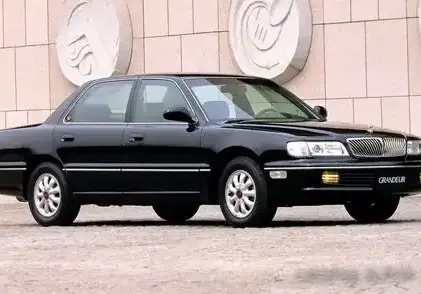
The Hyundai Grandeur II (LX), produced between 1996 and 1998, represented a significant step forward for the South Korean automaker in the mid-size luxury sedan segment. Positioned as a premium offering, the Grandeur II aimed to compete with established Japanese and American brands. This generation, internally designated LX, was a substantial redesign of the original Grandeur, offering increased refinement, improved performance, and a more modern aesthetic. The 3.0i V6 Automatic variant, detailed here, served as the flagship trim level, offering a balance of power and convenience for discerning buyers. It was a key model in Hyundai’s strategy to establish itself as a credible player in the global automotive market.
Technical Specifications
| Brand | Hyundai |
| Model | Grandeur/Azera |
| Generation | Grandeur II (LX) |
| Type (Engine) | 3.0i V6 (194 Hp) Automatic |
| Start of production | 1996 |
| End of production | 1998 |
| Powertrain Architecture | Internal Combustion engine |
| Body type | Sedan |
| Seats | 5 |
| Doors | 4 |
| Fuel Type | Petrol (Gasoline) |
| Maximum speed | 189 km/h (117.44 mph) |
| Weight-to-power ratio | 8.6 kg/Hp, 116.9 Hp/tonne |
| Weight-to-torque ratio | 6.6 kg/Nm, 152.4 Nm/tonne |
| Power | 194 Hp @ 6000 rpm |
| Power per litre | 65.3 Hp/l |
| Torque | 253 Nm @ 4500 rpm (186.6 lb.-ft. @ 4500 rpm) |
| Engine Model/Code | Sigma / G6CT |
| Engine displacement | 2972 cm3 (181.36 cu. in.) |
| Number of cylinders | 6 |
| Engine configuration | V-engine |
| Cylinder Bore | 91.1 mm (3.59 in.) |
| Piston Stroke | 76 mm (2.99 in.) |
| Compression ratio | 10:1 |
| Number of valves per cylinder | 4 |
| Fuel injection system | Multi-port manifold injection |
| Engine aspiration | Naturally aspirated engine |
| Valvetrain | DOHC |
| Engine oil capacity | 4.3 l (4.54 US qt | 3.78 UK qt) |
| Coolant capacity | 8.2 l (8.66 US qt | 7.21 UK qt) |
| Kerb Weight | 1660 kg (3659.67 lbs.) |
| Trunk (boot) space – minimum | 460 l (16.24 cu. ft.) |
| Fuel tank capacity | 72 l (19.02 US gal | 15.84 UK gal) |
| Length | 4980 mm (196.06 in.) |
| Width | 1810 mm (71.26 in.) |
| Height | 1445 mm (56.89 in.) |
| Wheelbase | 2745 mm (108.07 in.) |
| Front track | 1545 mm (60.83 in.) |
| Rear (Back) track | 1550 mm (61.02 in.) |
| Ride height (ground clearance) | 160 mm (6.3 in.) |
| Drag coefficient (Cd) | 0.37 |
| Minimum turning circle (turning diameter) | 11.4 m (37.4 ft.) |
| Drivetrain Architecture | The Internal combustion engine (ICE) drives the front wheels of the vehicle. |
| Drive wheel | Front wheel drive |
| Number of gears and type of gearbox | 4 gears, automatic transmission |
| Front brakes | Ventilated discs |
| Rear brakes | Disc |
| Steering type | Steering rack and pinion |
| Tires size | 195/70 R14 H |
| Wheel rims size | 14 |
Powertrain & Engine Architecture
The heart of the Grandeur II 3.0i was the Hyundai Sigma engine, specifically the G6CT variant. This 2.972-liter (181.36 cubic inches) V6 engine utilized a naturally aspirated configuration with a 60-degree V-angle. It featured a double overhead camshaft (DOHC) valvetrain with four valves per cylinder, contributing to its respectable power output. The engine employed multi-port fuel injection, a common technology in the mid-1990s, for precise fuel delivery. The 10:1 compression ratio was a balance between performance and fuel efficiency. Paired with the engine was a four-speed automatic transmission, designed for smooth and convenient operation. This transmission, while not offering the latest technology, was known for its reliability and suitability for comfortable cruising.
Driving Characteristics
The 194 horsepower and 186.6 lb-ft of torque delivered by the 3.0i V6 and automatic transmission combination provided adequate, though not exhilarating, performance. Acceleration was reasonably brisk, sufficient for highway merging and passing maneuvers. The automatic transmission, while smooth, did exhibit some typical characteristics of older four-speed units – noticeable shifts and a tendency to hunt for gears in certain situations. Compared to the manual transmission options available on lower trims, the automatic sacrificed some responsiveness. However, it offered a more relaxed driving experience, appealing to buyers prioritizing comfort over sporty handling. The gear ratios were tuned for cruising, making it a comfortable long-distance vehicle.
Equipment & Trim Levels
The 3.0i Automatic trim represented the highest level of equipment offered on the Grandeur II. Standard features typically included power windows, power locks, power mirrors, air conditioning, and a premium sound system. Interior upholstery was generally cloth or a higher-grade velour, with options for leather available. The dashboard layout was functional and straightforward, with a focus on ease of use. Optional extras could include a sunroof, upgraded audio systems, and alloy wheels. The overall interior ambiance aimed for a luxurious feel, though it didn’t quite match the refinement of some European competitors.
Chassis & Braking
The Grandeur II utilized a front-wheel-drive platform with an independent suspension setup at the front and a semi-independent suspension at the rear. The front suspension typically consisted of MacPherson struts, while the rear employed a multi-link design. Braking duties were handled by ventilated discs at the front and solid discs at the rear, providing adequate stopping power for the vehicle’s weight. The steering system was a rack-and-pinion setup, offering reasonable precision. Stabilizer bars were included at both the front and rear to reduce body roll during cornering.
Market Reception & Comparison
The Grandeur II 3.0i Automatic was generally well-received by critics as a competent and well-equipped family sedan. It offered a compelling value proposition compared to more expensive European and Japanese rivals. However, some reviewers noted that the driving experience lacked the refinement and sporty handling of some competitors. Fuel economy was average for a V6-powered sedan of its size. Compared to the lower-trim 2.0L and 2.5L models, the 3.0i offered significantly more power and a more luxurious experience, but at a higher price point. Reliability was generally good, though maintenance costs could be higher due to the V6 engine and more complex systems.
Legacy
The Hyundai Grandeur II 3.0i Automatic holds a significant place in Hyundai’s history as a pivotal model that helped establish the brand’s reputation for quality and value. The Sigma engine, while not groundbreaking, proved to be a durable and reliable powerplant. Today, these vehicles are relatively rare and are gaining interest among collectors and enthusiasts. The automatic transmission, while not known for its performance, has proven to be reasonably durable with proper maintenance. Finding well-maintained examples can be challenging, but the Grandeur II 3.0i remains a testament to Hyundai’s ambition and progress in the late 1990s.