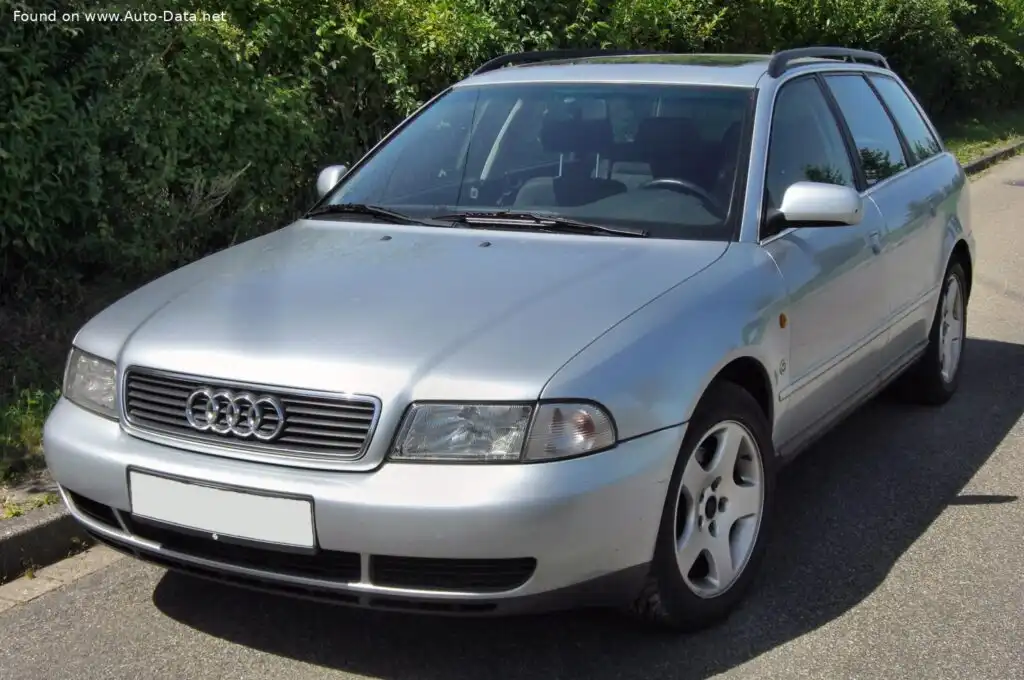
The Audi A4 Avant (B5, Typ 8D) 1.8 20V, produced between 1996 and 1999, represented a key entry point into the premium compact wagon market for Audi. Positioned as a practical and relatively affordable option within the B5 A4 range, it offered the versatility of a station wagon (estate) combined with Audi’s reputation for build quality and sophisticated engineering. This variant utilized the 1.8-liter, 20-valve inline-four engine, and was typically paired with a five-speed manual transmission, though an automatic option was also available. It played a significant role in establishing the A4 Avant as a desirable alternative to traditional sedans, particularly in Europe where the wagon body style enjoys greater popularity.
Technical Specifications
| Brand | Audi |
| Model | A4 |
| Generation | A4 Avant (B5, Typ 8D) |
| Type (Engine) | 1.8 20V (125 Hp) |
| Start of production | 1996 |
| End of production | 1999 |
| Powertrain Architecture | Internal Combustion engine |
| Body type | Station wagon (estate) |
| Seats | 5 |
| Doors | 5 |
| Fuel consumption (urban) | 12.1 l/100 km (19.4 US mpg, 23.3 UK mpg, 8.3 km/l) |
| Fuel consumption (extra urban) | 6.5 l/100 km (36.2 US mpg, 43.5 UK mpg, 15.4 km/l) |
| Fuel consumption (combined) | 7.6 l/100 km (30.9 US mpg, 37.2 UK mpg, 13.2 km/l) |
| Fuel Type | Petrol (Gasoline) |
| Acceleration 0 – 100 km/h | 10.7 sec |
| Acceleration 0 – 62 mph | 10.7 sec |
| Acceleration 0 – 60 mph | 10.2 sec |
| Maximum speed | 201 km/h (124.9 mph) |
| Weight-to-power ratio | 10.1 kg/Hp, 98.8 Hp/tonne |
| Weight-to-torque ratio | 7.3 kg/Nm, 136.8 Nm/tonne |
| Power | 125 Hp @ 5800 rpm |
| Power per litre | 70.2 Hp/l |
| Torque | 173 Nm @ 3950 rpm (127.6 lb.-ft. @ 3950 rpm) |
| Engine layout | Front, Longitudinal |
| Engine Model/Code | ADR, ARG |
| Engine displacement | 1781 cm3 (108.68 cu. in.) |
| Number of cylinders | 4 |
| Engine configuration | Inline |
| Cylinder Bore | 81 mm (3.19 in.) |
| Piston Stroke | 86.4 mm (3.4 in.) |
| Compression ratio | 10.3:1 |
| Number of valves per cylinder | 5 |
| Fuel injection system | Multi-port manifold injection |
| Engine aspiration | Naturally aspirated engine |
| Valvetrain | DOHC |
| Engine oil capacity | 3.5 l (3.7 US qt | 3.08 UK qt) |
| Coolant capacity | 6.5 l (6.87 US qt | 5.72 UK qt) |
| Kerb Weight | 1265 kg (2788.85 lbs.) |
| Max. weight | 1815 kg (4001.39 lbs.) |
| Max load | 550 kg (1212.54 lbs.) |
| Trunk (boot) space – minimum | 390 l (13.77 cu. ft.) |
| Trunk (boot) space – maximum | 1250 l (44.14 cu. ft.) |
| Fuel tank capacity | 62 l (16.38 US gal | 13.64 UK gal) |
| Length | 4479 mm (176.34 in.) |
| Width | 1733 mm (68.23 in.) |
| Height | 1417 mm (55.79 in.) |
| Wheelbase | 2622 mm (103.23 in.) |
| Front track | 1498 mm (58.98 in.) |
| Rear track | 1479 mm (58.23 in.) |
| Drag coefficient (Cd) | 0.31 |
| Minimum turning circle | 11.1 m (36.42 ft.) |
| Drivetrain Architecture | Front wheel drive |
| Number of gears | 5 |
| Gearbox type | Manual transmission |
| Front suspension | Wishbone |
| Rear suspension | Suspension with traction connecting levers |
| Front brakes | Disc |
| Rear brakes | Disc |
| Assisting systems | ABS (Anti-lock braking system) |
| Steering type | Steering rack and pinion |
| Power steering | Hydraulic Steering |
| Tires size | 195/65 R15 |
| Wheel rims size | 15 |
Powertrain & Engine Architecture
The heart of the A4 Avant 1.8 20V was the Audi-developed 1.8-liter inline-four engine, typically identified by engine codes ADR or ARG. This engine was a significant step forward in naturally aspirated four-cylinder technology. It featured a five-valve-per-cylinder (DOHC) configuration, enhancing both volumetric efficiency and power output. Fuel delivery was managed by a Bosch Motronic multi-port fuel injection system, optimizing the air-fuel mixture for improved combustion and reduced emissions. The engine’s design prioritized smooth operation and reasonable fuel economy. The five-speed manual transmission was the most common pairing, offering precise shifts and a direct connection to the engine. A four-speed automatic transmission was also available, providing convenience but at the expense of some performance and efficiency. The automatic transmission, while reliable, was known for being somewhat less responsive than the manual counterpart.
Driving Characteristics
The 1.8 20V engine, producing 125 horsepower, provided adequate performance for everyday driving in the A4 Avant. Acceleration from 0-60 mph took around 10.2 seconds, which was competitive for its class at the time. However, it wasn’t a particularly sporty variant. The power delivery was linear, with a noticeable emphasis on mid-range torque rather than peak horsepower. Compared to the more powerful 2.8-liter V6 models, the 1.8 felt noticeably less energetic, especially when fully loaded or tackling steep inclines. The automatic transmission, while smooth, further dulled the driving experience, resulting in slower acceleration and a less engaging feel. The gear ratios were tuned for fuel efficiency and comfort, rather than outright performance. The front-wheel-drive configuration provided predictable handling, but lacked the all-weather capability of Audi’s quattro all-wheel-drive system.
Equipment & Trim Levels
The A4 Avant 1.8 20V typically came with a respectable level of standard equipment. This included power windows, central locking, power steering, and an anti-lock braking system (ABS). Interior upholstery was usually cloth, with options for leather available at an extra cost. Dashboard trim was typically a simple, functional design, reflecting the car’s positioning as an entry-level premium wagon. Optional extras included a sunroof, alloy wheels, a premium sound system, and climate control. Higher trim levels added features like wood trim, upgraded upholstery, and more sophisticated audio systems. The base model focused on providing essential comfort and convenience features, while optional packages allowed buyers to customize the car to their preferences.
Chassis & Braking
The B5 A4 Avant featured a fully independent suspension system, with wishbones at the front and a multi-link setup at the rear. This provided a comfortable ride and good handling characteristics. The 1.8-liter models typically used slightly smaller stabilizer bars compared to the V6 variants, resulting in a bit more body roll during cornering. Braking duties were handled by disc brakes on all four wheels, providing adequate stopping power for most driving situations. The ABS system helped to maintain steering control during emergency braking. The suspension was tuned to prioritize ride comfort, making it a pleasant vehicle for long journeys.
Market Reception & Comparison
The A4 Avant 1.8 20V was generally well-received by automotive critics as a practical and well-built wagon. It was praised for its spacious interior, comfortable ride, and Audi’s renowned build quality. However, some reviewers noted that the 1.8-liter engine felt underpowered, especially when compared to the more potent V6 options. Fuel economy was considered good for its class, averaging around 31 mpg in combined driving. Compared to rivals like the BMW 3 Series Touring and the Mercedes-Benz C-Class Estate, the A4 Avant offered a compelling combination of practicality, refinement, and value. The 1.8L engine offered a lower price point, making it accessible to a wider range of buyers.
Legacy
The Audi A4 Avant (B5) 1.8 20V has proven to be a relatively reliable vehicle over the long term. The 1.8-liter engine is known for its durability, and with proper maintenance, can easily exceed 200,000 miles. The automatic transmission, while not as sporty as the manual, is generally reliable as well. Today, these cars are increasingly sought after by enthusiasts and collectors, particularly well-maintained examples. Parts availability is generally good, although some specific trim pieces may be difficult to find. The B5 A4 Avant 1.8 20V remains a popular choice for those seeking a practical, reliable, and stylish European wagon.