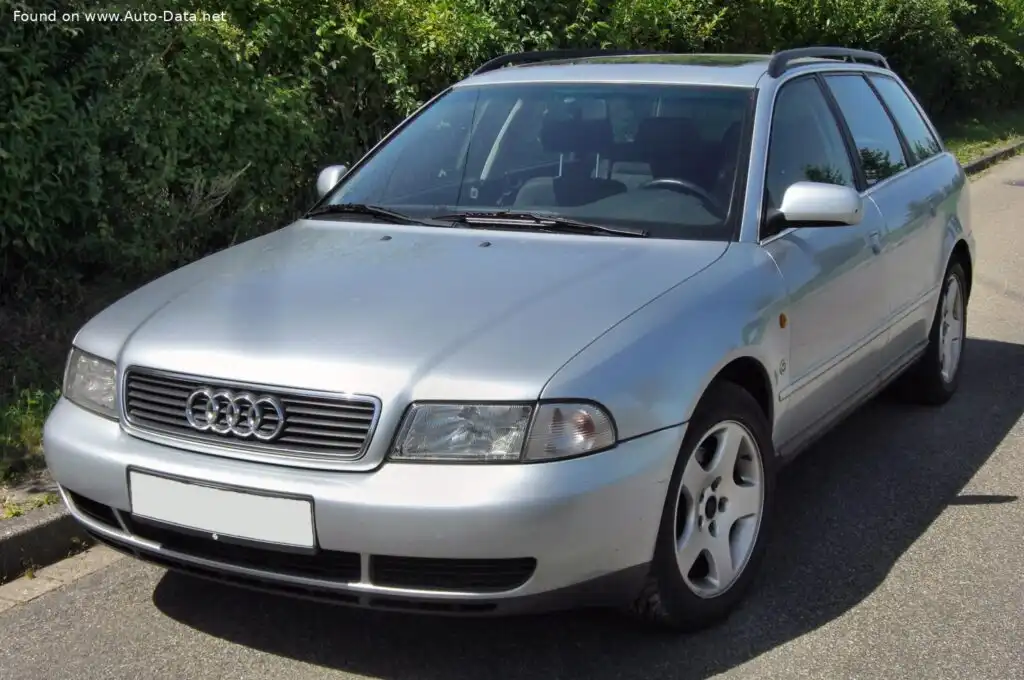
The Audi A4 Avant (B5, Typ 8D) 1.8 20V Automatic, produced between 1996 and 1999, represents a key iteration of Audi’s popular compact executive car. Positioned as a practical and comfortable option within the B5 A4 range, this variant combined the versatility of a station wagon (Avant) body style with a 1.8-liter, 20-valve inline-four engine paired to a four-speed automatic transmission. It served as a popular choice for families and individuals seeking a refined driving experience without the performance focus of higher-trim models like the 2.8 V6.
Technical Specifications
| Brand | Audi |
| Model | A4 |
| Generation | A4 Avant (B5, Typ 8D) |
| Type (Engine) | 1.8 20V (125 Hp) Automatic |
| Start of production | 1996 |
| End of production | 1999 |
| Powertrain Architecture | Internal Combustion engine |
| Body type | Station wagon (estate) |
| Seats | 5 |
| Doors | 5 |
| Fuel consumption (urban) | 12.3 l/100 km (19.1 US mpg, 23 UK mpg, 8.1 km/l) |
| Fuel consumption (extra urban) | 7 l/100 km (33.6 US mpg, 40.4 UK mpg, 14.3 km/l) |
| Fuel consumption (combined) | 7.6 l/100 km (30.9 US mpg, 37.2 UK mpg, 13.2 km/l) |
| Fuel Type | Petrol (Gasoline) |
| Acceleration 0 – 100 km/h | 12.6 sec |
| Acceleration 0 – 62 mph | 12.6 sec |
| Acceleration 0 – 60 mph | 12 sec |
| Maximum speed | 196 km/h (121.79 mph) |
| Weight-to-power ratio | 10.3 kg/Hp, 97.3 Hp/tonne |
| Weight-to-torque ratio | 7.4 kg/Nm, 134.6 Nm/tonne |
| Power | 125 Hp @ 5800 rpm |
| Power per litre | 70.2 Hp/l |
| Torque | 173 Nm @ 3950 rpm (127.6 lb.-ft. @ 3950 rpm) |
| Engine layout | Front, Longitudinal |
| Engine Model/Code | ADR, ARG |
| Engine displacement | 1781 cm3 (108.68 cu. in.) |
| Number of cylinders | 4 |
| Engine configuration | Inline |
| Cylinder Bore | 81 mm (3.19 in.) |
| Piston Stroke | 86.4 mm (3.4 in.) |
| Compression ratio | 10.3:1 |
| Number of valves per cylinder | 5 |
| Fuel injection system | Multi-port manifold injection |
| Engine aspiration | Naturally aspirated engine |
| Valvetrain | DOHC |
| Engine oil capacity | 3.5 l (3.7 US qt | 3.08 UK qt) |
| Coolant | 6.5 l (6.87 US qt | 5.72 UK qt) |
| Kerb Weight | 1285 kg (2832.94 lbs.) |
| Max. weight | 1835 kg (4045.48 lbs.) |
| Max load | 550 kg (1212.54 lbs.) |
| Trunk (boot) space – minimum | 390 l (13.77 cu. ft.) |
| Trunk (boot) space – maximum | 1250 l (44.14 cu. ft.) |
| Fuel tank capacity | 62 l (16.38 US gal | 13.64 UK gal) |
| Length | 4479 mm (176.34 in.) |
| Width | 1733 mm (68.23 in.) |
| Height | 1417 mm (55.79 in.) |
| Wheelbase | 2622 mm (103.23 in.) |
| Front track | 1498 mm (58.98 in.) |
| Rear (Back) track | 1479 mm (58.23 in.) |
| Drag coefficient (Cd) | 0.31 |
| Minimum turning circle | 11.1 m (36.42 ft.) |
| Drivetrain Architecture | The Internal combustion engine (ICE) drives the front wheels of the vehicle. |
| Drive wheel | Front wheel drive |
| Number of gears and type of gearbox | 4 gears, automatic transmission |
| Front suspension | Wishbone |
| Rear suspension | Suspension with traction connecting levers |
| Front brakes | Disc |
| Rear brakes | Disc |
| Assisting systems | ABS (Anti-lock braking system) |
| Steering type | Steering rack and pinion |
| Power steering | Hydraulic Steering |
| Tires size | 195/65 R15 |
| Wheel rims size | 15 |
INTRODUCTION
The B5 generation Audi A4, launched in 1994, represented a significant step forward for the brand, offering a more modern and sophisticated alternative to its predecessor, the Audi 80. The Avant (estate) version, introduced shortly after the sedan, provided increased practicality without sacrificing the A4’s refined character. The 1.8 20V Automatic variant, utilizing the ADR and ARG engine codes, was a mainstay of the lineup, particularly in European markets. It offered a balance between affordability, fuel efficiency, and usability, making it a popular choice for everyday driving.
Powertrain & Engine Architecture
At the heart of the A4 Avant 1.8 20V Automatic lies the ADR or ARG engine, a 1781cc inline-four cylinder powerplant. This engine featured a cast iron block with an aluminum cylinder head, incorporating dual overhead camshafts (DOHC) and five valves per cylinder (20 valves total). The multi-port fuel injection system delivered fuel directly into the intake ports, optimizing combustion. The engine’s design prioritized smooth power delivery and reasonable fuel economy over outright performance. The four-speed automatic transmission, typically the 5HP19, was known for its relatively smooth shifts, though it lacked the responsiveness of a manual gearbox. This transmission was electronically controlled, adapting shift points based on throttle position and vehicle speed.
Driving Characteristics
The 125 horsepower and 173 Nm (127.6 lb-ft) of torque produced by the 1.8L engine, when coupled with the four-speed automatic, resulted in a 0-60 mph time of around 12 seconds and a top speed of 196 km/h (121.79 mph). While not particularly quick, the powertrain offered adequate performance for everyday driving situations. The automatic transmission’s gear ratios were geared towards comfort and fuel efficiency, resulting in a somewhat leisurely acceleration feel. Compared to the five-speed manual version, the automatic felt less engaging and slightly slower. Higher-output versions, such as the 2.8 V6, offered significantly more power and a sportier driving experience, but at a higher price point.
Equipment & Trim Levels
The 1.8 20V Automatic A4 Avant typically came equipped with a reasonable level of standard features. These included power windows, central locking, power steering, ABS brakes, and an air conditioning system. Interior upholstery was usually cloth, with options for leather upgrades. Dashboard trim was typically wood or aluminum effect. Common optional extras included a sunroof, upgraded audio systems, and alloy wheels. Trim levels varied slightly depending on the market, but generally, this variant occupied a mid-range position in the A4 lineup, offering a good balance of features and affordability.
Chassis & Braking
The B5 A4 Avant featured a fully independent suspension system, with wishbone suspension at the front and a semi-independent suspension with traction connecting levers at the rear. This setup provided a comfortable ride and decent handling characteristics. Brakes were disc brakes on all four wheels, providing adequate stopping power. ABS (Anti-lock Braking System) was standard, enhancing safety. The chassis was relatively lightweight for its class, contributing to the car’s overall agility. Stabilizer bars were fitted front and rear to reduce body roll during cornering.
Market Reception & Comparison
The Audi A4 Avant 1.8 20V Automatic was generally well-received by automotive critics. It was praised for its comfortable ride, refined interior, and practical estate car body style. However, some critics noted that the automatic transmission could feel sluggish and that the engine lacked the punch of its larger counterparts. Compared to other cars in its class, such as the BMW 3 Series Touring and the Mercedes-Benz C-Class Estate, the A4 Avant offered a compelling combination of value, practicality, and sophistication. Fuel economy was competitive, and reliability was generally good, although preventative maintenance was crucial.
Legacy
The Audi A4 Avant (B5) 1.8 20V Automatic has proven to be a relatively durable and reliable vehicle. The engine, while not without its potential issues (such as oil consumption in some cases), is generally robust when properly maintained. The automatic transmission, if serviced regularly, can provide years of trouble-free operation. Today, these cars are increasingly sought after by enthusiasts and collectors, particularly well-maintained examples. They represent a classic example of 1990s German engineering, offering a blend of practicality, comfort, and understated style. The used car market values these A4 Avants based on condition, mileage, and service history, with prices varying accordingly.