
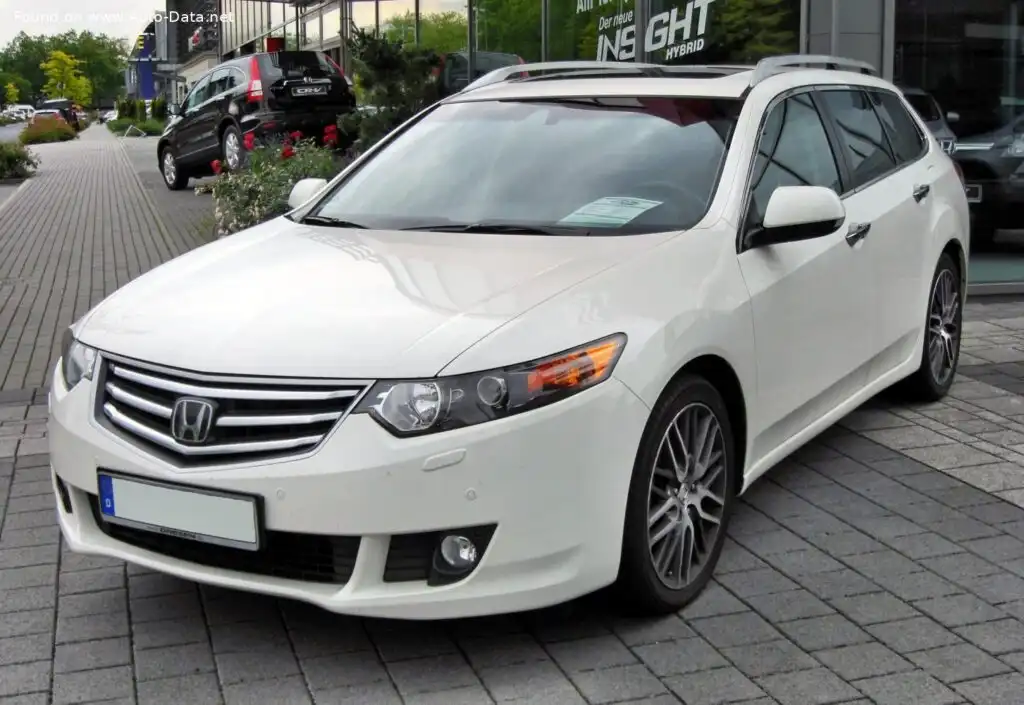
The Honda Accord VIII Wagon 2.0 (156 hp) Automatic, produced between 2008 and 2011, represents a practical and well-regarded offering within the eighth generation (2008-2012) of Honda’s globally successful Accord line. Specifically designed for the European market, the wagon (estate) body style aimed to provide the renowned Accord reliability and comfort in a more versatile package. This particular variant, equipped with the 2.0-liter inline-four engine and a five-speed automatic transmission, occupied a mid-range position in the Accord wagon lineup, offering a balance between fuel efficiency, performance, and affordability. It was positioned below the more powerful 2.4-liter engine options and above the diesel variants in terms of price and performance.
Technical Specifications
| Brand | Honda |
| Model | Accord |
| Generation | Accord VIII Wagon |
| Type (Engine) | 2.0 (156 Hp) Automatic |
| Start of production | 2008 |
| End of production | 2011 |
| Powertrain Architecture | Internal Combustion engine |
| Body type | Station wagon (estate) |
| Seats | 5 |
| Doors | 5 |
| Fuel consumption (urban) | 10.7 l/100 km (22 US mpg, 26.4 UK mpg, 9.3 km/l) |
| Fuel consumption (extra urban) | 6 l/100 km (39.2 US mpg, 47.1 UK mpg, 16.7 km/l) |
| Fuel consumption (combined) | 7.3 l/100 km (32.2 US mpg, 38.7 UK mpg, 13.7 km/l) |
| Fuel Type | Petrol (Gasoline) |
| Acceleration 0 – 100 km/h | 10.8 sec |
| Acceleration 0 – 62 mph | 10.8 sec |
| Acceleration 0 – 60 mph | 10.3 sec |
| Maximum speed | 210 km/h (130.49 mph) |
| Emission standard | Euro 5 |
| Weight-to-power ratio | 10.9 kg/Hp, 91.7 Hp/tonne |
| Weight-to-torque ratio | 9 kg/Nm, 111.6 Nm/tonne |
| Power | 156 Hp @ 6200 rpm |
| Power per litre | 78.1 Hp/l |
| Torque | 190 Nm @ 4200 rpm (140.14 lb.-ft. @ 4200 rpm) |
| Engine layout | Front, Transverse |
| Engine Model/Code | R20A3 |
| Engine displacement | 1997 cm3 (121.86 cu. in.) |
| Number of cylinders | 4 |
| Engine configuration | Inline |
| Cylinder Bore | 81 mm (3.19 in.) |
| Piston Stroke | 96.9 mm (3.81 in.) |
| Compression ratio | 10.5:1 |
| Number of valves per cylinder | 4 |
| Fuel injection system | Multi-port manifold injection |
| Engine aspiration | Naturally aspirated engine |
| Valvetrain | DOHC |
| Engine oil capacity | 3.7 l (3.91 US qt | 3.26 UK qt) |
| Coolant | 5.4 l (5.71 US qt | 4.75 UK qt) |
| Kerb Weight | 1702 kg (3752.27 lbs.) |
| Max. weight | 2100 kg (4629.71 lbs.) |
| Max load | 398 kg (877.44 lbs.) |
| Trunk (boot) space – minimum | 395 l (13.95 cu. ft.) |
| Trunk (boot) space – maximum | 1252 l (44.21 cu. ft.) |
| Fuel tank capacity | 65 l (17.17 US gal | 14.3 UK gal) |
| Length | 4750 mm (187.01 in.) |
| Width | 1840 mm (72.44 in.) |
| Height | 1470 mm (57.87 in.) |
| Wheelbase | 2750 mm (108.27 in.) |
| Front track | 1595 mm (62.8 in.) |
| Rear (Back) track | 1600 mm (62.99 in.) |
| Minimum turning circle | 11.8 m (38.71 ft.) |
| Drivetrain Architecture | ICE, Front wheel drive |
| Drive wheel | Front wheel drive |
| Number of gears | 5 gears, automatic transmission |
| Front suspension | Double wishbone |
| Rear suspension | Wishbone |
| Front brakes | Ventilated discs |
| Rear brakes | Disc |
| Assisting systems | ABS (Anti-lock braking system) |
| Steering type | Steering rack and pinion |
| Tires size | 215/60 R16 |
| Wheel rims size | 6.5J x 16 |
Powertrain & Engine Architecture
The heart of this Accord variant is the R20A3 2.0-liter inline-four cylinder engine. This engine is a naturally aspirated powerplant utilizing a multi-point fuel injection system. The engine features a double overhead camshaft (DOHC) valvetrain, contributing to efficient cylinder filling and improved performance. The R20A3 engine is known for its reliability and relatively simple design. Paired with this engine is a five-speed automatic transmission. This transmission, while providing convenient shift operation, wasn’t known for being particularly sporty or fuel-efficient compared to the available manual transmission. The automatic transmission’s gear ratios were tuned for comfortable cruising and everyday drivability rather than aggressive acceleration.
Driving Characteristics
The 156 hp and 190 Nm (140 lb-ft) of torque delivered by the 2.0-liter engine and automatic transmission combination resulted in a comfortable, but not particularly exhilarating, driving experience. Acceleration from 0-60 mph took around 10.3 seconds, and top speed was limited to 130.49 mph. Compared to the manual transmission version of the same engine, the automatic suffered a slight performance penalty due to the transmission’s inherent efficiency losses. The automatic transmission’s shift points were generally smooth, but could sometimes feel hesitant during quick overtaking maneuvers. The focus was clearly on providing a relaxed and refined driving experience, making it well-suited for daily commuting and long-distance journeys.
Equipment & Trim Levels
The 2.0-liter Automatic Accord Wagon typically came equipped with a respectable level of standard features. These included air conditioning, power windows and locks, a CD player with auxiliary input, and ABS brakes. Higher trim levels, often denoted by “SE” or “ES” designations, added features such as alloy wheels, a sunroof, upgraded audio systems, and climate control. Interior upholstery was typically cloth, with leather options available on higher trims. Optional extras could include navigation systems, parking sensors, and heated seats.
Chassis & Braking
The Accord Wagon featured a front independent double wishbone suspension and a rear independent wishbone suspension, providing a comfortable ride and decent handling characteristics. The front brakes were ventilated discs, offering good stopping power, while the rear brakes were solid discs. ABS (Anti-lock Braking System) was standard, enhancing safety during emergency braking situations. The suspension tuning was geared towards comfort, prioritizing ride quality over sporty handling. Stabilizer bars were fitted to both the front and rear axles to reduce body roll during cornering.
Market Reception & Comparison
The Honda Accord VIII Wagon 2.0 Automatic was generally well-received by automotive critics. It was praised for its spacious interior, comfortable ride, and Honda’s reputation for reliability. However, some reviewers noted that the automatic transmission felt somewhat dated and less responsive than those offered by competitors. Fuel economy was considered average for its class. Compared to the diesel variants, the 2.0-liter petrol engine offered less fuel efficiency but a smoother and quieter driving experience. Against the more powerful 2.4-liter engine options, the 2.0-liter provided a more affordable entry point into the Accord wagon range.
Legacy
The R20A3 engine, when properly maintained, has proven to be a durable and reliable unit. The five-speed automatic transmission, while not the most advanced, is also generally considered reliable. Today, used examples of the Accord VIII Wagon 2.0 Automatic are readily available and represent a good value for buyers seeking a practical and dependable estate car. Common maintenance issues include routine servicing items such as oil and filter changes, spark plug replacement, and occasional attention to suspension components. The Accord’s strong reputation for reliability continues to make it a popular choice in the used car market.