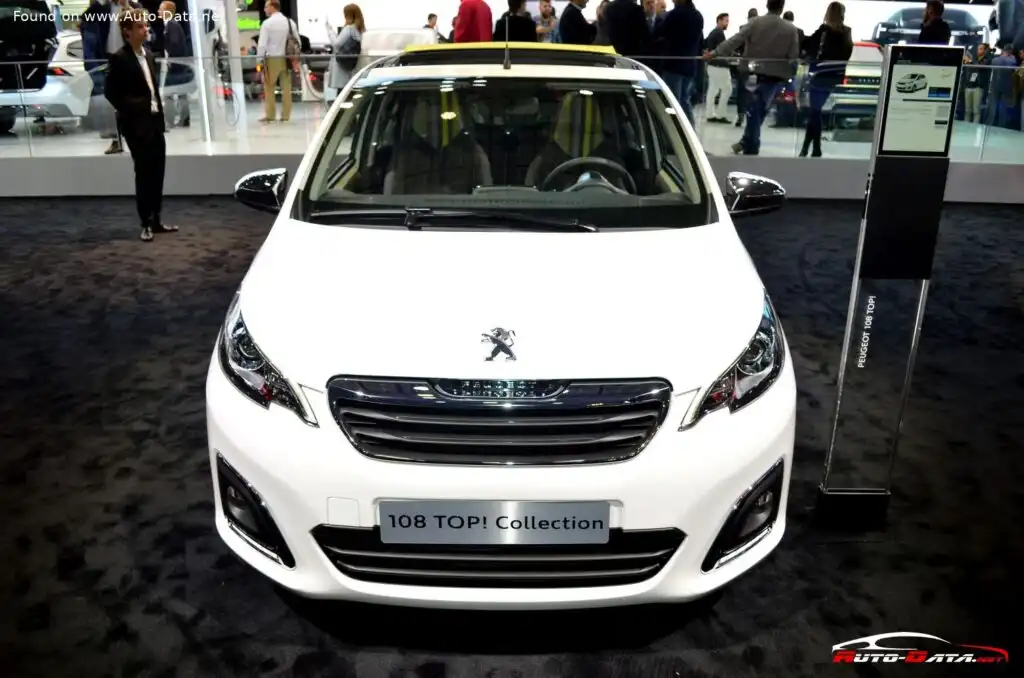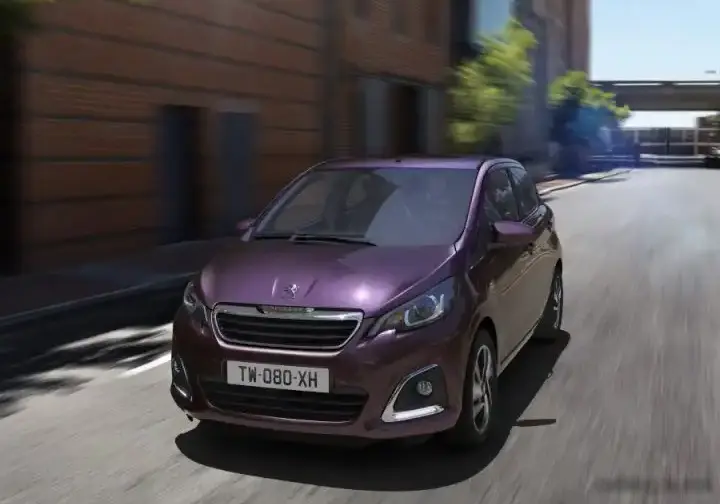
The Peugeot 108 Hatch 1.0i (72 hp) is a city car produced by the French manufacturer Peugeot from 2018 onwards. Part of the first generation of the 108 (launched in 2014), this variant represents the entry-level powertrain option within the 108 range, sharing its platform and many components with the Citroën C1 and Toyota Aygo – a collaboration known as the A9 family. Positioned as an affordable and economical choice, the 1.0i model aimed to provide basic transportation with a focus on fuel efficiency and low running costs. It was available in both 3-door and 5-door body styles, catering to different customer preferences.
Technical Specifications
| Brand | Peugeot |
| Model | 108 |
| Generation | 108 Hatch |
| Type (Engine) | 1.0i (72 Hp) |
| Start of production | 2018 |
| Powertrain Architecture | Internal Combustion engine |
| Body type | Hatchback |
| Seats | 5 |
| Doors | 3-5 |
| Fuel consumption (combined) | 4.9-5.3 l/100 km (48 – 44.4 US mpg, 57.6 – 53.3 UK mpg, 20.4 – 18.9 km/l) |
| CO2 emissions | 93 g/km |
| Fuel Type | Petrol (Gasoline) |
| Acceleration 0 – 100 km/h | 13.8 sec |
| Acceleration 0 – 62 mph | 13.8 sec |
| Acceleration 0 – 60 mph | 13.1 sec |
| Maximum speed | 159 km/h (98.8 mph) |
| Emission standard | Euro 6c |
| Weight-to-power ratio | 11.7 kg/Hp, 85.7 Hp/tonne |
| Weight-to-torque ratio | 6.7 kg/Nm, 150 Nm/tonne |
| Power | 72 Hp @ 6000 rpm |
| Power per litre | 72.1 Hp/l |
| Torque | 126 Nm @ 4400 rpm (92.93 lb.-ft. @ 4400 rpm) |
| Engine layout | Front, Transverse |
| Engine Model/Code | CFB 1KR |
| Engine displacement | 998 cm3 (60.9 cu. in.) |
| Number of cylinders | 3 |
| Engine configuration | Inline |
| Number of valves per cylinder | 4 |
| Fuel injection system | Multi-port manifold injection |
| Engine aspiration | Naturally aspirated engine |
| Engine oil capacity | 2.8 l (2.96 US qt | 2.46 UK qt) |
| Kerb Weight | 840 kg (1851.88 lbs.) |
| Max. weight | 1240 kg (2733.73 lbs.) |
| Max load | 400 kg (881.85 lbs.) |
| Trunk (boot) space – minimum | 227 l (8.02 cu. ft.) |
| Trunk (boot) space – maximum | 868 l (30.65 cu. ft.) |
| Fuel tank capacity | 35 l (9.25 US gal | 7.7 UK gal) |
| Length | 3475 mm (136.81 in.) |
| Width | 1615 mm (63.58 in.) |
| Width including mirrors | 1884 mm (74.17 in.) |
| Height | 1460 mm (57.48 in.) |
| Wheelbase | 2340 mm (92.13 in.) |
| Front track | 1425 mm (56.1 in.) |
| Rear (Back) track | 1420 mm (55.91 in.) |
| Front overhang | 675 mm (26.57 in.) |
| Rear overhang | 460 mm (18.11 in.) |
| Drivetrain Architecture | Front wheel drive |
| Number of gears and type of gearbox | 5 gears, manual transmission |
| Front suspension | Independent type McPherson |
| Rear suspension | Elastic beam |
| Front brakes | Ventilated discs |
| Rear brakes | Drum |
| Assisting systems | ABS (Anti-lock braking system) |
| Steering type | Steering rack and pinion |
| Tires size | 165/65 R14; 165/60 R15 |
| Wheel rims size | 14; 15 |
Powertrain & Engine Architecture
The Peugeot 108 1.0i utilizes the CFB 1KR engine, a 998cc three-cylinder petrol engine. This engine is part of Peugeot’s EB series of small displacement engines, known for its lightweight construction and efficiency. The 1KR engine employs a multi-point fuel injection system and features four valves per cylinder. It’s a naturally aspirated engine, meaning it doesn’t utilize a turbocharger or supercharger. This simplicity contributes to its reliability and lower maintenance costs. The engine is transversely mounted at the front of the vehicle, driving the front wheels. The 5-speed manual transmission is a standard unit, chosen for its affordability and ease of use. The transmission’s gear ratios are optimized for urban driving, prioritizing acceleration from low speeds over high-speed cruising.
Driving Characteristics
The 1.0i engine produces 72 horsepower and 93 lb-ft of torque. This translates to modest performance, with a 0-60 mph time of around 13.1 seconds and a top speed of approximately 99 mph. The acceleration is adequate for city driving and short trips, but it can feel strained when fully loaded or attempting to overtake on highways. The manual transmission allows for a reasonable degree of driver control, but the engine’s limited power requires frequent gear changes to maintain momentum. Compared to the more powerful 1.2-liter PureTech engine offered in other 108 variants, the 1.0i feels significantly slower. However, it offers a smoother and more linear power delivery, making it easier to drive for novice drivers.
Equipment & Trim Levels
The 1.0i version of the Peugeot 108 typically came with a basic level of equipment. Standard features included power steering, central locking, electric front windows, and an audio system with USB connectivity. Safety features such as ABS, ESP (Electronic Stability Program), and multiple airbags were also standard. Higher trim levels, such as Active and Allure, added features like air conditioning, alloy wheels, a touchscreen infotainment system, and parking sensors. Interior upholstery was typically cloth, with a simple and functional dashboard layout. Optional extras included a panoramic sunroof and various styling enhancements.
Chassis & Braking
The Peugeot 108 utilizes a McPherson strut front suspension and an elastic beam rear suspension. This setup provides a comfortable ride quality, particularly on smooth roads. The front brakes are ventilated discs, while the rear brakes are drums. This configuration is typical for vehicles in this weight class, balancing cost and performance. The steering is a rack and pinion system, providing precise and responsive handling. The 108’s relatively light weight (around 1852 lbs) contributes to its agility and maneuverability in urban environments.
Market Reception & Comparison
The Peugeot 108 1.0i was generally well-received as an affordable and economical city car. Critics praised its fuel efficiency, nimble handling, and compact size. However, the engine’s lack of power was a common criticism. Compared to the 1.2 PureTech variants, the 1.0i offered lower running costs but sacrificed performance. Against competitors like the Fiat 500 and Volkswagen up!, the 108 1.0i offered a competitive price point and a spacious interior. Its fuel economy of around 48-53 mpg was a significant selling point for budget-conscious buyers.
Legacy
The Peugeot 108 1.0i has proven to be a reliable and durable vehicle, with relatively few reported mechanical issues. The simple engine design and robust construction contribute to its longevity. In the used car market, the 1.0i variant remains an attractive option for first-time drivers or those seeking an affordable and economical city car. While not known for its performance, its low running costs and ease of maintenance make it a practical choice for everyday transportation. The 1.0i engine, while basic, has a reputation for being relatively trouble-free, making it a sensible option for buyers prioritizing reliability over outright speed.