
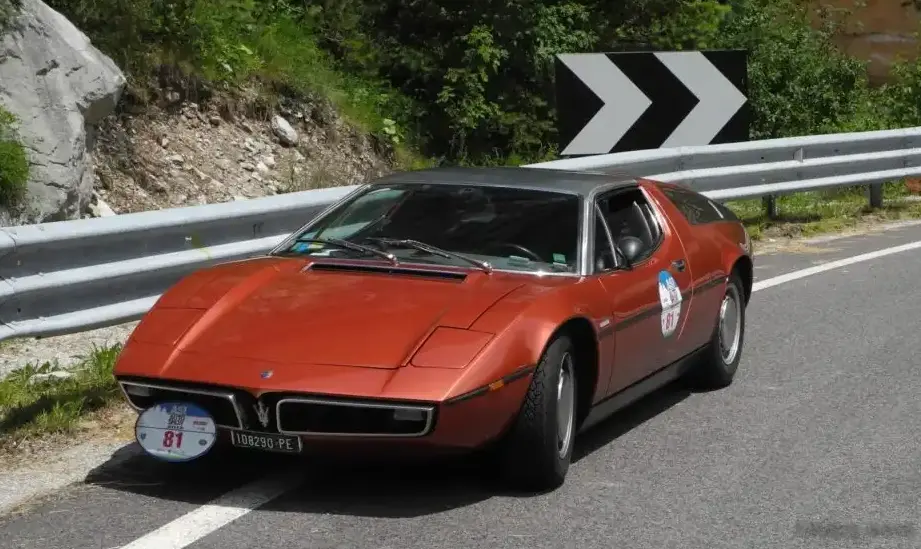
The Maserati Bora 4.7 V8, produced between June 1972 and June 1977, represents a pivotal moment in the Italian manufacturer’s history. It was Maserati’s first production mid-engine car, designed to compete directly with the Lamborghini Espada and Ferrari Daytona. The Bora, named after the cold, dry wind that blows down from the Balkans, quickly became an icon of Italian automotive design and engineering. This specific 4.7-liter V8 variant was the flagship model, offering the highest performance within the Bora range. It was a grand tourer intended for discerning customers who desired both luxury and exhilarating performance.
Technical Specifications
| Brand | Maserati |
| Model | Bora |
| Generation | Bora |
| Type (Engine) | 4.7 V8 (310 Hp) |
| Start of production | June, 1972 |
| End of production | June, 1977 |
| Powertrain Architecture | Internal Combustion engine |
| Body type | Coupe |
| Seats | 2 |
| Doors | 2 |
| Fuel Type | Petrol (Gasoline) |
| Acceleration 0 – 100 km/h | 6.5 sec |
| Acceleration 0 – 62 mph | 6.5 sec |
| Acceleration 0 – 60 mph | 6.2 sec |
| Maximum speed | 280 km/h (173.98 mph) |
| Weight-to-power ratio | 4.8 kg/Hp, 206.7 Hp/tonne |
| Weight-to-torque ratio | 3.3 kg/Nm, 307.3 Nm/tonne |
| Power | 310 Hp @ 6000 rpm |
| Power per litre | 65.7 Hp/l |
| Torque | 461 Nm @ 4200 rpm (340.02 lb.-ft. @ 4200 rpm) |
| Engine layout | Rear, Longitudinal |
| Engine Model/Code | AM117 |
| Engine displacement | 4719 cm3 (287.97 cu. in.) |
| Number of cylinders | 8 |
| Engine configuration | V-engine |
| Cylinder Bore | 93.9 mm (3.7 in.) |
| Piston Stroke | 85 mm (3.35 in.) |
| Compression ratio | 8.5:1 |
| Number of valves per cylinder | 2 |
| Fuel injection system | Carburettor |
| Engine aspiration | Naturally aspirated engine |
| Valvetrain | SOHC |
| Kerb Weight | 1500 kg (3306.93 lbs.) |
| Max. weight | 1720 kg (3791.95 lbs.) |
| Max load | 220 kg (485.02 lbs.) |
| Trunk (boot) space – minimum | 300 l (10.59 cu. ft.) |
| Fuel tank capacity | 90 l (23.78 US gal | 19.8 UK gal) |
| Length | 4335 mm (170.67 in.) |
| Width | 1768 mm (69.61 in.) |
| Height | 1134 mm (44.65 in.) |
| Wheelbase | 2600 mm (102.36 in.) |
| Front track | 1474 mm (58.03 in.) |
| Rear (Back) track | 1447 mm (56.97 in.) |
| Minimum turning circle | 10.5 m (34.45 ft.) |
| Drivetrain Architecture | Rear wheel drive |
| Number of gears and type of gearbox | 5 gears, manual transmission |
| Front suspension | Independent coil spring, Transverse stabilizer |
| Rear suspension | Independent coil spring, Transverse stabilizer |
| Front brakes | Ventilated discs |
| Rear brakes | Ventilated discs |
| Steering type | Steering rack and pinion |
| Power steering | Hydraulic Steering |
| Tires size | 215/70 R15 |
| Wheel rims size | 7.J x 15 |
Powertrain & Engine Architecture
The heart of the Bora 4.7 V8 is the AM117 engine, a 4.7-liter, naturally aspirated V8. This engine, derived from the earlier 4.2-liter unit, featured a single overhead camshaft (SOHC) design per bank, operating two valves per cylinder. Fuel delivery was managed by four Weber 38 DCOE carburetors, a relatively archaic system for the time but one that contributed to the engine’s raw, visceral character. The engine produced 310 horsepower at 6000 rpm and 340 lb-ft of torque at 4200 rpm. The engine was mounted longitudinally in the rear of the chassis, driving the rear wheels. The transmission was a five-speed manual gearbox, providing precise control over the engine’s power. The engine’s layout and carburation contributed to its distinctive sound – a throaty roar that became synonymous with the Bora.
Driving Characteristics
The Bora 4.7 V8 offered a thrilling driving experience. Acceleration to 60 mph was achieved in approximately 6.2 seconds, and it could reach a top speed of 174 mph. The five-speed manual transmission allowed drivers to fully exploit the engine’s powerband. The gear ratios were well-matched, providing strong acceleration in each gear. Compared to the later 3.0-liter inline-six version, the 4.7 V8 offered significantly more power and torque, resulting in a more engaging and rewarding driving experience. While the 3.0-liter was lighter and more nimble, the V8 provided a more muscular and authoritative feel. The car’s mid-engine layout contributed to excellent balance and handling, although the unassisted steering could be heavy at low speeds.
Equipment & Trim Levels
The Bora 4.7 V8 was a luxury grand tourer, and as such, it came equipped with a number of desirable features. Standard equipment included leather upholstery, power windows, and a wood-rimmed steering wheel. Air conditioning was often included, though not always standard. The interior was designed with comfort and elegance in mind, featuring high-quality materials and a refined aesthetic. Optional extras included a sunroof, upgraded audio systems, and custom paint colors. The dashboard layout was clean and functional, with easily accessible controls. The Bora’s interior was a testament to Italian craftsmanship and attention to detail.
Chassis & Braking
The Bora featured a steel monocoque chassis, providing a strong and rigid platform. The suspension consisted of independent coil springs and transverse stabilizers at both the front and rear, offering a comfortable ride and good handling. Braking was provided by ventilated discs on all four wheels, ensuring ample stopping power. The steering was a rack-and-pinion system, but it lacked power assistance, requiring a fair amount of effort, especially at low speeds. The car rode on 7J x 15 inch wheels, fitted with 215/70 R15 tires. The chassis and suspension were designed to complement the engine’s power, providing a balanced and predictable driving experience.
Market Reception & Comparison
The Maserati Bora 4.7 V8 was generally well-received by automotive critics. It was praised for its stunning design, powerful engine, and engaging driving dynamics. However, it was also criticized for its relatively high price and occasional reliability issues. Compared to the Ferrari Daytona, the Bora offered a more comfortable and refined driving experience, but lacked the Daytona’s outright performance. The Bora’s fuel economy was also relatively poor, typical for a high-performance V8 of that era. Despite these drawbacks, the Bora established Maserati as a serious competitor in the grand touring market.
Legacy
The Maserati Bora 4.7 V8 remains a highly sought-after classic car today. Its striking design and powerful engine continue to captivate enthusiasts. While the AM117 engine is known to require regular maintenance, it is generally considered a robust and reliable unit when properly cared for. The Bora’s mid-engine layout and advanced engineering paved the way for future Maserati models. In the used car market, well-maintained examples of the Bora 4.7 V8 can command significant prices, reflecting their rarity and historical importance. The Bora stands as a testament to Maserati’s engineering prowess and design flair, and it continues to be celebrated as one of the most iconic Italian sports cars of the 1970s.
