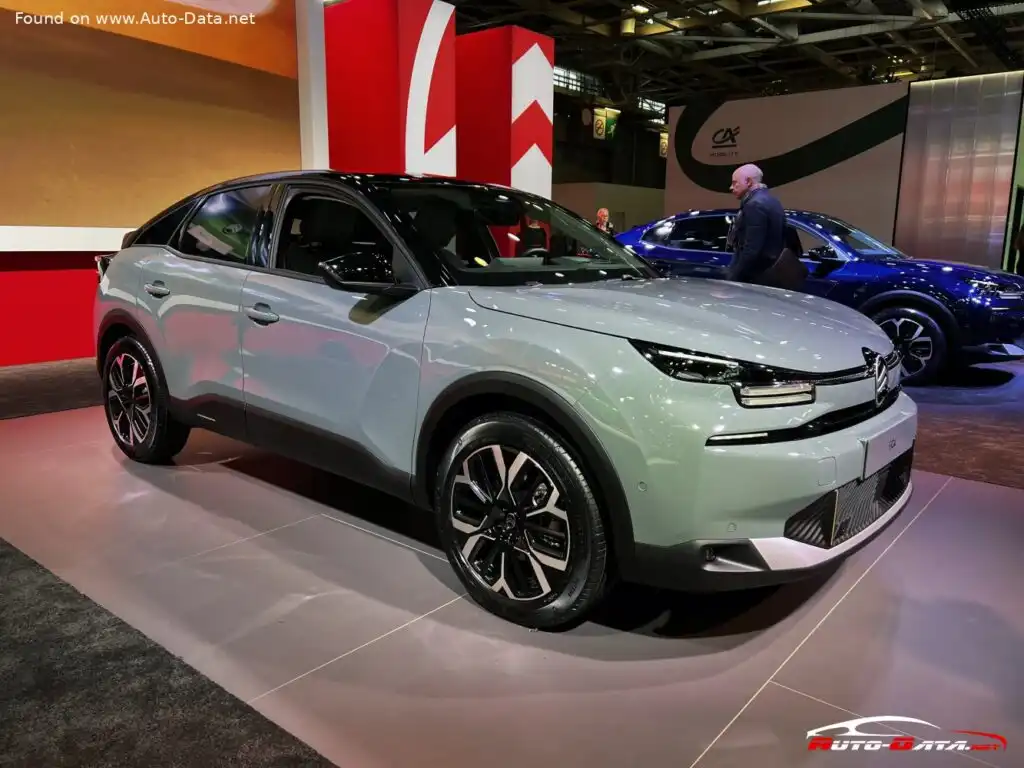
The Citroen C4 III Phase II, launched in October 2024, represents the latest iteration of Citroen’s compact hatchback and crossover vehicle. The 1.2 PureTech 130 horsepower (Hp) variant, paired with the eight-speed EAT8 automatic transmission, occupies a central position within the C4 III lineup, offering a balance between fuel efficiency, performance, and comfort. This model is designed to appeal to buyers seeking a versatile and modern vehicle for everyday use, particularly in European markets where compact cars are highly popular. It builds upon the foundation of the C4 III platform, offering updated styling and technology compared to earlier versions.
Technical Specifications
| Brand | Citroen |
| Model | C4 |
| Generation | C4 III (Phase II, 2024) |
| Type (Engine) | 1.2 PureTech (130 Hp) EAT8 |
| Start of production | October, 2024 |
| Powertrain Architecture | Internal Combustion engine |
| Body type | Coupe, SUV |
| Seats | 5 |
| Doors | 5 |
| Fuel consumption at Low speed (WLTP) | 7.7 l/100 km (30.5 US mpg, 36.7 UK mpg, 13 km/l) |
| Fuel consumption at Medium speed (WLTP) | 6 l/100 km (39.2 US mpg, 47.1 UK mpg, 16.7 km/l) |
| Fuel consumption at high speed (WLTP) | 5 l/100 km (47 US mpg, 56.5 UK mpg, 20 km/l) |
| Fuel consumption at very high speed (WLTP) | 6 l/100 km (39.2 US mpg, 47.1 UK mpg, 16.7 km/l) |
| Combined fuel consumption (WLTP) | 5.9 l/100 km (39.9 US mpg, 47.9 UK mpg, 16.9 km/l) |
| CO2 emissions (WLTP) | 134 g/km |
| Fuel Type | Petrol (Gasoline) |
| Acceleration 0 – 100 km/h | 10.2 sec |
| Acceleration 0 – 62 mph | 10.2 sec |
| Acceleration 0 – 60 mph | 9.7 sec |
| Maximum speed | 200 km/h (124.27 mph), Electronically limited |
| Emission standard | Euro 6e |
| Weight-to-power ratio | 9.7 kg/Hp, 102.7 Hp/tonne |
| Weight-to-torque ratio | 5.5 kg/Nm, 181.7 Nm/tonne |
| Power | 130 Hp @ 5500 rpm |
| Power per litre | 108.4 Hp/l |
| Torque | 230 Nm @ 1750 rpm (169.64 lb.-ft. @ 1750 rpm) |
| Engine layout | Front, Transverse |
| Engine displacement | 1199 cm3 (73.17 cu. in.) |
| Number of cylinders | 3 |
| Engine configuration | Inline |
| Cylinder Bore | 75 mm (2.95 in.) |
| Piston Stroke | 90.5 mm (3.56 in.) |
| Number of valves per cylinder | 4 |
| Fuel injection system | Direct injection |
| Engine aspiration | Turbocharger, Intercooler |
| Valvetrain | DOHC |
| Engine systems | Start & Stop System, Particulate filter |
| Kerb Weight | 1266-1371 kg (2791.05 – 3022.54 lbs.) |
| Max. weight | 1735-1755 kg (3825.02 – 3869.11 lbs.) |
| Max load | 384-469 kg (846.58 – 1033.97 lbs.) |
| Trunk (boot) space – minimum | 380 l (13.42 cu. ft.) |
| Trunk (boot) space – maximum | 1250 l (44.14 cu. ft.) |
| Fuel tank capacity | 50 l (13.21 US gal, 11 UK gal) |
| Max. roof load | 80 kg (176.37 lbs.) |
| Permitted trailer load with brakes (12%) | 1200 kg (2645.55 lbs.) |
| Permitted trailer load without brakes | 670 kg (1477.1 lbs.) |
| Permitted towbar download | 61 kg (134.48 lbs.) |
| Length | 4350 mm (171.26 in.) |
| Width | 1800 mm (70.87 in.) |
| Width with mirrors folded | 1834 mm (72.2 in.) |
| Width including mirrors | 2032 mm (80 in.) |
| Height | 1520-1525 mm (59.84 – 60.04 in.) |
| Wheelbase | 2670 mm (105.12 in.) |
| Front track | 1545-1560 mm (60.83 – 61.42 in.) |
| Rear (Back) track | 1545-1560 mm (60.83 – 61.42 in.) |
| Front overhang | 870 mm (34.25 in.) |
| Rear overhang | 810 mm (31.89 in.) |
| Ride height (ground clearance) | 156 mm (6.14 in.) |
| Minimum turning circle (turning diameter) | 10.9 m (35.76 ft.) |
| Drivetrain Architecture | The Internal combustion engine (ICE) drives the front wheels of the vehicle. |
| Drive wheel | Front wheel drive |
| Number of gears and type of gearbox | 8 gears, automatic transmission EAT |
| Front suspension | Independent, type McPherson with coil spring and anti-roll bar |
| Rear suspension | Coil spring, Torsion |
| Front brakes | Ventilated discs |
| Rear brakes | Disc |
| Assisting systems | ABS (Anti-lock braking system) |
| Steering type | Steering rack and pinion |
| Power steering | Electric Steering |
| Tires size | 215/65 R16; 195/60 R18 |
| Wheel rims size | 16; 18 |
Powertrain & Engine Architecture
The heart of this C4 variant is the PSA (now Stellantis) 1.2 PureTech engine, specifically the EB2DT variant producing 130 horsepower. This is a three-cylinder, turbocharged gasoline engine featuring direct fuel injection and a double overhead camshaft (DOHC) valvetrain. The engine benefits from advanced technologies like a particulate filter to reduce emissions, meeting Euro 6e standards. The turbocharger and intercooler work together to enhance power output and efficiency. The engine’s compact size and lightweight construction contribute to the vehicle’s overall agility. The EAT8 (Efficient Automatic Transmission 8) is an eight-speed automatic gearbox designed for smooth shifting and optimized fuel economy. It features a torque converter and adaptive shift logic, adjusting to driving conditions and driver input.
Driving Characteristics
The 1.2 PureTech 130 Hp/EAT8 combination delivers a comfortable and refined driving experience. Acceleration from 0 to 60 mph takes approximately 9.7 seconds, and 0-100 km/h in 10.2 seconds, making it suitable for everyday commuting and highway driving. While not a performance-oriented setup, the turbocharger provides adequate torque at low to mid-range RPMs, ensuring responsive acceleration. The EAT8 transmission shifts smoothly and efficiently, contributing to a relaxed driving experience. Compared to the more powerful engine options in the C4 III range, this variant prioritizes fuel economy and comfort over outright speed. The automatic transmission, while convenient, may exhibit some hesitation during quick overtaking maneuvers compared to a manual transmission.
Equipment & Trim Levels
The 1.2 PureTech 130 EAT8 typically comes with a generous level of standard equipment. This often includes features like a touchscreen infotainment system with Apple CarPlay and Android Auto compatibility, automatic climate control, rear parking sensors, and a suite of safety features such as lane departure warning and automatic emergency braking. Interior upholstery is typically cloth, with options for upgraded materials available. Higher trim levels may add features like a panoramic sunroof, leather seats, and advanced driver-assistance systems. The specific trim level dictates the availability of optional extras, such as a premium audio system or adaptive cruise control.
Chassis & Braking
The C4 III utilizes a McPherson strut front suspension and a torsion beam rear suspension. This setup provides a good balance between ride comfort and handling. The front brakes are ventilated discs, while the rear brakes are solid discs, providing adequate stopping power for the vehicle’s weight class. The electric power steering offers light and precise steering feel. Stabilizer bars are fitted to both the front and rear axles to reduce body roll during cornering. The suspension is tuned to prioritize comfort, resulting in a relatively soft ride quality.
Market Reception & Comparison
The Citroen C4 III 1.2 PureTech 130 EAT8 has been generally well-received by automotive critics. It is praised for its fuel efficiency, comfortable ride, and well-equipped interior. Compared to other engine options in the C4 III lineup, such as the diesel variants, this petrol engine offers a quieter and more refined driving experience. However, some critics note that the performance is not as strong as the more powerful engine options. In terms of fuel economy, it competes favorably with similar vehicles in its class, offering a combined fuel consumption of around 39.9 US mpg. Reliability has been generally good, although some owners have reported minor issues with the engine’s turbocharger or fuel injection system.
Legacy
The 1.2 PureTech engine has become a mainstay in the Stellantis lineup, powering a wide range of vehicles across multiple brands. The EAT8 transmission is also widely used, known for its smoothness and efficiency. The C4 III 1.2 PureTech 130 EAT8 represents a well-rounded and practical choice for buyers seeking a comfortable and fuel-efficient compact car. On the used car market, these models are generally considered reliable and offer good value for money, provided they have been well-maintained. The engine’s relatively simple design and readily available parts contribute to its long-term reliability and affordability.