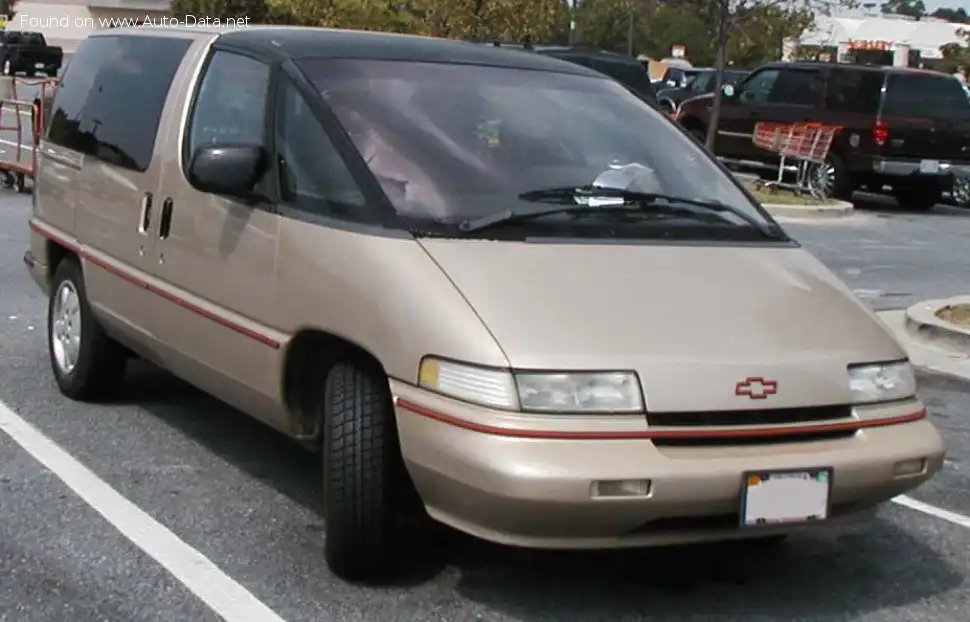
The Chevrolet Lumina APV 3.1i, produced from 1989 to 1996, represented Chevrolet’s entry into the increasingly popular minivan segment. Positioned as a more affordable and practical alternative to larger, more luxurious vans, the 3.1i variant – equipped with the 3.1-liter V6 engine and a 3-speed automatic transmission – served as a mainstay of the Lumina APV lineup. It was part of the first generation of the Lumina APV (and its mechanically identical siblings, the Oldsmobile Silhouette and Pontiac Trans Sport), all built on the U-body platform. The APV designation stood for “All-Purpose Vehicle,” reflecting Chevrolet’s intention to create a versatile family hauler.
Technical Specifications
| Brand | Chevrolet |
| Model | Lumina |
| Generation | Lumina APV |
| Type (Engine) | 3.1 i (122 Hp) |
| Start of production | 1989 |
| End of production | 1996 |
| Powertrain Architecture | Internal Combustion engine |
| Body type | Minivan |
| Seats | 5 |
| Doors | 4 |
| Fuel consumption (combined) | 11.7 l/100 km (20.1 US mpg, 24.1 UK mpg, 8.5 km/l) |
| Fuel Type | Petrol (Gasoline) |
| Weight-to-power ratio | 13.2 kg/Hp, 75.6 Hp/tonne |
| Weight-to-torque ratio | 6.8 kg/Nm, 146.8 Nm/tonne |
| Power | 122 Hp @ 4200 rpm |
| Power per litre | 38.9 Hp/l |
| Torque | 237 Nm @ 2200 rpm (174.8 lb.-ft. @ 2200 rpm) |
| Engine layout | Front, Transverse |
| Engine displacement | 3135 cm3 (191.31 cu. in.) |
| Number of cylinders | 6 |
| Engine configuration | V-engine |
| Cylinder Bore | 89 mm (3.5 in.) |
| Piston Stroke | 84 mm (3.31 in.) |
| Compression ratio | 8.5:1 |
| Number of valves per cylinder | 2 |
| Fuel injection system | Single-point injection |
| Engine aspiration | Naturally aspirated engine |
| Kerb Weight | 1614 kg (3558.26 lbs.) |
| Fuel tank capacity | 77 l (20.34 US gal | 16.94 UK gal) |
| Length | 4844 mm (190.71 in.) |
| Width | 1877 mm (73.9 in.) |
| Height | 1669 mm (65.71 in.) |
| Wheelbase | 2788 mm (109.76 in.) |
| Front track | 1504 mm (59.21 in.) |
| Rear track | 1560 mm (61.42 in.) |
| Drivetrain Architecture | The Internal combustion engine (ICE) drives the front wheels of the vehicle. |
| Drive wheel | Front wheel drive |
| Number of gears and type of gearbox | 3 gears, automatic transmission |
| Front suspension | Spring Strut |
| Rear suspension | Coil spring |
| Front brakes | Ventilated discs |
| Rear brakes | Drum |
| Assisting systems | ABS (Anti-lock braking system), Hydraulic Steering |
| Tires size | 205/70 R15 S |
Powertrain & Engine Architecture
The heart of the Lumina APV 3.1i was the 3.1-liter (191 cubic inch) 60-degree V6 engine, designated as the LH0. This engine was a relatively simple design, utilizing a cast iron block and aluminum cylinder heads. It featured a single overhead camshaft (SOHC) design with two valves per cylinder. Fuel delivery was handled by a multi-port fuel injection system, a step down from the more advanced systems found in some competing minivans. The 3.1L V6 produced 122 horsepower at 4200 rpm and 175 lb-ft of torque at 2200 rpm. The engine was transversely mounted in the front of the vehicle, driving the front wheels. The transmission was a 3-speed automatic, a TH700R4 unit, chosen for its affordability and reliability. While not known for its performance, this transmission was generally durable and well-suited to the engine’s power characteristics.
Driving Characteristics
The Lumina APV 3.1i offered adequate, but not exhilarating, performance. The 3-speed automatic transmission, while reliable, lacked the responsiveness of more modern transmissions. Acceleration was modest, and passing maneuvers required careful planning. The gear ratios were optimized for fuel economy rather than outright speed. Compared to the higher-output 3.8-liter V6 option available in some Lumina APV trims, the 3.1i felt noticeably slower. However, the 3.1i offered a smoother and more relaxed driving experience, particularly in city traffic. The front-wheel-drive configuration provided predictable handling, although it wasn’t particularly sporty. The suspension was tuned for comfort, absorbing bumps and road imperfections reasonably well.
Equipment & Trim Levels
The Lumina APV 3.1i typically came with a fairly basic level of standard equipment. Features generally included cloth upholstery, an AM/FM stereo, manual windows and locks, and air conditioning. Optional extras included power windows and locks, a cassette player, and upgraded interior trim. The interior design was functional but lacked the refinement of some competitors. The seating configuration typically accommodated five passengers, with a split-folding bench seat in the rear. The Lumina APV was designed with practicality in mind, offering a spacious interior and ample cargo capacity.
Chassis & Braking
The Lumina APV utilized a front-wheel-drive chassis with an independent front suspension featuring MacPherson struts and a solid rear axle with coil springs. The braking system consisted of ventilated disc brakes at the front and drum brakes at the rear. Anti-lock brakes (ABS) were available as an option, enhancing safety. Steering was handled by a hydraulic power steering system, providing relatively light and easy steering effort. The suspension was tuned for comfort, prioritizing ride quality over handling precision. The tires were typically 205/70R15 size, offering a balance of ride comfort and handling.
Market Reception & Comparison
The Lumina APV 3.1i was generally well-received as an affordable and practical minivan option. Critics praised its spacious interior and comfortable ride, but noted its lack of performance and somewhat dated styling. Compared to the 3.8-liter V6 version, the 3.1i offered better fuel economy but significantly less power. It also lagged behind some competitors, such as the Dodge Caravan and Chrysler Town & Country, in terms of features and refinement. However, its lower price point made it an attractive option for budget-conscious buyers. Fuel economy averaged around 20 mpg in combined driving, which was competitive for its time.
Legacy
The Chevrolet Lumina APV, including the 3.1i variant, played a significant role in establishing Chevrolet as a competitor in the minivan market. While not known for exceptional reliability, the 3.1-liter V6 engine proved to be reasonably durable with proper maintenance. Today, the Lumina APV 3.1i is a relatively affordable and readily available used vehicle. However, finding well-maintained examples can be challenging, as many have suffered from years of use and neglect. Parts availability is generally good, but some components may be becoming increasingly difficult to source. The Lumina APV represents a snapshot of American automotive design and engineering from the early 1990s, offering a glimpse into a time when minivans were becoming an essential part of family life.