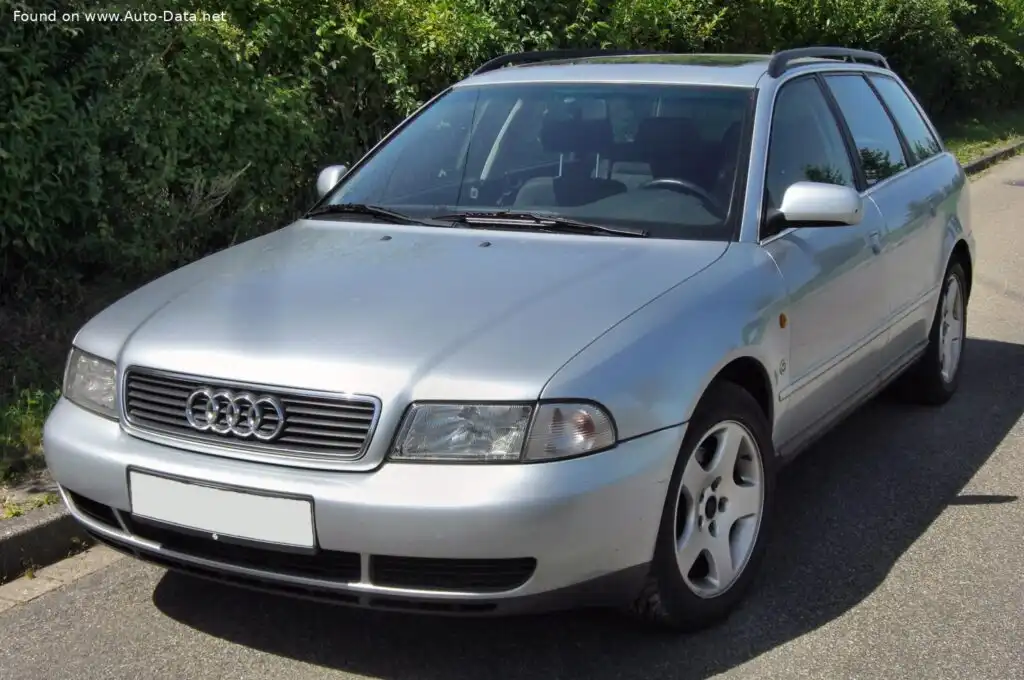
The Audi A4 Avant (B5, Typ 8D) 2.6 V6, produced from 1996 to 1997, represents a compelling blend of practicality and performance within the broader B5 A4 range. As the wagon (Avant) variant of Audi’s popular compact executive car, it offered a more versatile alternative to the sedan, appealing to buyers needing increased cargo capacity. This specific 2.6-liter V6 configuration occupied a mid-range position in the A4 Avant lineup, slotting above the entry-level 1.8-liter four-cylinder models and below the more potent 2.8-liter V6 options. It was primarily marketed in Europe, where the demand for wagons remained strong, offering a premium experience with a focus on comfortable cruising and refined driving dynamics.
Technical Specifications
| Brand | Audi |
| Model | A4 |
| Generation | A4 Avant (B5, Typ 8D) |
| Type (Engine) | 2.6 V6 (150 Hp) |
| Start of production | 1996 |
| End of production | 1997 |
| Powertrain Architecture | Internal Combustion engine |
| Body type | Station wagon (estate) |
| Seats | 5 |
| Doors | 5 |
| Fuel consumption (combined) | 8.9 l/100 km |
| Fuel consumption (US mpg) | 26.4 US mpg |
| Fuel consumption (UK mpg) | 31.7 UK mpg |
| Fuel consumption (km/l) | 11.2 km/l |
| Fuel Type | Petrol (Gasoline) |
| Acceleration 0 – 100 km/h | 8.9 sec |
| Acceleration 0 – 62 mph | 8.9 sec |
| Acceleration 0 – 60 mph | 8.5 sec |
| Maximum speed | 216 km/h (134.22 mph) |
| Weight-to-power ratio | 8.7 kg/Hp |
| Weight-to-torque ratio | 5.8 kg/Nm |
| Power | 150 Hp @ 5750 rpm |
| Power per litre | 57.7 Hp/l |
| Torque | 225 Nm @ 3500 rpm (165.95 lb.-ft. @ 3500 rpm) |
| Engine layout | Front, Longitudinal |
| Engine Model/Code | ABC |
| Engine displacement | 2598 cm3 (158.54 cu. in.) |
| Number of cylinders | 6 |
| Engine configuration | V-engine |
| Cylinder Bore | 82.5 mm (3.25 in.) |
| Piston Stroke | 81 mm (3.19 in.) |
| Compression ratio | 10:1 |
| Number of valves per cylinder | 2 |
| Fuel injection system | Multi-port manifold injection |
| Engine aspiration | Naturally aspirated engine |
| Valvetrain | OHC |
| Engine oil capacity | 5 l (5.28 US qt | 4.4 UK qt) |
| Coolant capacity | 6.5 l (6.87 US qt | 5.72 UK qt) |
| Kerb Weight | 1300 kg (2866.01 lbs.) |
| Max. weight | 1850 kg (4078.55 lbs.) |
| Max load | 550 kg (1212.54 lbs.) |
| Trunk (boot) space – minimum | 390 l (13.77 cu. ft.) |
| Trunk (boot) space – maximum | 1250 l (44.14 cu. ft.) |
| Fuel tank capacity | 62 l (16.38 US gal | 13.64 UK gal) |
| Length | 4479 mm (176.34 in.) |
| Width | 1733 mm (68.23 in.) |
| Height | 1417 mm (55.79 in.) |
| Wheelbase | 2622 mm (103.23 in.) |
| Front track | 1498 mm (58.98 in.) |
| Rear track | 1479 mm (58.23 in.) |
| Drag coefficient (Cd) | 0.32 |
| Minimum turning circle | 11.1 m (36.42 ft.) |
| Drivetrain Architecture | The Internal combustion engine (ICE) drives the front wheels of the vehicle. |
| Drive wheel | Front wheel drive |
| Number of gears | 5 |
| Gearbox type | Manual transmission |
| Front suspension | Wishbone |
| Rear suspension | Suspension with traction connecting levers |
| Front brakes | Ventilated discs |
| Rear brakes | Disc |
| Assisting systems | ABS (Anti-lock braking system) |
| Steering type | Steering rack and pinion |
| Power steering | Hydraulic Steering |
| Tires size | 195/65 R15 |
| Wheel rims size | 15 |
Powertrain & Engine Architecture
The heart of the A4 Avant 2.6 V6 is the ABC engine code, a 2.6-liter naturally aspirated V6. This engine is characterized by its smooth power delivery and relatively refined operation. It utilizes a cast iron block and aluminum cylinder heads, a common configuration for Audi’s V6 engines of the era. Fuel delivery is managed by a Bosch Motronic multi-port fuel injection system, ensuring precise fuel metering for optimal combustion. The engine features a single overhead camshaft (OHC) design per cylinder bank, operating two valves per cylinder (intake and exhaust). The 5-speed manual transmission was standard, providing a direct connection between the engine and the front wheels. This transmission was chosen for its durability and relatively sporty feel, although a 4-speed automatic transmission was also available as an option.
Driving Characteristics
The 2.6 V6 with the 5-speed manual offered a balanced driving experience. While not as overtly sporty as the 2.8 V6, it provided ample power for everyday driving and comfortable highway cruising. Acceleration from 0-60 mph took around 8.5 seconds, respectable for the mid-1990s. The engine’s torque curve was relatively flat, providing good responsiveness across a wide range of engine speeds. The manual transmission allowed for precise gear selection, enhancing driver engagement. Compared to the automatic version, the manual offered improved fuel economy and a more direct feel. The front-wheel-drive configuration provided predictable handling, although it lacked the all-weather capability of Audi’s quattro all-wheel-drive system, available on higher-spec models.
Equipment & Trim Levels
The A4 Avant 2.6 V6 typically came equipped with a reasonable level of standard features. These included power windows, central locking, power steering, and an anti-lock braking system (ABS). Interior upholstery was typically cloth, although leather options were available. The dashboard layout was functional and ergonomically designed, with clear instrumentation. Optional extras included a sunroof, alloy wheels, a premium sound system, and climate control. The trim level could vary depending on the market, but generally, this variant represented a step up from the base models, offering a more comfortable and well-equipped experience.
Chassis & Braking
The B5 A4 Avant featured an independent suspension system, with wishbones at the front and a semi-independent suspension with traction connecting levers at the rear. This setup provided a good balance between ride comfort and handling. The front brakes were ventilated discs, offering excellent stopping power, while the rear brakes were solid discs. The steering was a rack-and-pinion system with hydraulic power assistance, providing precise and responsive steering feel. The chassis was designed to be relatively lightweight, contributing to the car’s agility.
Market Reception & Comparison
The A4 Avant 2.6 V6 was generally well-received by automotive critics. It was praised for its smooth engine, comfortable ride, and practical wagon body style. However, some critics noted that it lacked the outright performance of the 2.8 V6 models. Compared to the 1.8-liter four-cylinder A4 Avants, the 2.6 V6 offered a significant performance upgrade, but at a higher price point. In terms of reliability, the ABC engine is generally considered to be robust, although it is susceptible to oil leaks as it ages. Fuel economy was reasonable for a V6 engine of this era, averaging around 26.4 US mpg.
Legacy
The Audi A4 Avant (B5, Typ 8D) 2.6 V6 remains a popular choice among enthusiasts and used car buyers. Its combination of practicality, performance, and build quality has ensured its longevity. While finding well-maintained examples can be challenging, the ABC engine is known for its durability when properly serviced. Today, these cars represent a relatively affordable entry point into the Audi brand, offering a classic European driving experience. The 2.6 V6 variant, in particular, is appreciated for its smooth power delivery and refined character, making it a desirable option for those seeking a comfortable and capable wagon.