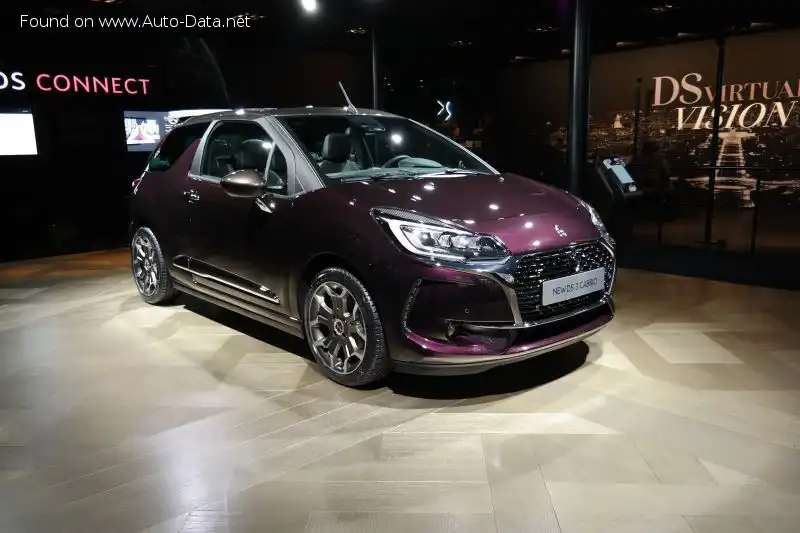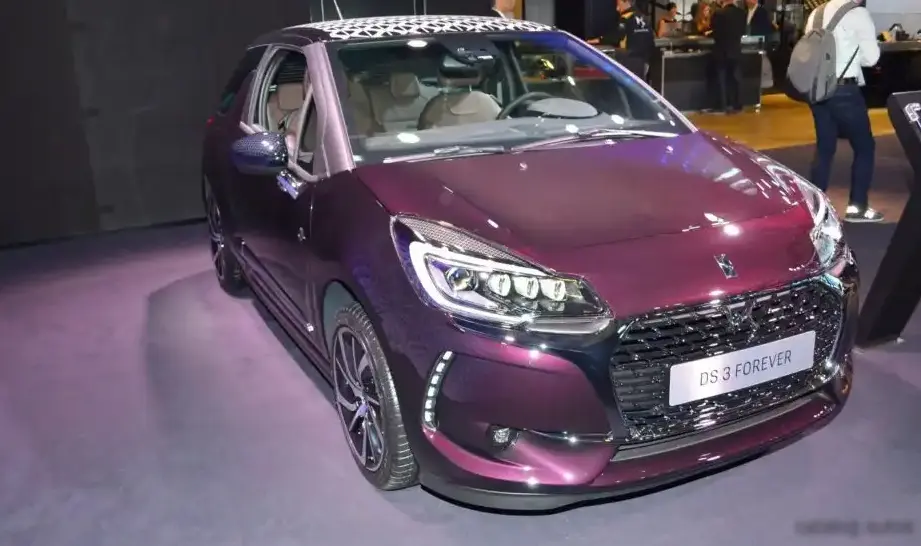
The DS 3 1.6 BlueHDi 120 Start&Stop was a diesel-powered variant of the DS 3 subcompact hatchback produced between 2016 and 2018. Positioned as a fuel-efficient option within the DS 3 range, it aimed to appeal to buyers seeking low running costs without sacrificing all performance. This model represented DS Automobiles’ (formerly Citroën DS) attempt to establish a distinct, premium identity, building upon the popular Citroën DS 3 platform. It was primarily marketed in Europe, where demand for diesel-powered vehicles remained strong during its production run.
Technical Specifications
| Brand | DS |
| Model | 3 |
| Generation | 3 |
| Type (Engine) | 1.6 BlueHDi (120 Hp) Start&Stop |
| Start of production | 2016 |
| End of production | 2018 |
| Powertrain Architecture | Internal Combustion engine |
| Body type | Hatchback |
| Seats | 5 |
| Doors | 3 |
| Fuel consumption (urban) | 4.4 l/100 km (53.5 US mpg, 64.2 UK mpg, 22.7 km/l) |
| Fuel consumption (extra urban) | 3.2 l/100 km (73.5 US mpg, 88.3 UK mpg, 31.3 km/l) |
| Fuel consumption (combined) | 3.6 l/100 km (65.3 US mpg, 78.5 UK mpg, 27.8 km/l) |
| CO2 emissions | 94 g/km |
| Fuel Type | Diesel |
| Acceleration 0 – 100 km/h | 9.4 sec |
| Acceleration 0 – 62 mph | 9.4 sec |
| Acceleration 0 – 60 mph | 8.9 sec |
| Maximum speed | 190 km/h (118.06 mph) |
| Emission standard | Euro 6 |
| Weight-to-power ratio | 9.6 kg/Hp, 104.3 Hp/tonne |
| Weight-to-torque ratio | 3.8 kg/Nm, 260.9 Nm/tonne |
| Power | 120 Hp @ 3500 rpm |
| Torque | 300 Nm @ 1750 rpm (221.27 lb.-ft. @ 1750 rpm) |
| Engine layout | Front, Transverse |
| Engine Model/Code | BHZ DV6FC |
| Engine displacement | 1560 cm3 (95.2 cu. in.) |
| Number of cylinders | 4 |
| Engine configuration | Inline |
| Cylinder Bore | 75 mm (2.95 in.) |
| Piston Stroke | 88.3 mm (3.48 in.) |
| Fuel injection system | Diesel Commonrail |
| Engine aspiration | Turbocharger, Intercooler |
| Engine oil capacity | 3.8 l (4.02 US qt | 3.34 UK qt) |
| Kerb Weight | 1150-1226 kg (2535.32 – 2702.87 lbs.) |
| Max. weight | 1653 kg (3644.24 lbs.) |
| Max load | 427-503 kg (941.37 – 1108.93 lbs.) |
| Trunk (boot) space – minimum | 285 l (10.06 cu. ft.) |
| Fuel tank capacity | 45 l (11.89 US gal | 9.9 UK gal) |
| Max. roof load | 70 kg (154.32 lbs.) |
| Permitted trailer load with brakes (12%) | 775 kg (1708.58 lbs.) |
| Permitted trailer load without brakes | 450 kg (992.08 lbs.) |
| Permitted towbar download | 46 kg (101.41 lbs.) |
| Length | 3954 mm (155.67 in.) |
| Width | 1715 mm (67.52 in.) |
| Width including mirrors | 2004 mm (78.9 in.) |
| Height | 1458-1483 mm (57.4 – 58.39 in.) |
| Wheelbase | 2464 mm (97.01 in.) |
| Front track | 1465-1468 mm (57.68 – 57.8 in.) |
| Rear (Back) track | 1467-1471 mm (57.76 – 57.91 in.) |
| Front overhang | 830 mm (32.68 in.) |
| Rear overhang | 660 mm (25.98 in.) |
| Drivetrain Architecture | The Internal combustion engine (ICE) drives the front wheels of the vehicle. |
| Drive wheel | Front wheel drive |
| Number of gears and type of gearbox | 6 gears, manual transmission |
| Front suspension | Independent type McPherson |
| Rear suspension | Semi-independent, coil spring |
| Front brakes | Ventilated discs |
| Rear brakes | Disc |
| Assisting systems | ABS (Anti-lock braking system) |
| Steering type | Steering rack and pinion |
| Power steering | Electric Steering |
| Tires size | 205/45 R17 |
| Wheel rims size | 17 |
INTRODUCTION
The DS 3 1.6 BlueHDi 120 Start&Stop, launched in 2016, was a key variant in the DS 3 lineup. It built upon the success of the Citroën DS 3, which had gained popularity for its stylish design and customizable options. The DS brand was repositioned as a premium offering, and the BlueHDi 120 aimed to provide a balance of efficiency and acceptable performance for everyday driving. This generation of DS 3 (often referred to as the second generation, though it was initially marketed as an evolution of the original) utilized the PSA Group’s PF1 platform, also known as the 1HX0/A3 platform, shared with models like the Peugeot 208 and Citroën C3.
Powertrain & Engine Architecture
At the heart of the DS 3 1.6 BlueHDi 120 was the PSA Group’s DV6FC engine, specifically the BHZ variant. This 1.6-liter, four-cylinder diesel engine was a common sight in European PSA vehicles. It featured a turbocharger with an intercooler to boost power and efficiency. The engine employed a common-rail direct injection system, delivering fuel at high pressure for optimized combustion. The DV6 engine family was known for its robust construction and relatively simple design, contributing to its longevity. The 120 horsepower output was achieved at 3500 rpm, while peak torque of 300 Nm (221 lb-ft) was available from just 1750 rpm, providing good low-end grunt. The engine also incorporated a Start&Stop system, automatically shutting off the engine when the vehicle came to a halt to further reduce fuel consumption and emissions. This variant was paired with a 6-speed manual transmission, chosen for its efficiency and driver engagement.
Driving Characteristics
The DS 3 1.6 BlueHDi 120 offered a comfortable and refined driving experience, prioritizing fuel economy over outright performance. Acceleration from 0-60 mph took around 8.9 seconds, which was adequate for everyday driving but not particularly sporty. The engine’s strong low-end torque made it easy to navigate city streets and overtake slower traffic. The 6-speed manual transmission allowed drivers to keep the engine in its optimal power band. Compared to higher-output versions of the DS 3, such as those with petrol engines, the BlueHDi 120 felt less eager to rev, but it compensated with significantly better fuel economy. The gear ratios were tuned for efficiency, with a relatively long final drive to maximize mileage. The steering was light and precise, making it easy to maneuver in tight spaces.
Equipment & Trim Levels
The DS 3 1.6 BlueHDi 120 typically came with a reasonable level of standard equipment. This included air conditioning, power windows, central locking, and a basic audio system with USB connectivity. Higher trim levels added features such as alloy wheels, a touchscreen infotainment system with navigation, automatic headlights and wipers, and parking sensors. Interior upholstery was typically cloth, with options for leather upgrades. The dashboard layout was modern and stylish, with a focus on ergonomics. Optional extras included a panoramic sunroof, upgraded sound system, and various styling packages to personalize the vehicle’s appearance.
Chassis & Braking
The DS 3 1.6 BlueHDi 120 featured a McPherson strut front suspension and a semi-independent coil spring rear suspension. This setup provided a good balance of ride comfort and handling. The front brakes were ventilated discs, while the rear brakes were solid discs, providing adequate stopping power for the vehicle’s weight and performance. ABS (Anti-lock Braking System) was standard, enhancing safety during emergency braking. The suspension was tuned to prioritize comfort, resulting in a relatively soft ride quality. Stabilizer bars were fitted to both the front and rear axles to reduce body roll during cornering.
Market Reception & Comparison
The DS 3 1.6 BlueHDi 120 was generally well-received by critics for its fuel efficiency and comfortable ride. However, some reviewers noted that the engine could be a bit noisy and lacked the refinement of some competitors. Compared to the petrol-powered DS 3 variants, the BlueHDi 120 offered significantly better fuel economy, making it an attractive option for high-mileage drivers. It also provided more torque than the equivalent petrol engine, resulting in better acceleration at lower speeds. However, the diesel engine came with a higher purchase price and potentially higher maintenance costs due to the more complex emissions control systems. Against rivals like the Volkswagen Polo and Audi A1, the DS 3 offered a more distinctive design and a more luxurious interior.
Legacy
The 1.6 BlueHDi engine proved to be a reliable and durable powertrain, although like all modern diesels, it was susceptible to issues with the diesel particulate filter (DPF) if not driven on longer journeys regularly. The DS 3 1.6 BlueHDi 120 remains a popular choice on the used car market, particularly for buyers seeking a fuel-efficient and stylish hatchback. Its relatively simple mechanicals and readily available parts contribute to its affordability and ease of maintenance. While newer, more efficient engines have since been developed, the DS 3 1.6 BlueHDi 120 continues to offer a compelling combination of value, economy, and practicality.