Technical Specifications
| Brand | Peugeot |
| Model | 2008 |
| Generation | 2008 I (facelift 2016) |
| Type (Engine) | 1.2 PureTech (82 Hp) |
| Start of production | 2016 |
| End of production | 2018 |
| Powertrain Architecture | Internal Combustion engine |
| Body type | SUV, Crossover |
| Seats | 5 |
| Doors | 5 |
| Fuel consumption (urban) | 6 l/100 km (39.2 US mpg, 47.1 UK mpg, 16.7 km/l) |
| Fuel consumption (extra urban) | 4.3 l/100 km (54.7 US mpg, 65.7 UK mpg, 23.3 km/l) |
| Fuel consumption (combined) | 4.9 l/100 km (48 US mpg, 57.6 UK mpg, 20.4 km/l) |
| CO2 emissions | 114 g/km |
| Fuel Type | Petrol (Gasoline) |
| Acceleration 0 – 100 km/h | 13.5 sec |
| Acceleration 0 – 62 mph | 13.5 sec |
| Acceleration 0 – 60 mph | 12.8 sec |
| Maximum speed | 168 km/h (104.39 mph) |
| Emission standard | Euro 6 |
| Weight-to-power ratio | 12.7 kg/Hp, 78.5 Hp/tonne |
| Weight-to-torque ratio | 8.9 kg/Nm, 112.9 Nm/tonne |
| Power | 82 Hp @ 5750 rpm |
| Power per litre | 68.4 Hp/l |
| Torque | 118 Nm @ 2750 rpm (87.03 lb.-ft. @ 2750 rpm) |
| Engine layout | Front, Transverse |
| Engine Model/Code | HMZ EB2F |
| Engine displacement | 1199 cm3 (73.17 cu. in.) |
| Number of cylinders | 3 |
| Engine configuration | Inline |
| Cylinder Bore | 75 mm (2.95 in.) |
| Piston Stroke | 90.5 mm (3.56 in.) |
| Number of valves per cylinder | 4 |
| Fuel injection system | Multi-port manifold injection |
| Engine aspiration | Naturally aspirated engine |
| Valvetrain | DOHC |
| Engine oil capacity | 3.25 l (3.43 US qt | 2.86 UK qt) |
| Kerb Weight | 1045 kg (2303.83 lbs.) |
| Max. weight | 1590 kg (3505.35 lbs.) |
| Max load | 545 kg (1201.52 lbs.) |
| Trunk (boot) space – minimum | 350 l (12.36 cu. ft.) |
| Trunk (boot) space – maximum | 1194 l (42.17 cu. ft.) |
| Fuel tank capacity | 50 l (13.21 US gal | 11 UK gal) |
| Max. roof load | 75 kg (165.35 lbs.) |
| Permitted trailer load with brakes (12%) | 1100 kg (2425.08 lbs.) |
| Permitted trailer load without brakes | 560 kg (1234.59 lbs.) |
| Permitted towbar download | 51 kg (112.44 lbs.) |
| Length | 4159 mm (163.74 in.) |
| Width | 1829 mm (72.01 in.) |
| Width including mirrors | 2004 mm (78.9 in.) |
| Height | 1556 mm (61.26 in.) |
| Wheelbase | 2538 mm (99.92 in.) |
| Front track | 1472-1482 mm (57.95 – 58.35 in.) |
| Rear (Back) track | 1482-1492 mm (58.35 – 58.74 in.) |
| Front overhang | 820 mm (32.28 in.) |
| Rear overhang | 801 mm (31.54 in.) |
| Ride height (ground clearance) | 165 mm (6.5 in.) |
| Minimum turning circle (turning diameter) | 11.2 m (36.75 ft.) |
| Drivetrain Architecture | The Internal combustion engine (ICE) drives the front wheels of the vehicle. |
| Drive wheel | Front wheel drive |
| Number of gears and type of gearbox | 5 gears, manual transmission |
| Front suspension | Independent, type McPherson with coil spring and anti-roll bar |
| Rear suspension | Semi-independent, coil spring |
| Front brakes | Ventilated discs |
| Rear brakes | Disc |
| Assisting systems | ABS (Anti-lock braking system) |
| Steering type | Steering rack and pinion |
| Power steering | Electric Steering |
| Tires size | 195/65 R15; 195/60 R16 |
| Wheel rims size | 15; 16 |
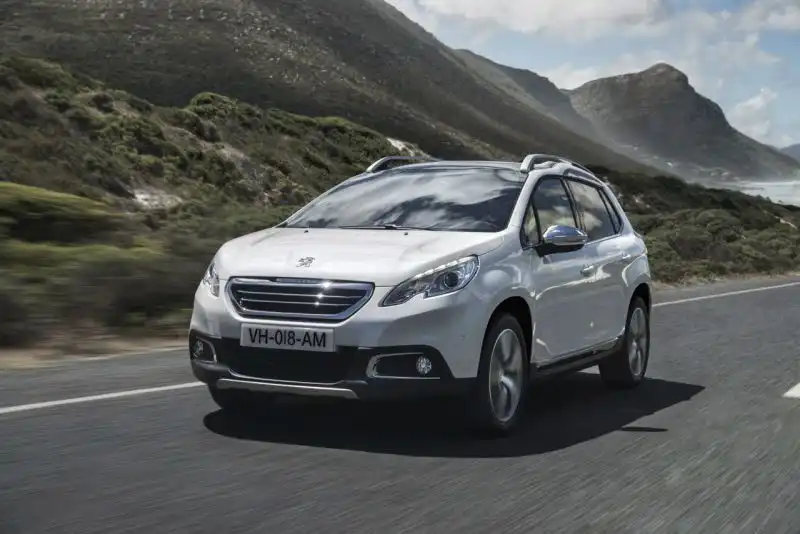
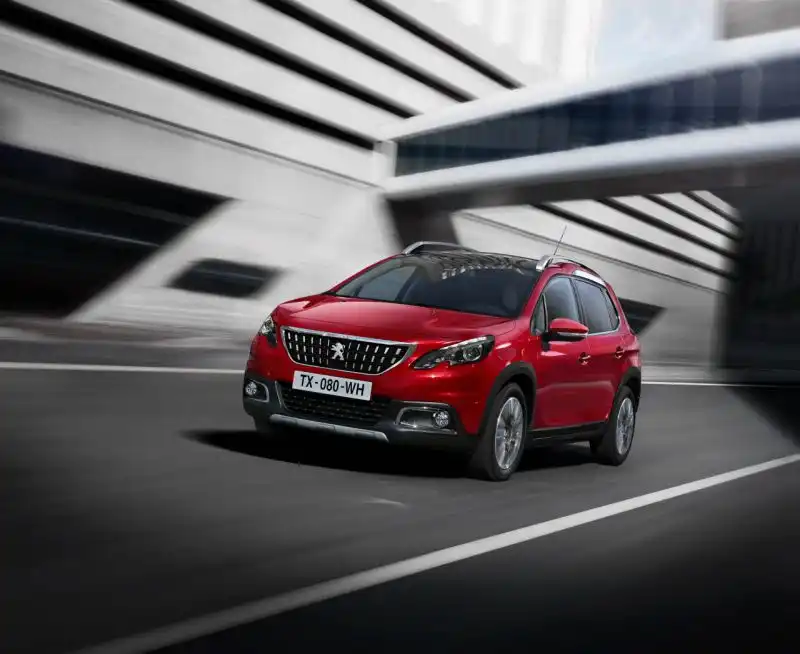
The Peugeot 2008 I (facelift 2016) 1.2 PureTech 82 hp was a crucial entry point into the popular Peugeot 2008 crossover range, manufactured from 2016 to 2018. Positioned as the base model, it offered a more accessible price point within the first generation (T8) 2008 lineup, which was built on the PF1 platform shared with the Citroën C4 Cactus and other PSA Group vehicles. This version aimed to provide a balance between fuel efficiency and practicality, appealing to buyers seeking a stylish and versatile small SUV without breaking the bank. The facelift introduced in 2016 brought cosmetic and equipment revisions across the entire 2008 range, including this 1.2 PureTech model.
Powertrain & Engine Architecture
The 1.2 PureTech 82 hp variant is powered by the Peugeot-developed 1.2 PureTech engine, identified by the code HMZ EB2F. This is a three-cylinder, naturally aspirated gasoline engine with a displacement of 1199cc. It features multi-point fuel injection and a double overhead camshaft (DOHC) valvetrain. The engine’s design focused on maximizing efficiency and minimizing internal friction. Unlike its turbocharged counterparts within the PureTech family, this 82 hp version does not employ forced induction, resulting in a more predictable, though less forceful, power delivery. The engine is mounted transversely at the front of the vehicle. It was typically paired with a 5-speed manual transmission, chosen for its simplicity and contribution to fuel economy.
Driving Characteristics
The combination of the 1.2 PureTech 82 hp engine and the 5-speed manual gearbox delivered adequate, but not particularly sporty, performance. Acceleration from 0-60 mph took approximately 12.8 seconds, and the top speed was limited to 104 mph. The engine performed best in urban and suburban environments, providing sufficient torque for everyday driving. Overtaking maneuvers on highways required careful planning and downshifting. Compared to the more powerful 1.6L petrol or diesel options, this engine prioritized fuel economy over outright performance. The gear ratios were optimized for efficiency, which could sometimes result in the engine feeling strained at higher speeds or when carrying a heavier load.
Equipment & Trim Levels
The 1.2 PureTech 82 hp model generally represented the entry-level trim in the 2008 range. Standard features typically included air conditioning, electric front windows, a basic audio system with USB connectivity, and ABS brakes. Safety features like ESP (Electronic Stability Program) were also standard. Interior upholstery was usually cloth, and the dashboard featured a functional, if somewhat spartan, design. Optional extras included alloy wheels, a touchscreen infotainment system, rear parking sensors, and cruise control. Higher trim levels, such as the Allure or GT Line, offered more premium features like automatic climate control, upgraded upholstery, and advanced safety systems.
Chassis & Braking
The 2008 I utilized a McPherson strut front suspension and a semi-independent coil spring rear suspension. This configuration provided a reasonable compromise between ride comfort and handling. Front brakes were ventilated discs, while rear brakes were solid discs. The steering was electrically assisted, offering light and easy maneuverability. The relatively low weight of the 1.2 PureTech variant (around 1045 kg) helped to offset the lower engine output. Stabilizer bars were fitted to both the front and rear axles to minimize body roll during cornering.
Market Reception & Comparison
The 1.2 PureTech 82 hp variant was generally well-received as an affordable and economical option within the 2008 lineup. Critics acknowledged its fuel efficiency and practicality, but noted its lack of significant performance. Compared to the more powerful engines, it offered a lower purchase price and reduced running costs, making it appealing to budget-conscious buyers. The 1.6L petrol engine provided a noticeable performance boost, while the diesel variants offered even better fuel economy. However, the 1.2 PureTech struck a good balance for those prioritizing affordability and everyday usability.
Legacy
The 1.2 PureTech engine, in its various iterations, became a cornerstone of the PSA Group’s powertrain strategy. While early versions of the 1.2 PureTech engine were sometimes associated with timing chain reliability concerns, the HMZ EB2F version found in this 2008 variant generally proved to be relatively dependable with regular maintenance. On the used car market, these models represent a cost-effective entry point into 2008 ownership. Their simplicity and relatively low running costs continue to make them an attractive option for buyers seeking a practical and affordable small SUV.