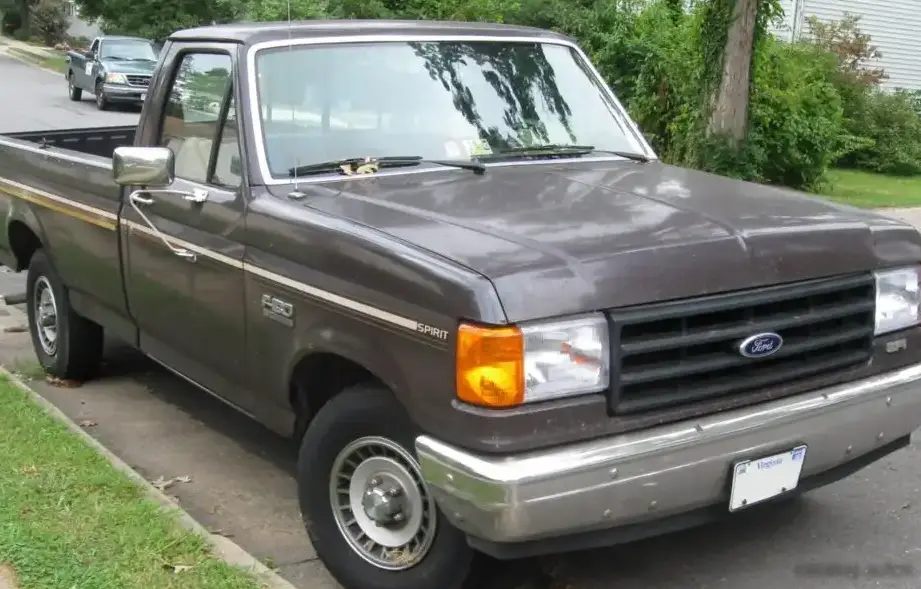
The Ford F-Series F-150 VIII Regular Cab, equipped with the 5.0-liter V8 Windsor engine producing 185 horsepower and a four-wheel-drive (4×4) system, was a mainstay of Ford’s truck lineup from 1986 to 1991. This generation, part of the broader F-Series redesign initiated in 1980, represented a significant step forward in comfort, convenience, and capability for the American pickup truck market. The F-150, positioned between the lighter-duty F-100 and the heavier-duty F-250/F-350, aimed to provide a balance of everyday usability and work-ready toughness. The Regular Cab configuration, with its two doors and three-passenger seating, was the most common body style during this period, catering to both individual owners and commercial users.
Technical Specifications
| Brand | Ford |
| Model | F-Series F-100/F-150 |
| Generation | F-Series F-150 VIII Regular Cab |
| Type (Engine) | 5.0 V8 Windsor (185 Hp) 4×4 |
| Start of production | 1986 |
| End of production | 1991 |
| Powertrain Architecture | Internal Combustion engine |
| Body type | Pick-up |
| Seats | 3 |
| Doors | 2 |
| Fuel Type | Petrol (Gasoline) |
| Power | 185 Hp |
| Power per litre | 37.4 Hp/l |
| Torque | 366 Nm / 269.95 lb.-ft. |
| Engine layout | Front, Longitudinal |
| Engine displacement | 4949 cm3 / 302.01 cu. in. |
| Number of cylinders | 8 |
| Engine configuration | V-engine |
| Fuel injection system | Multi-port manifold injection |
| Engine aspiration | Naturally aspirated engine |
| Max. weight | 2835 kg / 6250.11 lbs. |
| Fuel tank capacity | 62-72 l / 16.38 – 19.02 US gal | 13.64 – 15.84 UK gal |
| Length | 4917-5339 mm / 193.58 – 210.2 in. |
| Height | 1859-1875 mm / 73.19 – 73.82 in. |
| Wheelbase | 2967-3378 mm / 116.81 – 132.99 in. |
| Wading depth | 833-846 mm / 32.8 – 33.31 in. |
| Drivetrain Architecture | The Internal combustion engine (ICE) drives the rear wheels permanently, and the front wheels are driven through an electrically or mechanically operated clutch if necessary. |
| Drive wheel | All wheel drive (4×4) |
| Number of gears and type of gearbox | 4 gears, manual transmission |
| Front suspension | Independent coil spring |
| Rear suspension | Leaf spring |
| Front brakes | Disc |
| Rear brakes | Drum |
| Power steering | Electric Steering |
| Tires size | 235/75 R15 |
| Wheel rims size | 6J x 15 |
Powertrain & Engine Architecture
The heart of this F-150 variant was the 5.0-liter (302 cubic inch) Windsor V8 engine. This engine, a Ford mainstay for decades, was known for its durability and relatively simple design. The 185 horsepower output was achieved through a two-barrel, multi-port fuel injection system, a significant upgrade over the carbureted engines of earlier years. This system improved fuel efficiency and reduced emissions while providing adequate power for most tasks. The engine featured a cast iron block and cylinder heads, contributing to its robust nature. The four-speed manual transmission was a common pairing, offering drivers full control over gear selection. The 4×4 system employed a transfer case allowing the driver to switch between two-wheel drive and four-wheel drive modes, enhancing traction in challenging conditions.
Driving Characteristics
The 185 hp Windsor V8, coupled with the four-speed manual transmission, provided a reasonably responsive driving experience for its time. While not a performance-oriented setup, it delivered sufficient torque for hauling and towing, typical tasks for an F-150 owner. Acceleration was adequate, but the truck’s weight and aerodynamic profile limited top-end speed. The manual transmission allowed for precise control, particularly useful when navigating off-road terrain or towing heavy loads. Compared to the available six-cylinder engine, the V8 offered a noticeable increase in power and refinement. However, it fell short of the performance offered by the optional 351 Windsor V8, which provided significantly more horsepower and torque. The 4×4 system, when engaged, transformed the F-150 into a capable off-road vehicle, able to tackle dirt roads, snow, and moderate trails.
Equipment & Trim Levels
The F-150 Regular Cab in this configuration typically came with a fairly basic level of equipment. Standard features included a vinyl bench seat, a basic AM radio, and manual windows and locks. Options were plentiful, however, and could include air conditioning, a more powerful stereo system, upgraded interior trim, and a sliding rear window. The exterior typically featured black steel wheels and minimal chrome trim. The trim level largely depended on the buyer’s preferences and budget. The “Custom” trim added some interior and exterior enhancements, while the “XLT” trim offered a more luxurious experience with features like cloth upholstery and additional chrome accents.
Chassis & Braking
The F-150 VIII utilized a body-on-frame construction, providing a sturdy and durable platform. The front suspension consisted of independent coil springs, offering a relatively comfortable ride. The rear suspension employed leaf springs, designed to handle heavier loads. The braking system featured disc brakes on the front wheels and drum brakes on the rear. Power steering was standard, making maneuvering the large truck easier. The tires, typically 235/75R15, were chosen for a balance of on-road comfort and off-road traction. The chassis was designed to withstand the rigors of daily use and occasional off-road adventures.
Market Reception & Comparison
The 1986-1991 Ford F-150 was a popular choice among truck buyers, consistently ranking among the best-selling vehicles in the United States. Critics praised its improved comfort, durability, and overall capability compared to previous generations. The 5.0-liter V8 engine was generally well-regarded for its reliability and adequate power. However, some reviewers noted that the 185 hp output was somewhat underwhelming compared to the larger V8 options. Fuel economy was typical for a full-size pickup truck of the era, averaging around 14-16 mpg in mixed driving. Compared to the Chevrolet Silverado and Dodge Ram of the same period, the F-150 offered a competitive combination of features, performance, and value.
Legacy
The 5.0-liter Windsor V8 engine, in this F-150 application, has proven to be remarkably durable over the long term. Many examples are still on the road today, a testament to its robust construction. While maintenance is relatively straightforward, common issues include oil leaks and wear on the timing chain. The 4×4 system, if properly maintained, remains reliable. In the used car market, these F-150s are often sought after by enthusiasts and those looking for a classic American pickup truck. Their affordability, simplicity, and readily available parts make them attractive options for restoration projects or as daily drivers. The 1986-1991 F-150 represents a pivotal era in Ford truck history, bridging the gap between the older, more utilitarian pickups and the more refined and technologically advanced trucks of the modern era.