Technical Specifications
| Brand | Fiat |
| Model | Multipla |
| Generation | Multipla (186) |
| Type (Engine) | 1.6 16V Bipower (103 Hp) |
| Start of production | October, 2000 |
| End of production | September, 2004 |
| Powertrain Architecture | Internal Combustion engine |
| Body type | MPV |
| Seats | 6 |
| Doors | 4 |
| Fuel consumption (economy) – urban | 11.6 l/100 km (20.3 US mpg, 24.4 UK mpg, 8.6 km/l) |
| Fuel consumption (economy) – urban (CNG) | 11.1 kg/100 km |
| Fuel consumption (economy) – extra urban | 7.3 l/100 km (32.2 US mpg, 38.7 UK mpg, 13.7 km/l) |
| Fuel consumption (economy) – extra urban (CNG) | 7.2 kg/100 km |
| Fuel consumption (economy) – combined | 8.9 l/100 km (26.4 US mpg, 31.7 UK mpg, 11.2 km/l) |
| Fuel consumption (economy) – combined (CNG) | 8.6 kg/100 km |
| Fuel Type | Petrol / CNG |
| Acceleration 0 – 100 km/h | 13.5 sec |
| Acceleration 0 – 62 mph | 13.5 sec |
| Acceleration 0 – 60 mph | 12.8 sec |
| Maximum speed | 168 km/h (104.39 mph) |
| Weight-to-power ratio | 13.3 kg/Hp, 74.9 Hp/tonne |
| Weight-to-torque ratio | 9.5 kg/Nm, 105.5 Nm/tonne |
| Power | 103 Hp @ 5750 rpm |
| Power per litre | 64.5 Hp/l |
| Torque | 145 Nm @ 4000 rpm (106.95 lb.-ft. @ 4000 rpm) |
| Engine layout | Front, Transverse |
| Engine Model/Code | 182A4000 |
| Engine displacement | 1596 cm3 (97.39 cu. in.) |
| Number of cylinders | 4 |
| Engine configuration | Inline |
| Cylinder Bore | 80.5 mm (3.17 in.) |
| Piston Stroke | 78.4 mm (3.09 in.) |
| Compression ratio | 10.5:1 |
| Number of valves per cylinder | 4 |
| Fuel injection system | Multi-port manifold injection |
| Engine aspiration | Naturally aspirated engine |
| Valvetrain | DOHC |
| Engine oil capacity | 3.8 l (4.02 US qt | 3.34 UK qt) |
| Coolant | 7 l (7.4 US qt | 6.16 UK qt) |
| Kerb Weight | 1375 kg (3031.36 lbs.) |
| Max. weight | 1870 kg (4122.64 lbs.) |
| Max load | 495 kg (1091.29 lbs.) |
| Trunk (boot) space – minimum | 430 l (15.19 cu. ft.) |
| Trunk (boot) space – maximum | 1850 l (65.33 cu. ft.) |
| Fuel tank capacity | 38 l (10.04 US gal | 8.36 UK gal) |
| CNG cylinder capacity | 170 kg |
| Max. roof load | 70 kg (154.32 lbs.) |
| Permitted trailer load with brakes (12%) | 1000 kg (2204.62 lbs.) |
| Permitted trailer load without brakes | 400 kg (881.85 lbs.) |
| Length | 3994 mm (157.24 in.) |
| Width | 1871 mm (73.66 in.) |
| Height | 1695 mm (66.73 in.) |
| Wheelbase | 2660 mm (104.72 in.) |
| Front track | 1515 mm (59.65 in.) |
| Rear (Back) track | 1520 mm (59.84 in.) |
| Minimum turning circle | 11 m (36.09 ft.) |
| Drivetrain Architecture | The Internal combustion engine (ICE) drives the front wheels of the vehicle. |
| Drive wheel | Front wheel drive |
| Number of gears and type of gearbox | 5 gears, manual transmission |
| Front suspension | Independent, type McPherson with coil spring and anti-roll bar |
| Rear suspension | Independent coil spring, Transverse stabilizer |
| Front brakes | Ventilated discs, 284 mm |
| Rear brakes | Drum, 228 mm |
| Assisting systems | ABS (Anti-lock braking system) |
| Steering type | Steering rack and pinion |
| Power steering | Hydraulic Steering |
| Tires size | 185/65 R15 |
| Wheel rims size | 6J x 15 |
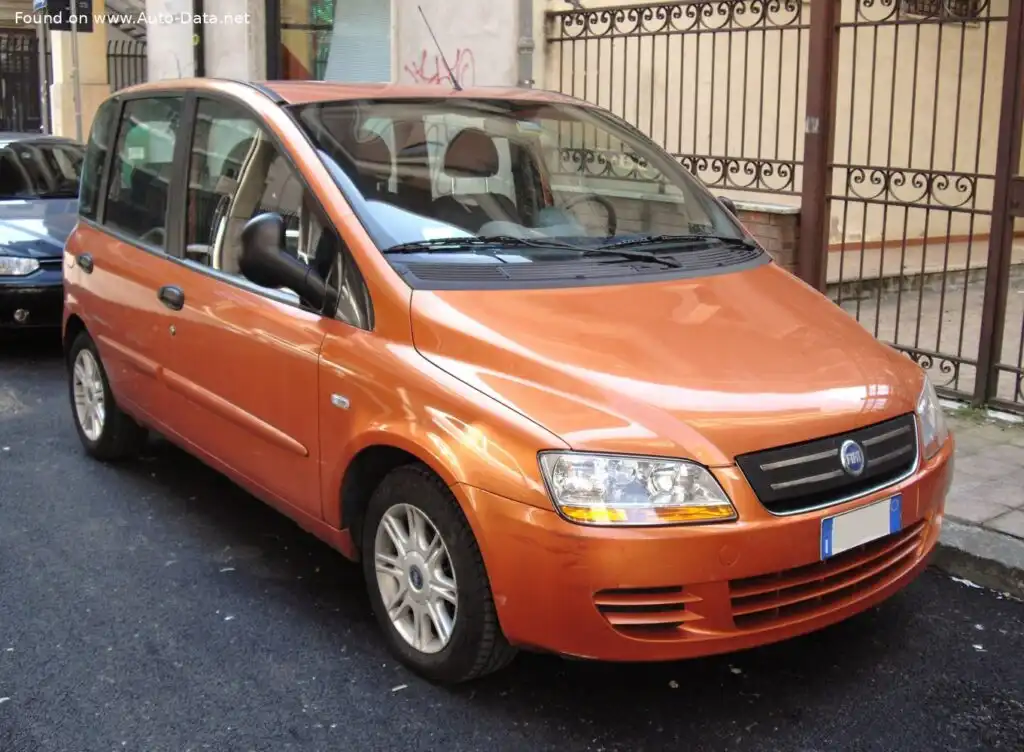
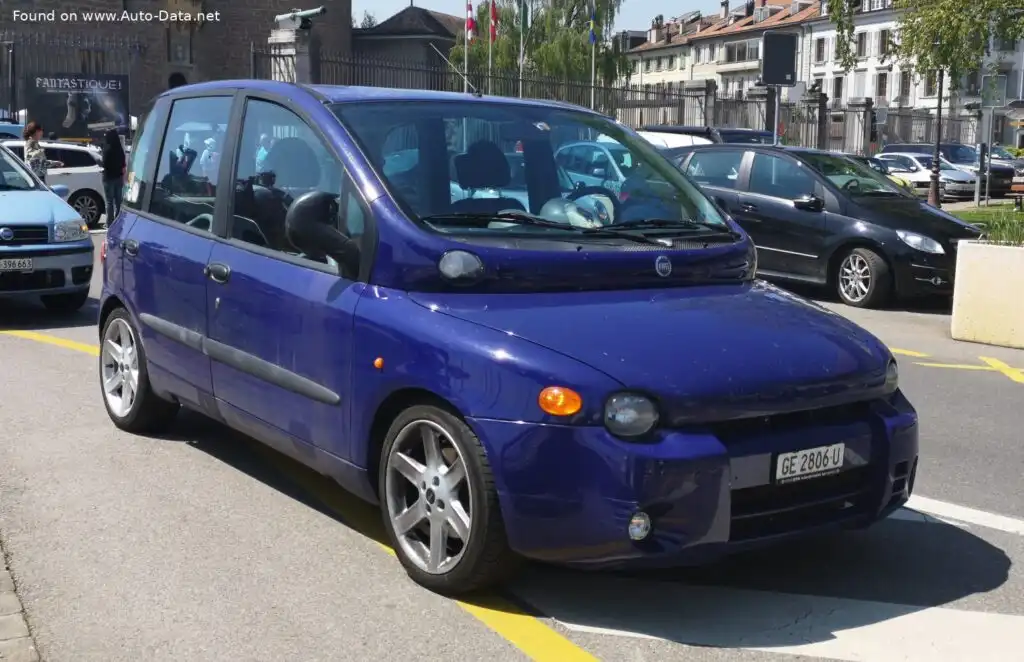
The Fiat Multipla 1.6 16V Bipower, produced from October 2000 to September 2004, represents a distinctive offering within the second generation of the Multipla line (186). This variant, characterized by its combined petrol and Compressed Natural Gas (CNG) capability – the “Bipower” designation – aimed to provide an economical and environmentally conscious option for families. Positioned as a mid-range trim, it offered a balance between affordability and functionality within the Multipla’s diverse lineup, which also included petrol-only versions and, in some markets, diesel options. The Multipla itself was a radical departure from conventional MPV design, prioritizing interior space and modularity over traditional aesthetics. It was primarily sold in Europe, where demand for compact, multi-passenger vehicles was strong.
Powertrain & Engine Architecture
The heart of the Multipla 1.6 16V Bipower is the 182A4000 engine, a 1.6-liter inline-four cylinder powerplant. This engine features a double overhead camshaft (DOHC) valvetrain operating four valves per cylinder, contributing to its relatively high output for its displacement. Fuel delivery is managed by a multi-port fuel injection system. The “Bipower” aspect comes from the addition of a CNG conversion, allowing the engine to run on either petrol or compressed natural gas, or a combination of both. When running on CNG, power output remains similar, but emissions are significantly reduced. The engine is transversely mounted at the front of the vehicle. The transmission is a five-speed manual gearbox, chosen for its simplicity and efficiency. While an automatic transmission was available on other Multipla variants, it was not offered with the 1.6 16V Bipower.
Driving Characteristics
The 1.6 16V Bipower Multipla offered a modest, but adequate, level of performance. With 103 horsepower and 145 Nm (107 lb-ft) of torque, acceleration from 0 to 60 mph took around 12.8 seconds, and top speed was approximately 104 mph. Compared to the more powerful 1.9 JTD diesel or the 2.0 16V petrol versions, the Bipower felt noticeably slower, particularly when fully loaded. However, the five-speed manual transmission allowed drivers to keep the engine in its optimal power band. The gear ratios were tuned for fuel efficiency and drivability rather than outright performance. Switching to CNG didn’t dramatically alter the driving experience, although a slight reduction in power was sometimes perceptible. The primary benefit of CNG was the lower running costs and reduced environmental impact.
Equipment & Trim Levels
The 1.6 16V Bipower trim typically included features such as power steering, ABS brakes, central locking, and electric front windows. Interior upholstery was generally cloth, with a functional, if somewhat utilitarian, dashboard layout. Optional extras included air conditioning, alloy wheels, and a radio/CD player. The Multipla’s defining feature was its incredibly flexible interior, with individual, adjustable seats that could be folded, removed, or even rotated to create various seating configurations. This made it exceptionally versatile for families or those needing to transport bulky items.
Chassis & Braking
The Multipla 1.6 16V Bipower utilized an independent suspension setup at all four wheels. The front suspension employed McPherson struts with a coil spring and anti-roll bar, while the rear featured an independent coil spring arrangement with a transverse stabilizer. This setup provided a reasonably comfortable ride, although the Multipla’s high center of gravity and relatively soft suspension meant it wasn’t particularly sporty to drive. Brakes were ventilated discs at the front and drum brakes at the rear. The ABS system provided enhanced braking control, particularly on slippery surfaces.
Market Reception & Comparison
The Multipla 1.6 16V Bipower was generally well-received as a practical and economical family vehicle, particularly in countries with established CNG infrastructure. Critics praised its spacious interior, versatility, and low running costs when running on CNG. However, its unconventional styling was often a point of contention. Compared to the diesel versions, the Bipower offered lower fuel economy but a smoother, quieter engine. Against the petrol-only 2.0 16V, it was less powerful but more affordable to purchase and operate, especially with the CNG option.
Legacy
The Fiat Multipla 1.6 16V Bipower, while not a high-performance vehicle, has gained a cult following among those who appreciate its practicality and unique character. The 182A4000 engine, when properly maintained, proved to be relatively reliable. The CNG conversion, however, requires periodic inspection and maintenance to ensure safe and efficient operation. Today, finding a well-maintained example can be challenging, but they represent an interesting and affordable option for those seeking a spacious and versatile MPV with a touch of individuality. The Bipower variant stands as a testament to Fiat’s willingness to experiment with alternative fuels and innovative vehicle designs.