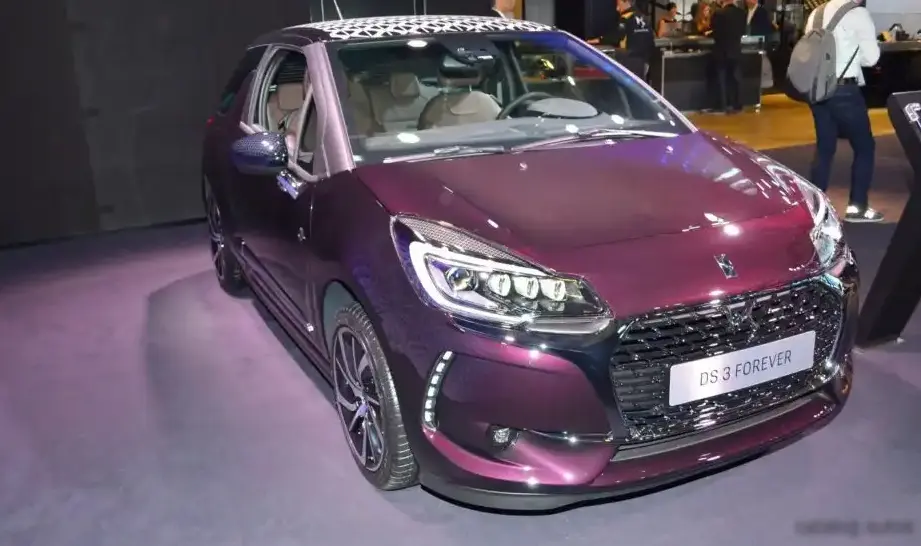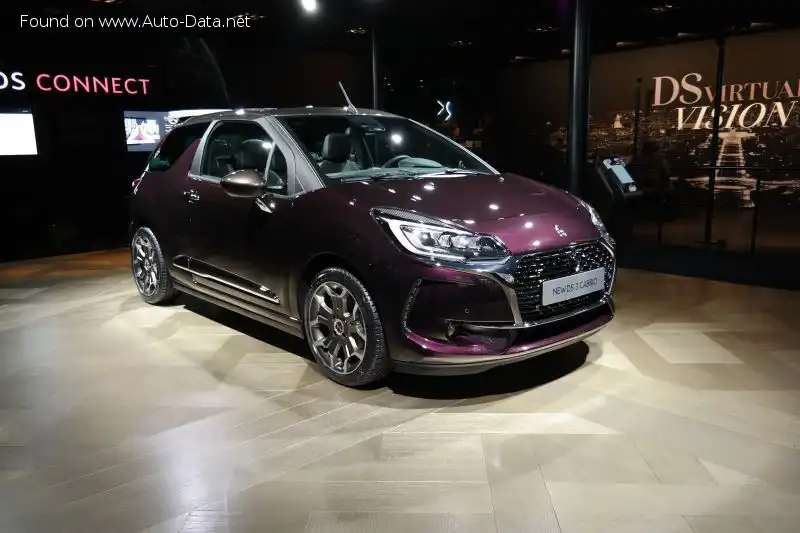
The DS 3 Cabrio 1.6 BlueHDi (120 hp) Stop&Start was a front-wheel-drive, four-seater convertible produced by the French automaker DS Automobiles between 2016 and 2018. Positioned as a stylish and fuel-efficient option within the DS 3 Cabrio range, it offered a blend of open-top motoring with the benefits of a modern diesel engine. This variant occupied a mid-range position in the DS 3 Cabrio lineup, offering a balance between performance and economy, appealing to buyers seeking a practical yet fashionable vehicle. It was based on the Citroën DS3 platform, itself a derivative of the Peugeot 207 and Citroën C3, known internally as the T9 platform.
Technical Specifications
| Brand | DS |
| Model | 3 |
| Generation | 3 Cabrio |
| Type (Engine) | 1.6 BlueHDi (120 Hp) Stop&Start |
| Start of production | 2016 |
| End of production | 2018 |
| Powertrain Architecture | Internal Combustion engine |
| Body type | Cabriolet |
| Seats | 4 |
| Doors | 3 |
| Fuel consumption (urban) | 4.4 l/100 km (53.5 US mpg, 64.2 UK mpg, 22.7 km/l) |
| Fuel consumption (extra urban) | 3.2 l/100 km (73.5 US mpg, 88.3 UK mpg, 31.3 km/l) |
| Fuel consumption (combined) | 3.6 l/100 km (65.3 US mpg, 78.5 UK mpg, 27.8 km/l) |
| CO2 emissions | 94 g/km |
| Fuel Type | Diesel |
| Acceleration 0 – 100 km/h | 9.4 sec |
| Acceleration 0 – 62 mph | 9.4 sec |
| Acceleration 0 – 60 mph | 8.9 sec |
| Maximum speed | 190 km/h (118.06 mph) |
| Emission standard | Euro 6 |
| Weight-to-power ratio | 10 kg/Hp, 100 Hp/tonne |
| Weight-to-torque ratio | 4.7 kg/Nm, 211.7 Nm/tonne |
| Power | 120 Hp @ 3500 rpm |
| Power per litre | 76.9 Hp/l |
| Torque | 254 Nm @ 1750 rpm (187.34 lb.-ft. @ 1750 rpm) |
| Engine layout | Front, Transverse |
| Engine Model/Code | BHZ DV6FC |
| Engine displacement | 1560 cm3 (95.2 cu. in.) |
| Number of cylinders | 4 |
| Engine configuration | Inline |
| Cylinder Bore | 75 mm (2.95 in.) |
| Piston Stroke | 88.3 mm (3.48 in.) |
| Fuel injection system | Diesel Commonrail |
| Engine aspiration | Turbocharger, Intercooler |
| Engine oil capacity | 3.8 l (4.02 US qt | 3.34 UK qt) |
| Kerb Weight | 1200-1217 kg (2645.55 – 2683.03 lbs.) |
| Max. weight | 1665 kg (3670.7 lbs.) |
| Max load | 448-465 kg (987.67 – 1025.15 lbs.) |
| Trunk (boot) space – minimum | 245 l (8.65 cu. ft.) |
| Fuel tank capacity | 46 l (12.15 US gal | 10.12 UK gal) |
| AdBlue tank | 17 l (4.49 US gal | 3.74 UK gal) |
| Permitted trailer load with brakes (12%) | 775 kg (1708.58 lbs.) |
| Permitted trailer load without brakes | 450 kg (992.08 lbs.) |
| Permitted towbar download | 46 kg (101.41 lbs.) |
| Length | 3954 mm (155.67 in.) |
| Width with mirrors folded | 1715 mm (67.52 in.) |
| Width including mirrors | 2004 mm (78.9 in.) |
| Height | 1458-1483 mm (57.4 – 58.39 in.) |
| Wheelbase | 2464 mm (97.01 in.) |
| Front track | 1465-1468 mm (57.68 – 57.8 in.) |
| Rear (Back) track | 1467-1471 mm (57.76 – 57.91 in.) |
| Front overhang | 830 mm (32.68 in.) |
| Rear overhang | 660 mm (25.98 in.) |
| Minimum turning circle (turning diameter) | 10.4 m (34.12 ft.) |
| Drivetrain Architecture | The Internal combustion engine (ICE) drives the front wheels of the vehicle. |
| Drive wheel | Front wheel drive |
| Number of gears and type of gearbox | 6 gears, manual transmission |
| Front suspension | Independent type McPherson |
| Rear suspension | Semi-independent, coil spring |
| Front brakes | Ventilated discs |
| Rear brakes | Disc |
| Assisting systems | ABS (Anti-lock braking system) |
| Steering type | Steering rack and pinion |
| Power steering | Electric Steering |
| Tires size | 205/45 R17 |
| Wheel rims size | 17 |
Powertrain & Engine Architecture
The DS 3 Cabrio 1.6 BlueHDi (120 hp) Stop&Start was powered by the PSA Group’s DV6FC engine, specifically the BHZ variant. This 1.6-liter, four-cylinder diesel engine utilized a common-rail direct injection system, delivering fuel at extremely high pressure for optimized combustion. The engine featured a turbocharger with an intercooler to enhance power output and efficiency. The Stop&Start system automatically shut off the engine when the vehicle came to a halt, reducing fuel consumption and emissions. The engine produced 120 horsepower at 3500 rpm and 254 Nm (187 lb-ft) of torque at 1750 rpm. This engine was known for its relatively quiet operation and good low-end torque. The engine was transversely mounted in the front of the vehicle. The transmission was a six-speed manual gearbox, chosen for its efficiency and driver engagement.
Driving Characteristics
The 1.6 BlueHDi engine, paired with the six-speed manual transmission, provided a respectable driving experience for the DS 3 Cabrio. While not a performance-oriented variant, the engine delivered sufficient power for everyday driving and highway cruising. Acceleration from 0 to 62 mph (0-100 km/h) took approximately 9.4 seconds. The engine’s strong low-end torque made it easy to navigate city streets and overtake slower vehicles. The manual gearbox allowed for precise control over gear selection, enhancing the driving experience. Compared to the more powerful petrol variants, the BlueHDi offered superior fuel economy, but lacked the same level of outright acceleration. The Cabriolet body style added a slight weight penalty compared to the standard hatchback, but the impact on performance was minimal.
Equipment & Trim Levels
The DS 3 Cabrio 1.6 BlueHDi (120 hp) Stop&Start typically came equipped with a range of standard features, including air conditioning, a touchscreen infotainment system with Bluetooth connectivity, alloy wheels, and electric front windows. Safety features included ABS, ESP (Electronic Stability Program), and multiple airbags. Interior upholstery was typically cloth, with options for leather upgrades. Optional extras included a panoramic sunroof, automatic climate control, and a premium sound system. The trim level often included unique styling elements, such as chrome accents and distinctive badging. The overall interior design aimed for a premium feel, with attention to detail and quality materials.
Chassis & Braking
The DS 3 Cabrio utilized a McPherson strut front suspension and a semi-independent coil spring rear suspension. This setup provided a good balance between ride comfort and handling. The front brakes were ventilated discs, while the rear brakes were solid discs. ABS (Anti-lock Braking System) was standard, enhancing braking performance and safety. The steering was electric power-assisted, providing light and precise steering feel. The Cabriolet version featured reinforced chassis components to compensate for the lack of a fixed roof, ensuring structural rigidity and safety.
Market Reception & Comparison
The DS 3 Cabrio 1.6 BlueHDi (120 hp) Stop&Start was generally well-received by automotive critics for its fuel efficiency, stylish design, and comfortable ride. It was often praised as a practical and economical choice for buyers seeking a fashionable convertible. Compared to the petrol-powered DS 3 Cabrio variants, the BlueHDi offered significantly better fuel economy, making it an attractive option for those who prioritized running costs. However, some critics noted that the diesel engine lacked the refinement and responsiveness of the petrol engines. In terms of reliability, the DV6 engine family had a generally good reputation, although some owners reported issues with the diesel particulate filter (DPF) system, particularly on vehicles used primarily for short journeys.
Legacy
The DS 3 Cabrio 1.6 BlueHDi (120 hp) Stop&Start remains a relatively common sight on the used car market. The DV6 engine, while not without its potential issues, is generally considered to be durable and reliable when properly maintained. The availability of spare parts is good, and maintenance costs are reasonable. The DS 3 Cabrio’s distinctive styling and open-top motoring experience continue to appeal to buyers seeking a stylish and affordable convertible. The model helped establish DS Automobiles as a distinct brand, separate from Citroën, and contributed to the growing popularity of small, fuel-efficient convertibles.