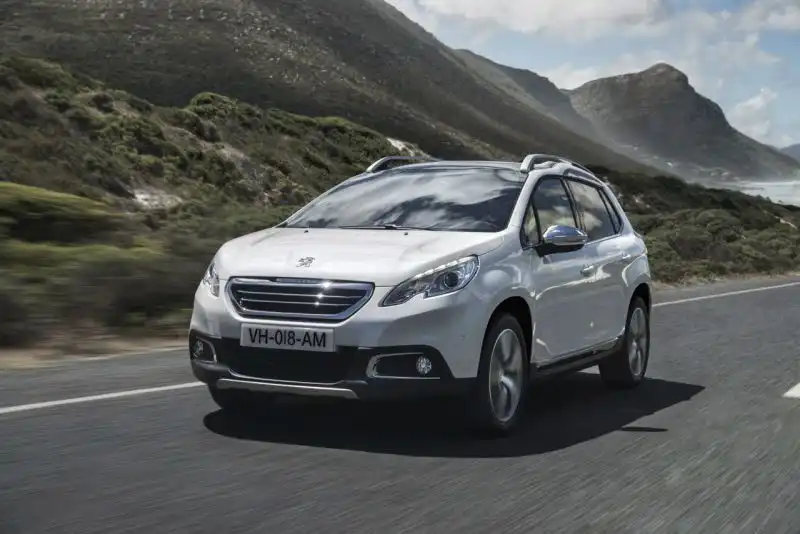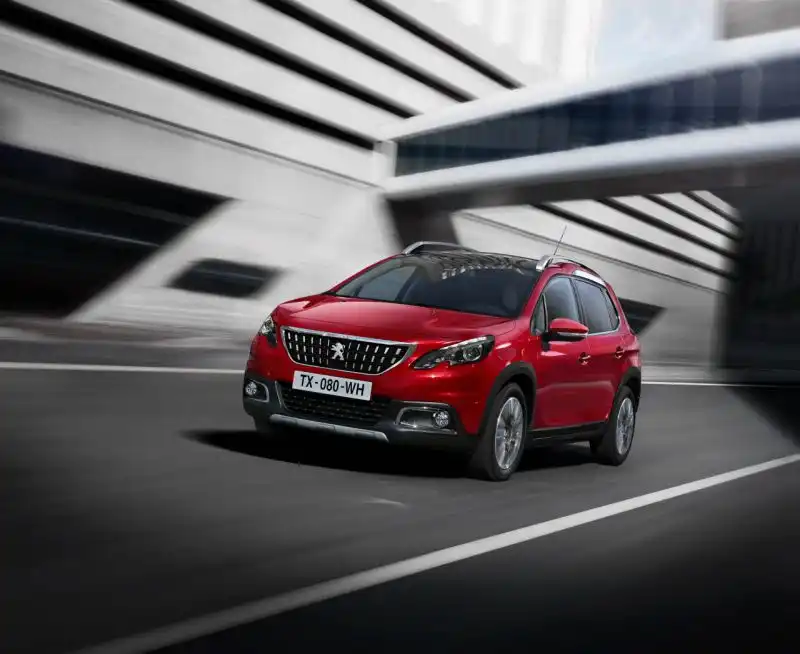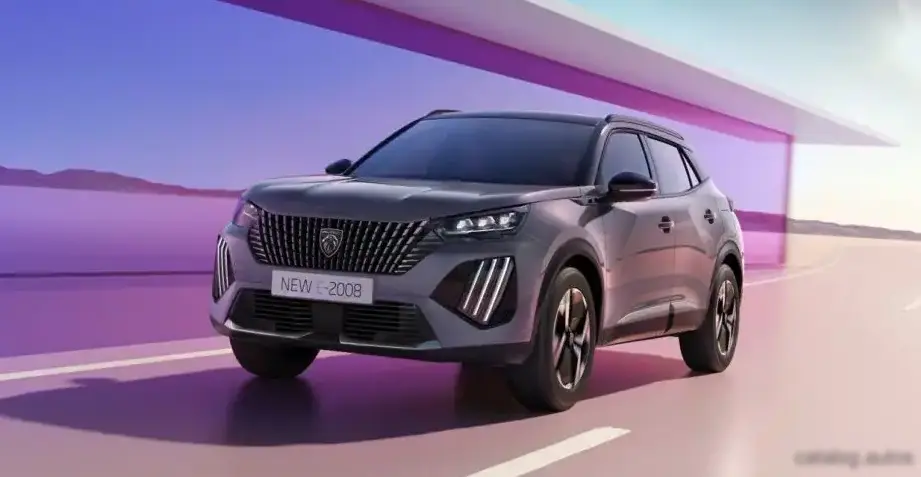
The Peugeot 2008 II (facelift 2023) 1.2 (145 hp) Mild Hybrid e-DCS represents a significant evolution of Peugeot’s popular subcompact SUV. Introduced in March 2025, this variant builds upon the second-generation 2008 (launched in 2020), incorporating mild-hybrid technology to enhance fuel efficiency and reduce emissions. Positioned as a mid-range offering within the 2008 lineup, it slots between the standard petrol models and the fully electric e-2008. The facelift brought styling updates, improved interior technology, and refinements to the powertrain, solidifying the 2008’s position in the highly competitive European and increasingly global small SUV market.
| Brand | Peugeot |
| Model | 2008 |
| Generation | 2008 II (facelift 2023) |
| Type (Engine) | 1.2 (145 Hp) Mild Hybrid e-DCS |
| Start of production | March, 2025 |
| Powertrain Architecture | MHEV (Mild Hybrid Electric Vehicle) |
| Body type | SUV |
| Seats | 5 |
| Doors | 5 |
| Combined fuel consumption (WLTP) | 4.9-5.0 l/100 km (48-47 US mpg, 57.6-56.5 UK mpg, 20.4-20 km/l) |
| CO2 emissions (WLTP) | 110-113 g/km |
| Fuel Type | Petrol (Gasoline) |
| Acceleration 0 – 100 km/h | 8.3 sec |
| Acceleration 0 – 62 mph | 8.3 sec |
| Acceleration 0 – 60 mph | 7.9 sec |
| Maximum speed | 206 km/h (128 mph) |
| Emission standard | Euro 6e |
| Weight-to-power ratio | 8.9 kg/Hp, 111.8 Hp/tonne |
| Weight-to-torque ratio | 5.6 kg/Nm, 177.3 Nm/tonne |
| Gross battery capacity | 0.432 kWh |
| Battery voltage | 48 V |
| Battery technology | Lithium-ion (Li-Ion) |
| Battery weight | 13 kg (28.66 lbs) |
| Battery location | Below the floor, under the front seats |
| Electric motor power | 29 Hp @ 4264 rpm (55 Nm @ 750-2499 rpm / 40.57 lb.-ft. @ 750-2499 rpm) |
| System power | 145 Hp |
| Engine Power | 136 Hp @ 5500 rpm |
| Torque | 230 Nm @ 1750 rpm (169.64 lb.-ft. @ 1750 rpm) |
| Engine layout | Front, Transverse |
| Engine Model/Code | EB2LTD |
| Engine displacement | 1199 cm3 (73.17 cu. in.) |
| Number of cylinders | 3 |
| Engine configuration | Inline |
| Number of valves per cylinder | 4 |
| Fuel injection system | Direct injection |
| Engine aspiration | Turbocharger, Intercooler |
| Engine oil capacity | 3.5 l (3.7 US qt | 3.08 UK qt) |
| Kerb Weight | 1297 kg (2859.4 lbs) |
| Max. weight | 1790 kg (3946.27 lbs) |
| Max load | 493 kg (1086.88 lbs) |
| Trunk (boot) space – minimum | 434 l (15.33 cu. ft.) |
| Trunk (boot) space – maximum | 1467 l (51.81 cu. ft.) |
| Fuel tank capacity | 44 l (11.62 US gal | 9.68 UK gal) |
| Permitted trailer load with brakes (12%) | 1100 kg (2425.08 lbs) |
| Length | 4304 mm (169.45 in) |
| Width | 1770 mm (69.69 in) |
| Width with mirrors folded | 1815 mm (71.46 in) |
| Width including mirrors | 1987 mm (78.23 in) |
| Height | 1550 mm (61.02 in) |
| Wheelbase | 2605 mm (102.56 in) |
| Front track | 1540 mm (60.63 in) |
| Rear (Back) track | 1540 mm (60.63 in) |
| Front overhang | 874 mm (34.41 in) |
| Rear overhang | 825 mm (32.48 in) |
| Minimum turning circle | 11.2 m (36.75 ft) |
| Drivetrain Architecture | Front wheel drive. MHEV. ICE and electric motor drive the front wheels. |
| Drive wheel | Front wheel drive |
| Number of gears | 6 |
| Gearbox type | Automatic transmission e-DCS |
| Front suspension | Independent type McPherson |
| Rear suspension | Elastic beam |
| Front brakes | Disc, 302×26 mm |
| Rear brakes | Disc, 249×10 mm |
| Assisting systems | ABS (Anti-lock braking system) |
| Steering type | Steering rack and pinion |
| Power steering | Electric Steering |
| Tires size | 215/65 R16 98H; 215/60 R17 96H; 215/70 R17 100H; 215/55 R18 99V |
| Wheel rims size | 16; 17; 18 |
Powertrain & Engine Architecture
At the heart of the 2008 II 1.2 Mild Hybrid e-DCS lies the Peugeot-Citroën (PCA) group’s EB2LTD engine. This is a 1.2-liter, three-cylinder turbocharged petrol engine producing 136 horsepower at 5500 rpm and 230 Nm (169.64 lb-ft) of torque at 1750 rpm. The ‘Mild Hybrid’ designation indicates the inclusion of a 48-volt electrical system and a small electric motor (29 hp and 55 Nm / 40.57 lb-ft) integrated with the six-speed e-DCS (Dual Clutch System) automatic transmission. This system allows for regenerative braking, electric assist during acceleration, and extended engine-off coasting, contributing to improved fuel economy. The engine utilizes direct fuel injection and a turbocharger with an intercooler to optimize performance and efficiency. The e-DCS transmission is a key component, offering smooth and relatively quick gear changes, and is specifically tuned to work in conjunction with the mild-hybrid system.
Driving Characteristics
The 1.2-liter Mild Hybrid e-DCS powertrain delivers a balanced driving experience. While not offering the outright performance of higher-powered variants, the 145 hp combined output provides adequate acceleration for everyday driving, achieving 0-60 mph in approximately 7.9 seconds. The electric motor’s assistance is most noticeable during initial acceleration, providing a boost that helps overcome the slight turbo lag inherent in smaller displacement engines. The e-DCS transmission generally shifts smoothly, although some drivers may find it less responsive than a traditional manual gearbox. The mild-hybrid system’s engine-off coasting feature is effective in reducing fuel consumption, particularly in urban environments. Compared to the standard 1.2 PureTech petrol version, the mild-hybrid offers improved fuel economy and a slightly more refined driving experience. It falls short of the performance of the more powerful petrol engines, but provides a compelling balance of efficiency and usability.
Equipment & Trim Levels
The 1.2 (145 hp) Mild Hybrid e-DCS trim typically comes well-equipped as a mid-range offering. Standard features generally include air conditioning, a touchscreen infotainment system with Apple CarPlay and Android Auto compatibility, rear parking sensors, cruise control, and a suite of safety features such as automatic emergency braking and lane departure warning. Interior upholstery is typically cloth, with options for upgraded materials. Higher trim levels add features like a larger touchscreen, panoramic sunroof, keyless entry, and advanced driver-assistance systems. The specific equipment levels can vary depending on the market and optional packages selected.
Chassis & Braking
The 2008 II utilizes a McPherson strut front suspension and an elastic beam rear suspension. This setup provides a comfortable ride quality, well-suited for everyday driving. The chassis is tuned to prioritize comfort over outright sportiness. Braking duties are handled by disc brakes on all four wheels, with the front discs measuring 302x26mm and the rear discs at 249x10mm. The vehicle is equipped with ABS (Anti-lock Braking System) and electronic stability control as standard safety features. Steering is provided by an electric power steering system, offering light and precise control.
Market Reception & Comparison
The Peugeot 2008 II 1.2 Mild Hybrid e-DCS has been generally well-received by automotive critics. It’s praised for its fuel efficiency, comfortable ride, and stylish design. The mild-hybrid system is seen as a positive step towards reducing emissions without the higher cost and range anxiety associated with fully electric vehicles. Compared to other trims in the 2008 lineup, the mild-hybrid offers a compelling balance of performance and economy. It’s more fuel-efficient than the standard petrol models, but less expensive than the fully electric e-2008. Competitors in the subcompact SUV segment, such as the Renault Captur and Volkswagen T-Cross, offer similar powertrain options and features.
Legacy
The EB2LTD engine, in its various iterations, has proven to be a reliable and durable powertrain. The addition of mild-hybrid technology in the 2008 II 1.2 e-DCS variant further enhances its efficiency and longevity. While long-term reliability data is still emerging for this specific configuration, the underlying engine architecture has a solid track record. On the used car market, the 2008 II 1.2 Mild Hybrid e-DCS is expected to hold its value well due to its fuel efficiency and modern features. The e-DCS transmission, while generally reliable, may require more specialized maintenance than a traditional automatic gearbox, so prospective buyers should be aware of this potential cost.