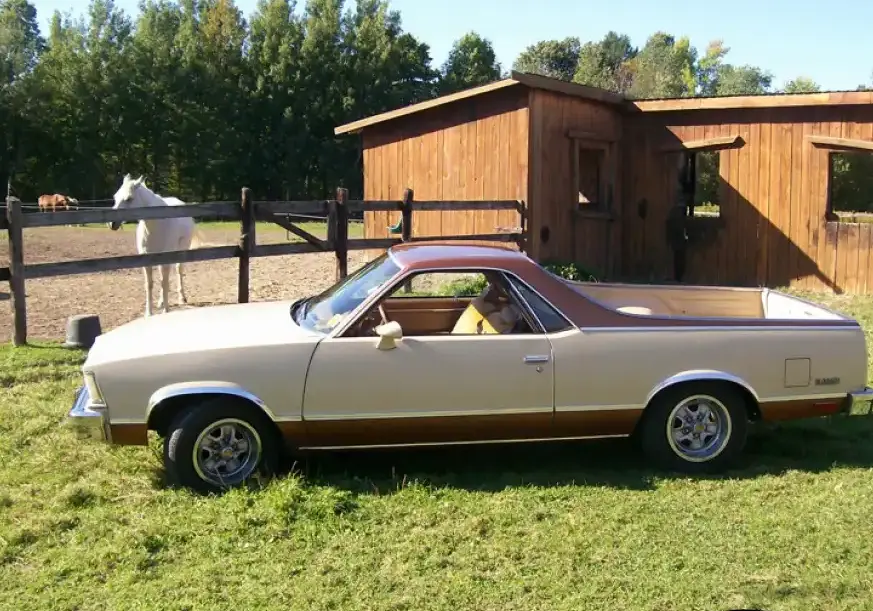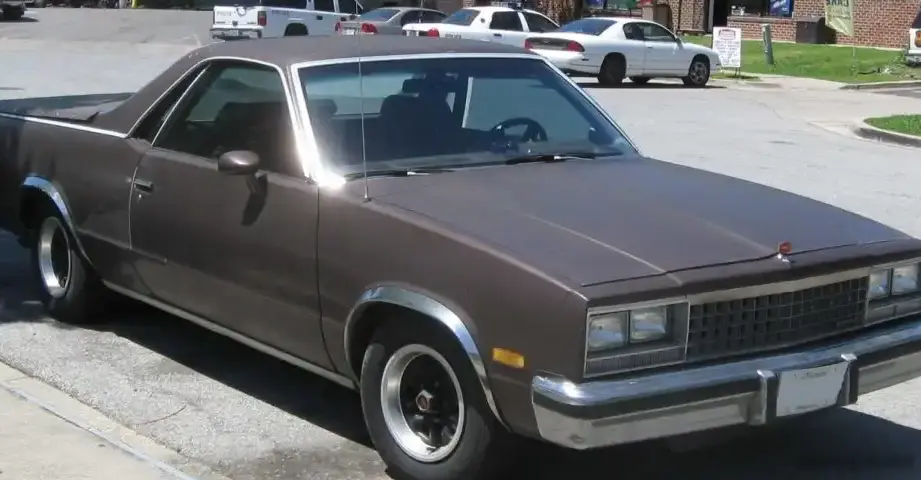
The Chevrolet Malibu El Camino, specifically the 1981-1983 facelifted model featuring the 3.8L V6 engine paired with a three-speed automatic transmission, represents a unique chapter in Chevrolet’s history. This variant blended the practicality of a pickup truck with the styling of a mid-size sedan, appealing to buyers seeking a versatile vehicle. Positioned as a mid-range offering within the El Camino lineup, it slotted below the more powerful V8 options and above any potential four-cylinder base models. Production spanned from 1981 to 1983, marking the end of the El Camino nameplate for several decades.
Technical Specifications
| Brand | Chevrolet |
| Model | Malibu |
| Generation | Malibu El Camino (Sedan Pickup, facelift 1981) |
| Type (Engine) | 3.8 V6 (110 Hp) CAT Automatic |
| Start of production | 1981 |
| End of production | 1983 |
| Powertrain Architecture | Internal Combustion engine |
| Body type | Pick-up |
| Seats | 3 |
| Doors | 2 |
| Fuel Type | Petrol (Gasoline) |
| Weight-to-power ratio | 13.4 kg/Hp, 74.7 Hp/tonne |
| Weight-to-torque ratio | 6.4 kg/Nm, 156.3 Nm/tonne |
| Power | 110 Hp @ 4200 rpm |
| Power per litre | 29.3 Hp/l |
| Torque | 230 Nm @ 2000 rpm (169.64 lb.-ft. @ 2000 rpm) |
| Engine layout | Front, Longitudinal |
| Engine Model/Code | LC3 |
| Engine displacement | 3752 cm3 (228.96 cu. in.) |
| Number of cylinders | 6 |
| Engine configuration | V-engine |
| Cylinder Bore | 95 mm (3.74 in.) |
| Piston Stroke | 88.4 mm (3.48 in.) |
| Compression ratio | 8.6:1 |
| Number of valves per cylinder | 2 |
| Fuel injection system | Carburettor |
| Engine aspiration | Naturally aspirated engine |
| Valvetrain | OHV |
| Engine oil capacity | 3.8 l (4.02 US qt | 3.34 UK qt) |
| Coolant | 14.4 l (15.22 US qt | 12.67 UK qt) |
| Kerb Weight | 1472 kg (3245.2 lbs) |
| Fuel tank capacity | 67 l (17.7 US gal | 14.74 UK gal) |
| Length | 5121 mm (201.61 in) |
| Width | 1776 mm (69.92 in) |
| Height | 1408 mm (55.43 in) |
| Wheelbase | 2974 mm (117.09 in) |
| Front track | 1486 mm (58.5 in) |
| Rear (Back) track | 1467 mm (57.76 in) |
| Front overhang | 915 mm (36.02 in) |
| Rear overhang | 1232 mm (48.5 in) |
| Ride height (ground clearance) | 160 mm (6.3 in) |
| Minimum turning circle (turning diameter) | 13.0 m (42.65 ft) |
| Approach angle | 23.5° |
| Departure angle | 17.5° |
| Ramp-over (brakeover) angle | 14.5° |
| Drivetrain Architecture | The Internal combustion engine (ICE) drives the rear wheels of the vehicle. |
| Drive wheel | Rear wheel drive |
| Number of gears and type of gearbox | 3 gears, automatic transmission |
| Front suspension | Independent, type McPherson with coil spring and anti-roll bar |
| Rear suspension | dependent spring suspension, Transverse stabilizer, Trailing arm |
| Front brakes | Ventilated discs |
| Rear brakes | Drum |
| Steering type | Steering rack and pinion |
| Tires size | 205/75 R14 |
| Wheel rims size | 6.0J x 14 |
INTRODUCTION
The 1981-1983 Chevrolet Malibu El Camino, powered by the 3.8L V6 and equipped with a three-speed automatic transmission, was a product of a changing automotive landscape. Following the discontinuation of the traditional Chevelle-based El Camino in 1977, Chevrolet reintroduced the nameplate in 1981 as part of the second generation, based on the A-body platform shared with the Malibu sedan and Monte Carlo coupe. This iteration aimed to capture a segment of the market desiring a car-based pickup with a more comfortable ride than traditional truck offerings. The facelift in 1981 brought updated styling cues, including a revised front fascia and interior refinements. This particular 3.8L automatic configuration was designed to offer a balance between fuel efficiency and adequate performance for everyday use.
Powertrain & Engine Architecture
The heart of this El Camino variant was the Chevrolet 3.8L (231 cubic inch) V6 engine, designated the LC3. This engine was a descendant of the earlier 3.8L designs, but featured a catalytic converter (hence the “CAT” designation) to meet increasingly stringent emissions regulations. The LC3 utilized a two-barrel carburetor for fuel delivery, a relatively simple system compared to fuel injection, but common for the era. The engine employed an overhead valve (OHV) valvetrain with two valves per cylinder. The three-speed automatic transmission, typically the TH350, was chosen for its durability and relatively smooth operation. While not offering the performance of a four-speed automatic, it was well-suited to the engine’s torque curve and intended use. The engine was mounted longitudinally in the chassis, driving the rear wheels.
Driving Characteristics
The 3.8L V6 automatic El Camino offered a comfortable, if not particularly exhilarating, driving experience. With 110 horsepower, acceleration was adequate for highway merging and passing, but it wasn’t a performance-oriented vehicle. The three-speed automatic transmission featured relatively conservative gear ratios, prioritizing fuel economy and smooth shifts over rapid acceleration. Compared to the available V8 engines, the 3.8L felt noticeably less powerful, especially when hauling cargo or towing. However, the automatic transmission made it easier to drive in city traffic than the available manual transmissions. The El Camino’s suspension, while providing a reasonably comfortable ride, wasn’t designed for aggressive handling. It leaned in corners and lacked the precision of more modern suspension systems.
Equipment & Trim Levels
The 1981-1983 Malibu El Camino with the 3.8L V6 and automatic transmission typically came standard with features like cloth upholstery, a basic AM radio, and full wheel covers. Power steering and power brakes were generally included. Optional extras included air conditioning, a more advanced stereo system, cruise control, and upgraded interior trim packages. The interior design was similar to that of the Malibu sedan, offering a functional and relatively spacious cabin for a pickup truck. The dashboard layout was straightforward, with clearly marked gauges and easy-to-use controls.
Chassis & Braking
The El Camino chassis utilized an independent front suspension with McPherson struts, coil springs, and an anti-roll bar. The rear suspension was a more traditional dependent spring setup with trailing arms and a transverse stabilizer bar. This combination provided a reasonable balance between ride comfort and load-carrying capacity. Braking duties were handled by ventilated disc brakes at the front and drum brakes at the rear. While adequate for normal driving conditions, the braking system lacked the stopping power and modulation of more modern systems. The steering was a rack-and-pinion setup, providing reasonably precise steering feel.
Market Reception & Comparison
The 3.8L V6 automatic El Camino was generally viewed as a practical and affordable option within the El Camino lineup. Critics acknowledged its comfortable ride and decent fuel economy, but often noted its lack of outright performance. Compared to the V8-powered models, the 3.8L offered significantly lower fuel consumption, making it a more attractive choice for buyers prioritizing economy. However, those seeking more power or towing capacity typically opted for the V8. Reliability was generally good, although the carburetor required periodic maintenance. The 3.8L engine was known for its durability, and the automatic transmission was also considered relatively reliable.
Legacy
The 1981-1983 Chevrolet Malibu El Camino, particularly the 3.8L V6 automatic variant, holds a nostalgic appeal for many enthusiasts. While not a high-performance machine, it represents a unique blend of practicality and style. The LC3 3.8L V6 engine, while not particularly sophisticated by modern standards, proved to be a durable and reliable powerplant. Today, these El Caminos are sought after by collectors and enthusiasts looking for a classic American vehicle with a distinctive character. The 3.8L automatic configuration, while not the most desirable trim, remains a relatively affordable entry point into El Camino ownership, offering a comfortable and enjoyable driving experience for those seeking a piece of automotive history.