Technical Specifications
| Brand | Chevrolet |
| Model | Malibu |
| Generation | Malibu IV Sedan (facelift 1981) |
| Type (Engine) | 3.8 V6 (110 Hp) CAT Automatic |
| Start of production | 1981 |
| End of production | 1983 |
| Powertrain Architecture | Internal Combustion engine |
| Body type | Sedan |
| Seats | 6 |
| Doors | 4 |
| Fuel Type | Petrol (Gasoline) |
| Weight-to-power ratio | 13.2 kg/Hp, 76 Hp/tonne |
| Weight-to-torque ratio | 6.3 kg/Nm, 158.9 Nm/tonne |
| Power | 110 Hp @ 4200 rpm |
| Power per litre | 29.3 Hp/l |
| Torque | 230 Nm @ 2000 rpm, 169.64 lb.-ft. @ 2000 rpm |
| Engine layout | Front, Longitudinal |
| Engine Model/Code | LC3 |
| Engine displacement | 3752 cm3, 228.96 cu. in. |
| Number of cylinders | 6 |
| Engine configuration | V-engine |
| Cylinder Bore | 95 mm, 3.74 in. |
| Piston Stroke | 88.4 mm, 3.48 in. |
| Compression ratio | 8.6:1 |
| Number of valves per cylinder | 2 |
| Fuel injection system | Carburettor |
| Engine aspiration | Naturally aspirated engine |
| Valvetrain | OHV |
| Engine oil capacity | 3.8 l, 4.02 US qt | 3.34 UK qt |
| Coolant | 14.4 l, 15.22 US qt | 12.67 UK qt |
| Kerb Weight | 1447 kg, 3190.09 lbs |
| Trunk (boot) space – maximum | 469 l, 16.56 cu. ft |
| Fuel tank capacity | 69 l, 18.23 US gal | 15.18 UK gal |
| Length | 4895 mm, 192.72 in |
| Width | 1837 mm, 72.32 in |
| Height | 1414 mm, 55.67 in |
| Wheelbase | 2745 mm, 108.07 in |
| Front track | 1486 mm, 58.5 in |
| Rear (Back) track | 1467 mm, 57.76 in |
| Front overhang | 915 mm, 36.02 in |
| Rear overhang | 1235 mm, 48.62 in |
| Ride height (ground clearance) | 153 mm, 6.02 in |
| Minimum turning circle (turning diameter) | 12.2 m, 40.03 ft |
| Approach angle | 23.3° |
| Departure angle | 16.5° |
| Ramp-over (brakeover) angle | 15.4° |
| Drivetrain Architecture | The Internal combustion engine (ICE) drives the rear wheels of the vehicle. |
| Drive wheel | Rear wheel drive |
| Number of gears and type of gearbox | 3 gears, automatic transmission |
| Front suspension | Independent, type McPherson with coil spring and anti-roll bar |
| Rear suspension | dependent spring suspension, Transverse stabilizer, Trailing arm |
| Front brakes | Ventilated discs |
| Rear brakes | Drum |
| Steering type | Steering rack and pinion |
| Tires size | 185/75 R14 |
| Wheel rims size | 6.0J x 14 |
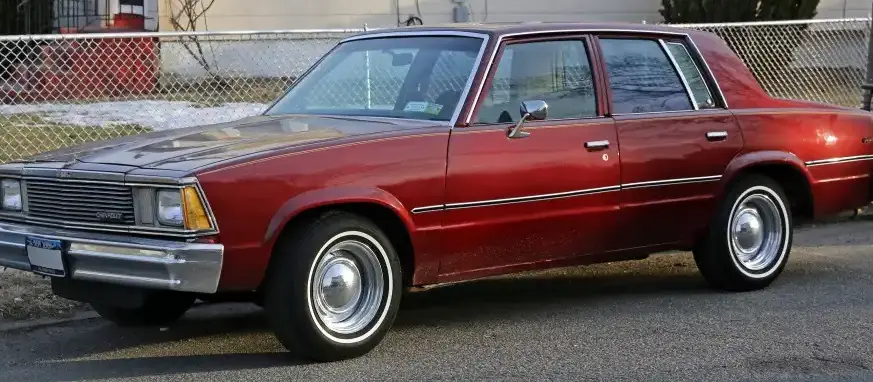
The Chevrolet Malibu IV Sedan, specifically the facelifted version produced from 1981 to 1983, represented a significant downsize for the traditionally large American sedan. This generation, built on the A-body platform, aimed to offer improved fuel efficiency in response to the energy crisis of the 1970s while still providing the comfort and space expected of a family car. The 3.8 V6 (110 hp) with a catalytic converter and automatic transmission variant occupied a middle ground in the Malibu lineup, offering a balance between performance and economy. It was positioned above the base 2.5-liter four-cylinder models but below the more powerful V8 options, targeting buyers who desired a smoother, more refined driving experience than the four-cylinder could provide, without the added cost and fuel consumption of the larger engines.
Powertrain & Engine Architecture
The heart of this Malibu variant was the Chevrolet 3.8-liter (229 cubic inch) V6 engine, designated the LC3. This engine was a descendant of the long-running Chevrolet small-block V6 family. It featured a 90-degree V-angle, overhead valve (OHV) valvetrain with two valves per cylinder, and a cast iron block with aluminum cylinder heads. The LC3 utilized a two-barrel carburetor for fuel delivery, a common setup for the era, but one that would later be superseded by fuel injection in subsequent Chevrolet models. The catalytic converter, denoted by the “CAT” in the model name, was a crucial component for meeting increasingly stringent emissions regulations. The three-speed automatic transmission, a TH350 variant, was the sole transmission option for this engine. It was chosen for its smoothness and ease of use, appealing to the target demographic of comfort-oriented buyers.
Driving Characteristics
The 110 horsepower and 230 Nm (169.64 lb-ft) of torque produced by the 3.8L V6 and automatic transmission combination provided adequate, but not exhilarating, performance. Acceleration was respectable for the time, but noticeably slower than the V8-powered Malibus. The automatic transmission’s gear ratios were optimized for cruising and fuel economy rather than outright speed. The rear-wheel-drive configuration offered a balanced feel, but the relatively soft suspension tuning prioritized ride comfort over sporty handling. Compared to the manual transmission versions of the 3.8L, the automatic resulted in a slight performance decrease due to the inherent power loss in the torque converter and the transmission’s shift programming. However, the automatic offered a more relaxed and convenient driving experience, particularly in city traffic.
Equipment & Trim Levels
The 3.8L automatic Malibu typically came standard with features like cloth upholstery, a basic AM/FM radio, and full wheel covers. Power steering and power brakes were often included. Optional extras included air conditioning, a more advanced stereo system, cruise control, and upgraded interior trim. The interior design was fairly straightforward, reflecting the car’s focus on practicality and affordability. The dashboard layout was functional, with clearly marked gauges and easy-to-reach controls. The level of trim could vary depending on regional packages and dealer options.
Chassis & Braking
The Malibu IV Sedan utilized a body-on-frame construction, a common practice for American cars of that era. The front suspension was independent, employing a McPherson strut design with coil springs and an anti-roll bar. The rear suspension was a more traditional solid axle setup with coil springs and a transverse stabilizer bar. Braking duties were handled by ventilated discs at the front and drum brakes at the rear. The braking system was adequate for normal driving conditions, but lacked the stopping power of more modern systems. The steering was a rack-and-pinion setup, providing reasonably precise control.
Market Reception & Comparison
The 1981-1983 Chevrolet Malibu with the 3.8L V6 and automatic transmission received mixed reviews. Critics praised its comfortable ride and improved fuel economy compared to larger, older models. However, some found the performance underwhelming, particularly when compared to European and Japanese sedans. The automatic transmission was generally well-received for its smoothness, but some reviewers noted a slight decrease in fuel economy compared to the manual transmission options. In terms of reliability, the 3.8L V6 proved to be a durable engine, but the carburetor could require occasional adjustments and maintenance. Compared to the four-cylinder Malibu, the V6 offered a significant improvement in refinement and power, but at a higher price point. Compared to the V8 models, it provided a better balance of fuel economy and performance.
Legacy
The 3.8L V6 and automatic transmission combination in the 1981-1983 Chevrolet Malibu represents a transitional period in American automotive history. It marked a shift towards smaller, more fuel-efficient vehicles while still retaining some of the traditional American characteristics of comfort and space. While not a particularly sought-after classic today, these Malibus are appreciated by enthusiasts for their simplicity and affordability. The 3.8L V6 engine itself went on to become a mainstay in Chevrolet’s lineup for many years, proving to be a reliable and versatile powerplant. In the used car market, these Malibus are relatively inexpensive to acquire and maintain, making them a popular choice for budget-minded buyers and those looking for a classic American car experience.