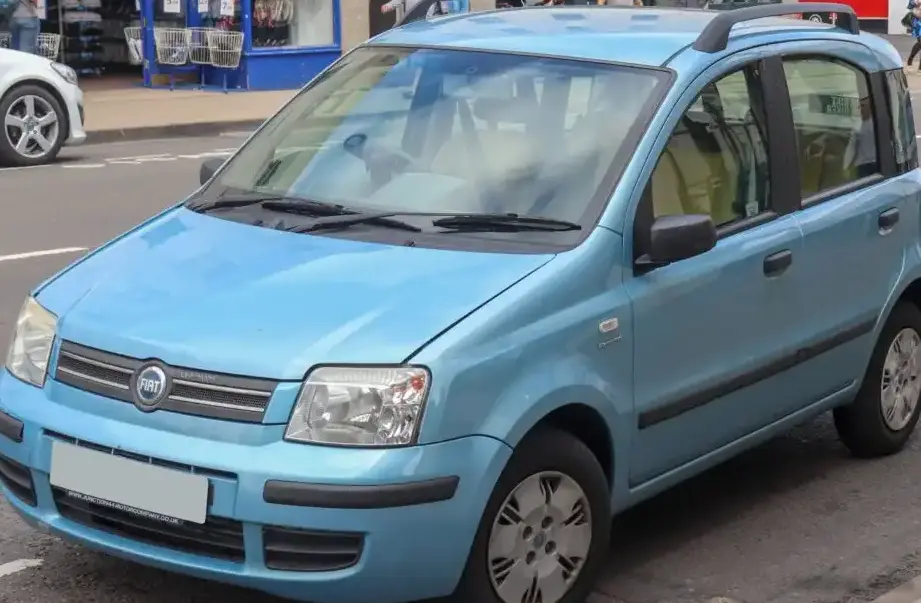
The Fiat Panda II (169) 1.3 16V Multijet 75 HP DPF, produced from September 2006 to September 2012, represents a significant iteration of Fiat’s iconic city car. Positioned as a fuel-efficient and practical option within the Panda II range, this variant aimed to balance affordability with modern diesel technology. It was a key model for Fiat in the European market, particularly in countries where small, economical cars were highly valued. The 169 series Panda, launched in 2003, was a substantial redesign of the original Panda, offering increased space, safety, and refinement while retaining the core values of simplicity and affordability. This specific 1.3 Multijet version was designed to appeal to buyers seeking low running costs and acceptable performance for urban and short-distance driving.
Technical Specifications
| Brand | Fiat |
| Model | Panda |
| Generation | Panda II (169) |
| Type (Engine) | 1.3 16V Multijet (75 Hp) DPF |
| Start of production | September, 2006 |
| End of production | September, 2012 |
| Powertrain Architecture | Internal Combustion engine |
| Body type | Hatchback |
| Seats | 5 |
| Doors | 5 |
| Fuel consumption (urban) | 5.3 l/100 km (44.4 US mpg, 53.3 UK mpg, 18.9 km/l) |
| Fuel consumption (extra urban) | 3.7 l/100 km (63.6 US mpg, 76.3 UK mpg, 27 km/l) |
| Fuel consumption (combined) | 4.3 l/100 km (54.7 US mpg, 65.7 UK mpg, 23.3 km/l) |
| CO2 emissions | 113 g/km |
| Fuel Type | Diesel |
| Acceleration 0 – 100 km/h | 13 sec |
| Acceleration 0 – 62 mph | 13 sec |
| Acceleration 0 – 60 mph | 12.4 sec |
| Maximum speed | 165 km/h (102.53 mph) |
| Emission standard | Euro 4 |
| Weight-to-power ratio | 12.5 kg/Hp, 80.2 Hp/tonne |
| Weight-to-torque ratio | 6.4 kg/Nm, 155.1 Nm/tonne |
| Power | 75 Hp @ 4000 rpm |
| Power per litre | 60.1 Hp/l |
| Torque | 145 Nm @ 1500 rpm (106.95 lb.-ft. @ 1500 rpm) |
| Engine layout | Front, Transverse |
| Engine Model/Code | 169A1000 |
| Engine displacement | 1248 cm3 (76.16 cu. in.) |
| Number of cylinders | 4 |
| Engine configuration | Inline |
| Cylinder Bore | 69.5 mm (2.74 in.) |
| Piston Stroke | 82 mm (3.23 in.) |
| Compression ratio | 18:1 |
| Number of valves per cylinder | 4 |
| Fuel injection system | Diesel Commonrail |
| Engine aspiration | Turbocharger, Intercooler |
| Valvetrain | DOHC |
| Engine oil capacity | 3 l (3.17 US qt | 2.64 UK qt) |
| Coolant | 6.5 l (6.87 US qt | 5.72 UK qt) |
| Kerb Weight | 935 kg (2061.32 lbs.) |
| Max. weight | 1380 kg (3042.38 lbs.) |
| Max load | 445 kg (981.06 lbs.) |
| Trunk (boot) space – minimum | 206 l (7.27 cu. ft.) |
| Trunk (boot) space – maximum | 860 l (30.37 cu. ft.) |
| Fuel tank capacity | 35 l (9.25 US gal | 7.7 UK gal) |
| Max. roof load | 50 kg (110.23 lbs.) |
| Permitted trailer load with brakes (12%) | 900 kg (1984.16 lbs.) |
| Permitted trailer load without brakes | 400 kg (881.85 lbs.) |
| Permitted towbar download | 60 kg (132.28 lbs.) |
| Length | 3538 mm (139.29 in.) |
| Width | 1589 mm (62.56 in.) |
| Height | 1578 mm (62.13 in.) |
| Wheelbase | 2299 mm (90.51 in.) |
| Front track | 1366 mm (53.78 in.) |
| Rear (Back) track | 1357 mm (53.43 in.) |
| Minimum turning circle | 9.5 m (31.17 ft.) |
| Drivetrain | Front wheel drive |
| Number of gears and type of gearbox | 5 gears, manual transmission |
| Front suspension | Independent, type McPherson with coil spring and anti-roll bar |
| Rear suspension | Spring Strut, Semi-dependent beam with stabilizer lateral stability |
| Front brakes | Ventilated discs, 240 mm |
| Rear brakes | Drum, 180 mm |
| Assisting systems | ABS (Anti-lock braking system) |
| Steering type | Steering rack and pinion |
| Power steering | Electric Steering |
| Tires size | 155/80 R13; 165/65 R14 |
| Wheel rims size | 13; 14 |
Powertrain & Engine Architecture
The heart of this Panda variant is the 1.3 16V Multijet engine, identified by the code 169A1000. This engine is a four-cylinder, inline diesel utilizing a common rail direct injection system. The Multijet technology, developed by Fiat, allows for multiple injections of fuel per combustion cycle, improving efficiency, reducing noise, and lowering emissions. A turbocharger with an intercooler further enhances performance by forcing more air into the cylinders. The engine features a double overhead camshaft (DOHC) valvetrain with four valves per cylinder, contributing to its relatively high power output for its size. The 5-speed manual transmission was the standard offering, chosen for its simplicity and contribution to fuel economy. The engine’s 18:1 compression ratio is typical for a diesel engine, maximizing efficiency. The particulate filter (DPF) was a crucial component for meeting Euro 4 emission standards, trapping soot particles from the exhaust.
Driving Characteristics
The 75 HP 1.3 Multijet engine, paired with the 5-speed manual gearbox, provided adequate, though not exhilarating, performance. Acceleration from 0-60 mph took around 12.4 seconds, and top speed was approximately 102.53 mph. In real-world driving, the engine felt most comfortable in the mid-range, with usable torque available from around 1500 rpm. The gear ratios were geared towards economy, meaning that highway cruising required the engine to work a bit harder. Compared to the more powerful 1.4-liter petrol engine available in the Panda II range, the Multijet offered significantly better fuel economy but less outright performance. It also contrasted with the later, more sophisticated Multijet engines found in other Fiat models, which offered higher power outputs and more refined operation.
Equipment & Trim Levels
The 1.3 16V Multijet typically came with a relatively basic level of equipment, reflecting its position as a value-oriented model. Standard features generally included power steering, ABS brakes, a driver’s airbag, and central locking. Interior upholstery was typically cloth, and the dashboard featured a functional, if somewhat spartan, design. Optional extras included air conditioning, electric windows, and a radio/CD player. Higher trim levels, such as the “Dynamic” or “Eleganza” variants, added features like alloy wheels, body-colored bumpers, and upgraded interior trim.
Chassis & Braking
The Panda II utilized a McPherson strut front suspension and a semi-independent torsion beam rear suspension. This setup provided a comfortable ride for city driving, although it wasn’t particularly sporty. The front brakes were ventilated discs, while the rear brakes were drums, a cost-saving measure common in this segment. ABS was standard, enhancing braking safety. The relatively light weight of the vehicle (935 kg) helped to compensate for the modest braking performance.
Market Reception & Comparison
The Fiat Panda II 1.3 Multijet was generally well-received by critics for its fuel efficiency, practicality, and low running costs. It was praised as an ideal city car, easy to maneuver and park in tight spaces. However, some reviewers noted the engine could be noisy and lacked refinement compared to some competitors. Compared to other small diesel cars of the time, such as the Renault Clio or Peugeot 206, the Panda offered a more affordable entry point but lacked some of their features and sophistication. Its fuel economy was a key selling point, consistently outperforming petrol-powered rivals.
Legacy
The 1.3 Multijet engine proved to be a reliable and durable unit, and many examples of the Panda II 1.3 Multijet are still on the road today. The engine’s relatively simple design and robust construction contribute to its longevity. On the used car market, these Pandas are valued for their affordability and fuel efficiency, making them a popular choice for first-time drivers or those seeking a low-cost runabout. However, potential buyers should be aware of the need for regular maintenance, particularly regarding the DPF system, which can require costly repairs if neglected. The Panda II 1.3 Multijet remains a testament to Fiat’s ability to create practical, economical, and enduring small cars.