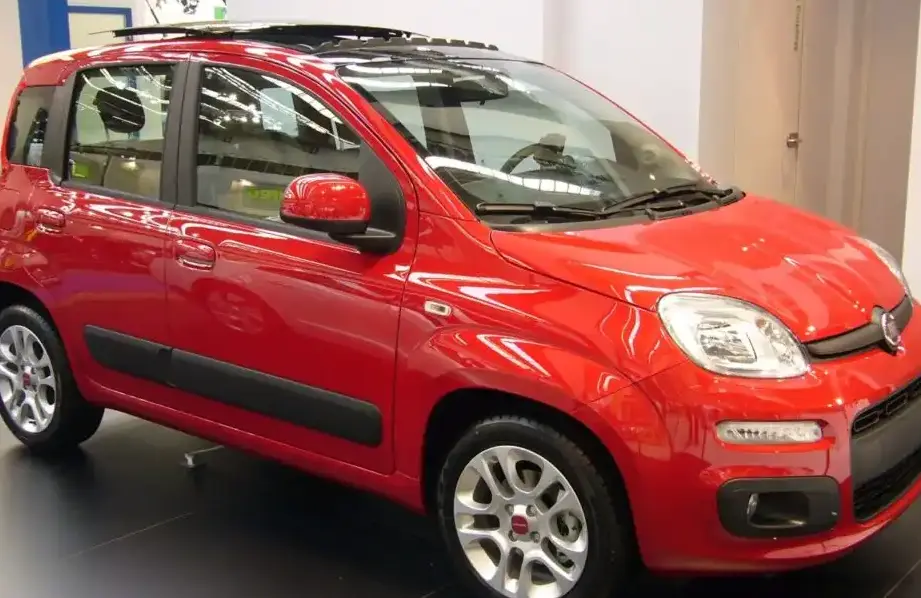
The Fiat Panda III (319) 0.9 MultiAir 70 hp CNG, produced from 2018 to 2020, represents a unique offering within the third generation of Fiat’s iconic city car. Positioned as an economical and environmentally conscious variant, it combined a small-displacement turbocharged engine with the flexibility of Compressed Natural Gas (CNG) capability. This model aimed to appeal to buyers seeking low running costs and reduced emissions, particularly in European markets where CNG infrastructure was more developed. It sat towards the entry-level of the Panda III range, offering a more affordable alternative to the petrol-only versions and those with higher power outputs.
Technical Specifications
| Brand | Fiat |
| Model | Panda |
| Generation | Panda III (319) |
| Type (Engine) | 0.9 MultiAir (70 Hp) CNG |
| Start of production | 2018 year |
| End of production | 2020 year |
| Powertrain Architecture | Internal Combustion engine |
| Body type | Hatchback |
| Seats | 4-5 |
| Doors | 5 |
| Fuel consumption (economy) – urban | 6.8 l/100 km (34.6 US mpg, 41.5 UK mpg, 14.7 km/l) |
| Fuel consumption (economy) – urban (CNG) | 4.3 kg/100 km |
| Fuel consumption (economy) – extra urban | 4.8 l/100 km (49 US mpg, 58.9 UK mpg, 20.8 km/l) |
| Fuel consumption (economy) – extra urban (CNG) | 3.2 kg/100 km |
| Fuel consumption (economy) – combined | 5.5 l/100 km (42.8 US mpg, 51.4 UK mpg, 18.2 km/l) |
| Fuel consumption (economy) – combined (CNG) | 3.6 kg/100 km |
| CO2 emissions | 125 g/km |
| CO2 emissions (CNG) | 97 g/km |
| Fuel Type | Petrol / CNG |
| Acceleration 0 – 100 km/h | 14.1 sec |
| Acceleration 0 – 62 mph | 14.1 sec |
| Acceleration 0 – 60 mph | 13.4 sec |
| Maximum speed | 162 km/h (100.66 mph) |
| Emission standard | Euro 6d – Temp |
| Weight-to-power ratio | 16.5 kg/Hp, 60.6 Hp/tonne |
| Weight-to-torque ratio | 8.6 kg/Nm, 116.9 Nm/tonne |
| Power | 70 Hp @ 5500 rpm |
| Power per litre | 80 Hp/l |
| Torque | 135 Nm @ 2500 rpm (99.57 lb.-ft. @ 2500 rpm) |
| Engine layout | Front, Transverse |
| Engine Model/Code | 463 37 566 |
| Engine displacement | 875 cm3 (53.4 cu. in.) |
| Number of cylinders | 2 |
| Engine configuration | Inline |
| Cylinder Bore | 80.5 mm (3.17 in.) |
| Piston Stroke | 86 mm (3.39 in.) |
| Compression ratio | 10:1 |
| Number of valves per cylinder | 4 |
| Engine aspiration | Turbocharger |
| Valvetrain | MultiAir |
| Engine oil capacity | 3.2 l (3.38 US qt, 2.82 UK qt) |
| Coolant | 5.2 l (5.49 US qt, 4.58 UK qt) |
| Kerb Weight | 1155 kg (2546.34 lbs.) |
| Max. weight | 1540-1550 kg (3395.12 – 3417.17 lbs.) |
| Max load | 385-395 kg (848.78 – 870.83 lbs.) |
| Trunk (boot) space – minimum | 200 l (7.06 cu. ft.) |
| Fuel tank capacity | 35 l (9.25 US gal, 7.7 UK gal) |
| CNG cylinder capacity | 12 kg |
| Length | 3653 mm (143.82 in.) |
| Width | 1643 mm (64.69 in.) |
| Height | 1605 mm (63.19 in.) |
| Wheelbase | 2300 mm (90.55 in.) |
| Front track | 1414 mm (55.67 in.) |
| Rear (Back) track | 1408 mm (55.43 in.) |
| Minimum turning circle | 9.7 m (31.82 ft.) |
| Drivetrain Architecture | The Internal combustion engine (ICE) drives the front wheels of the vehicle. |
| Drive wheel | Front wheel drive |
| Number of gears and type of gearbox | 5 gears, manual transmission |
| Front suspension | Independent, type McPherson with coil spring and anti-roll bar |
| Rear suspension | Torsion |
| Front brakes | Ventilated discs, 257 mm |
| Rear brakes | Drum, 203 mm |
| Assisting systems | ABS (Anti-lock braking system) |
| Steering type | Steering rack and pinion |
| Power steering | Electric Steering |
| Wheel rims size | 14; 15 |
INTRODUCTION
The Fiat Panda III, launched in 2012, represented a significant modernization of the long-running Panda lineage. The 0.9 MultiAir 70 hp CNG variant, introduced in 2018, built upon the success of the third generation by offering a bi-fuel option. This allowed drivers to switch between petrol and CNG, capitalizing on the lower cost and reduced emissions associated with CNG fuel. The Panda III platform (319) was designed to be a practical and affordable city car, and the CNG version further enhanced its appeal to environmentally conscious buyers. Production of this specific variant continued until 2020, after which Fiat continued to offer other engine options within the Panda III range.
Powertrain & Engine Architecture
At the heart of the Panda III 0.9 MultiAir CNG lies Fiat’s 875cc two-cylinder turbocharged engine, designated as the 463 37 566. This engine is a member of the FireFly family, known for its efficiency and compact size. The key technology employed is Fiat’s MultiAir system, a fully variable valve actuation system. MultiAir allows for independent control of the intake valve timing and lift, optimizing combustion for improved fuel economy, reduced emissions, and increased torque. The engine utilizes direct fuel injection and a single overhead camshaft. When running on CNG, a dedicated fuel injection system manages the gas delivery, while the petrol system is used for starting and when CNG supply is depleted. The engine produces 70 horsepower at 5500 rpm and 135 Nm (99.57 lb-ft) of torque at 2500 rpm. The engine is paired with a five-speed manual transmission, which was the only transmission option available for this variant.
Driving Characteristics
The 0.9 MultiAir 70 hp CNG Panda offers a driving experience geared towards urban practicality rather than outright performance. Acceleration from 0-60 mph takes around 13.4 seconds, and the top speed is 100.66 mph. The turbocharger helps to mitigate the effects of the small engine displacement, providing a reasonable amount of low-end torque for city driving. However, the engine can feel strained when climbing hills or during overtaking maneuvers. The five-speed manual transmission is well-matched to the engine’s characteristics, with gear ratios optimized for fuel efficiency. Switching to CNG slightly reduces power output, but the lower fuel cost often outweighs this performance difference. The suspension is tuned for comfort, providing a relatively smooth ride on typical urban roads.
Equipment & Trim Levels
The Panda III 0.9 MultiAir 70 hp CNG typically came with a modest level of standard equipment, reflecting its position as an entry-level model. Standard features generally included air conditioning, power steering, ABS brakes, and a basic audio system. Interior upholstery was typically cloth, and the dashboard featured a simple, functional design. Optional extras included alloy wheels, a touchscreen infotainment system, and parking sensors. The trim level often dictated the availability of these optional features. The CNG variant didn’t necessarily have a unique trim level, but was often offered as an option on existing trims like the ‘Lounge’ or ‘Pop’.
Chassis & Braking
The Panda III utilizes a front-wheel-drive layout with an independent McPherson strut suspension at the front and a torsion beam suspension at the rear. The front brakes are ventilated discs measuring 257mm, while the rear brakes are drums measuring 203mm. This configuration is typical for a vehicle in this weight class and provides adequate stopping power for everyday driving. The electric power steering offers light and precise steering feel, making it easy to maneuver in tight urban environments. The chassis is designed to be lightweight, contributing to the car’s overall fuel efficiency.
Market Reception & Comparison
The Fiat Panda III 0.9 MultiAir 70 hp CNG was generally well-received by critics as a practical and economical city car. Its low running costs, thanks to the CNG capability, were a major selling point. Compared to the petrol-only versions of the Panda III, the CNG variant offered significant fuel savings, particularly for drivers who frequently used CNG filling stations. However, the CNG version’s higher initial purchase price and the limited availability of CNG infrastructure in some regions were drawbacks. Compared to higher-powered Panda variants, such as the 1.2-liter petrol engine, the CNG version offered less performance but superior fuel economy.
Legacy
The Fiat Panda III 0.9 MultiAir 70 hp CNG represents a noteworthy attempt to combine small-displacement engine technology with alternative fuel capabilities. While the CNG variant is no longer in production, it remains a popular choice on the used car market, particularly among buyers seeking a low-cost and environmentally friendly vehicle. The FireFly engine family, including the 0.9 MultiAir, has proven to be relatively reliable, although regular maintenance is essential to ensure optimal performance. The MultiAir system, while innovative, can be prone to issues if not properly maintained, requiring periodic valve adjustments. Overall, the Panda III 0.9 MultiAir CNG has left a positive legacy as a practical and economical city car that offered a viable alternative to traditional petrol-powered vehicles.