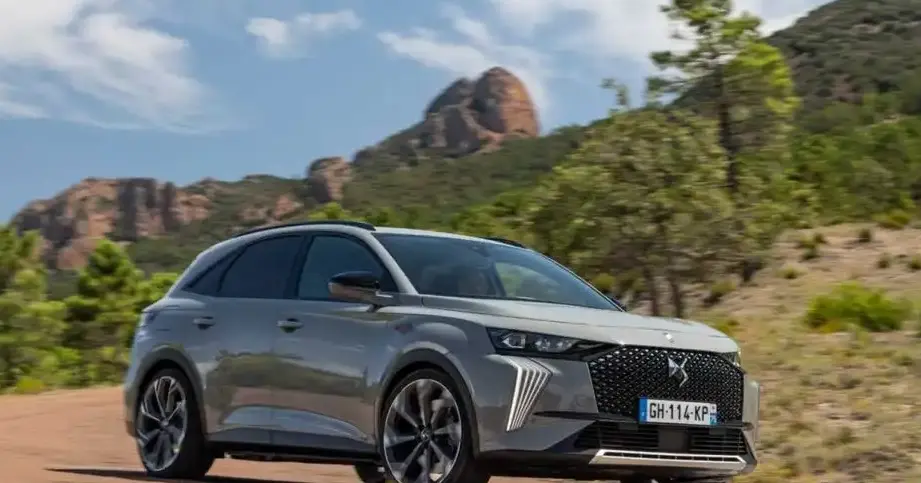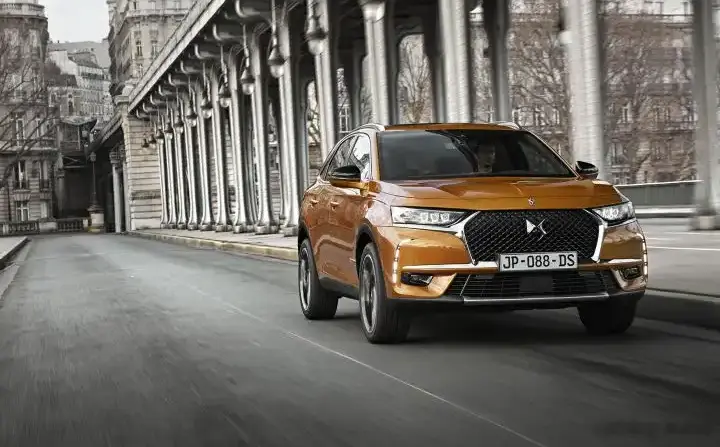
The DS 7 Crossback 1.6 PureTech (300 Hp) E-TENSE 4×4 Automatic is a plug-in hybrid electric vehicle (PHEV) produced by the French luxury automaker DS Automobiles between March 2019 and July 2022. Positioned as a premium offering within the DS 7 Crossback range, this variant combined a 1.6-liter turbocharged gasoline engine with a dual-electric motor system, providing all-wheel drive capability and a significant boost in power and efficiency. It represented DS Automobiles’ commitment to electrification and sophisticated vehicle technology, targeting buyers seeking a luxurious and environmentally conscious SUV.
Technical Specifications
| Brand | DS |
| Model | 7 |
| Generation | 7 Crossback |
| Type (Engine) | 1.6 PureTech (300 Hp) E-TENSE 4×4 Automatic |
| Start of production | March, 2019 |
| End of production | July, 2022 |
| Powertrain Architecture | PHEV (Plug-in Hybrid Electric Vehicle) |
| Body type | SUV |
| Seats | 5 |
| Doors | 5 |
| Fuel consumption at Low speed (WLTP) | 9-9.1 l/100 km (26.1 – 25.8 US mpg, 31.4 – 31 UK mpg, 11.1 – 11 km/l) |
| Fuel consumption at Medium speed (WLTP) | 5.8-6.3 l/100 km (40.6 – 37.3 US mpg, 48.7 – 44.8 UK mpg, 17.2 – 15.9 km/l) |
| Fuel consumption at high speed (WLTP) | 5.9-6.4 l/100 km (39.9 – 36.8 US mpg, 47.9 – 44.1 UK mpg, 16.9 – 15.6 km/l) |
| Fuel consumption at very high speed (WLTP) | 7.8-8.3 l/100 km (30.2 – 28.3 US mpg, 36.2 – 34 UK mpg, 12.8 – 12 km/l) |
| Combined fuel consumption (WLTP) | 1.3-1.5 l/100 km (180.9 – 156.8 US mpg, 217.3 – 188.3 UK mpg, 76.9 – 66.7 km/l) |
| CO2 emissions (WLTP) | 30-35 g/km |
| Fuel consumption (economy) – combined (NEDC, WLTP equivalent) | 1.5-1.6 l/100 km (156.8 – 147 US mpg, 188.3 – 176.6 UK mpg, 66.7 – 62.5 km/l) |
| CO2 emissions (NEDC, WLTP equivalent) | 34-36 g/km |
| Fuel Type | Petrol / electricity |
| Acceleration 0 – 100 km/h | 5.9 sec |
| Acceleration 0 – 62 mph | 5.9 sec |
| Acceleration 0 – 60 mph | 5.6 sec |
| Maximum speed | 235 km/h (146.02 mph) |
| Emission standard | Euro 6.3 |
| Weight-to-power ratio | 6.1 kg/Hp, 164.4 Hp/tonne |
| Weight-to-torque ratio | 3.5 kg/Nm, 284.9 Nm/tonne |
| Gross battery capacity | 13.2 kWh |
| All-electric range (WLTP) | 58 km (36.04 mi) |
| Electric motor power (1) | 110 Hp |
| Electric motor Torque (1) | 320 Nm (236.02 lb.-ft.) |
| Electric motor location (1) | Between the combustion engine and the transmission |
| Electric motor power (2) | 113 Hp |
| Electric motor Torque (2) | 166 Nm (122.44 lb.-ft.) |
| Electric motor location (2) | Rear axle, Transverse |
| System power | 300 Hp |
| System torque | 520 Nm (383.53 lb.-ft.) |
| Power | 200 Hp @ 6000 rpm |
| Torque | 300 Nm @ 3000 rpm (221.27 lb.-ft. @ 3000 rpm) |
| Engine layout | Front, Transverse |
| Engine Model/Code | 5GB EP6FADTXHP |
| Engine displacement | 1598 cm3 (97.52 cu. in.) |
| Number of cylinders | 4 |
| Engine configuration | Inline |
| Number of valves per cylinder | 4 |
| Fuel injection system | Direct injection |
| Engine aspiration | Twin-Turbo, Intercooler |
| Engine oil capacity | 4.25 l (4.49 US qt | 3.74 UK qt) |
| Kerb Weight | 1825 kg (4023.44 lbs.) |
| Max. weight | 2400 kg (5291.09 lbs.) |
| Max load | 575 kg (1267.66 lbs.) |
| Trunk (boot) space – minimum | 555 l (19.6 cu. ft.) |
| Trunk (boot) space – maximum | 1752 l (61.87 cu. ft.) |
| Fuel tank capacity | 43 l (11.36 US gal | 9.46 UK gal) |
| Permitted trailer load with brakes (12%) | 1200 kg (2645.55 lbs.) |
| Permitted trailer load without brakes | 750 kg (1653.47 lbs.) |
| Permitted towbar download | 55 kg (121.25 lbs.) |
| Length | 4573 mm (180.04 in.) |
| Width | 1906 mm (75.04 in.) |
| Width including mirrors | 2098 mm (82.6 in.) |
| Height | 1625 mm (63.98 in.) |
| Wheelbase | 2738 mm (107.8 in.) |
| Front track | 1621 mm (63.82 in.) |
| Rear (Back) track | 1598 mm (62.91 in.) |
| Front overhang | 925 mm (36.42 in.) |
| Rear overhang | 910 mm (35.83 in.) |
| Ride height (ground clearance) | 190 mm (7.48 in.) |
| Minimum turning circle (turning diameter) | 10.45 m (34.28 ft.) |
| Drivetrain Architecture | An Internal combustion engine (ICE) drives the front wheels, one electric motor drives the front wheels, one electric motor drives the rear wheels. There is an ability for running in full electric or mixed mode. |
| Drive wheel | All wheel drive (4×4) |
| Number of gears and type of gearbox | 8 gears, automatic transmission |
| Front suspension | Independent, type McPherson with coil spring and anti-roll bar |
| Rear suspension | Independent multi-link spring suspension with stabilizer |
| Front brakes | Ventilated discs, 304×28 mm |
| Rear brakes | Disc, 290×12 mm |
| Assisting systems | ABS (Anti-lock braking system) |
| Steering type | Steering rack and pinion |
| Power steering | Electric Steering |
| Tires size | 225/55 R18 102V; 235/50 R19 103V |
| Wheel rims size | 18; 19 |
INTRODUCTION
The DS 7 Crossback 1.6 PureTech (300 Hp) E-TENSE 4×4 Automatic, launched in 2019, was a pivotal model for DS Automobiles, signaling the brand’s transition towards electrified powertrains. Built on the EMP2 platform (also known as the 1HX0/A3 platform), the DS 7 Crossback aimed to compete with premium European SUVs like the Audi Q5 and BMW X3. This particular variant, combining a gasoline engine with plug-in hybrid technology, offered a compelling blend of performance, efficiency, and luxury. It was positioned as a higher-end trim within the DS 7 Crossback lineup, appealing to customers seeking a sophisticated and technologically advanced driving experience.
Powertrain & Engine Architecture
At the heart of the DS 7 Crossback E-TENSE 4×4 lies the 5GB EP6FADTXHP 1.6-liter turbocharged four-cylinder gasoline engine. This engine, part of the PureTech family developed by the PSA Group (now Stellantis), utilizes direct fuel injection and a twin-scroll turbocharger to deliver 200 horsepower at 6000 rpm and 300 Nm (221.27 lb.-ft.) of torque at 3000 rpm. The engine’s design emphasizes efficiency and responsiveness.
The “E-TENSE” designation indicates the presence of a plug-in hybrid system. This system incorporates two electric motors: one positioned between the combustion engine and the eight-speed automatic transmission, driving the front wheels, and another located on the rear axle, providing all-wheel drive capability. The front electric motor produces 110 Hp and 320 Nm (236.02 lb.-ft.) of torque, while the rear motor generates 113 Hp and 166 Nm (122.44 lb.-ft.). The combined system output reaches 300 Hp and 520 Nm (383.53 lb.-ft.) of torque. A 13.2 kWh battery pack provides an all-electric range of up to 58 km (36.04 miles) under WLTP testing. The eight-speed automatic transmission is specifically tuned to work seamlessly with the hybrid powertrain, optimizing gear changes for both fuel efficiency and performance.
Driving Characteristics
The DS 7 Crossback 1.6 PureTech E-TENSE 4×4 Automatic delivers a refined and engaging driving experience. The instant torque from the electric motors provides brisk acceleration, with a 0-60 mph time of around 5.6 seconds. In electric mode, the vehicle operates silently and smoothly, ideal for urban driving. When the gasoline engine engages, the transition is generally seamless. The all-wheel drive system enhances traction and stability, particularly in adverse weather conditions. Compared to lower-powered versions of the DS 7 Crossback, such as those equipped with the 1.5 BlueHDi diesel engine, the E-TENSE offers significantly more power and a more dynamic driving feel. However, the added weight of the battery pack and electric motors does slightly impact handling agility compared to lighter variants. The eight-speed automatic transmission provides smooth and responsive shifts, contributing to a comfortable ride.
Equipment & Trim Levels
The DS 7 Crossback 1.6 PureTech E-TENSE 4×4 Automatic typically came well-equipped as a premium trim level. Standard features often included leather upholstery, a panoramic sunroof, a touchscreen infotainment system with Apple CarPlay and Android Auto compatibility, a premium sound system, and advanced driver-assistance systems such as adaptive cruise control, lane-keeping assist, and automatic emergency braking. Optional extras could include upgraded leather packages, massaging seats, and a head-up display. The interior design emphasized luxury and sophistication, with high-quality materials and meticulous attention to detail.
Chassis & Braking
The DS 7 Crossback features an independent suspension system, with McPherson struts at the front and a multi-link setup at the rear. This configuration provides a comfortable ride and good handling characteristics. Stabilizer bars are fitted to both axles to reduce body roll during cornering. The braking system consists of ventilated discs at the front (304×28 mm) and solid discs at the rear (290×12 mm). Anti-lock braking system (ABS) is standard, along with electronic brakeforce distribution and emergency brake assist. The suspension tuning is geared towards comfort, but the E-TENSE variant, with its added weight, may have slightly stiffer spring rates to maintain control.
Market Reception & Comparison
The DS 7 Crossback 1.6 PureTech E-TENSE 4×4 Automatic received generally positive reviews from automotive critics. Praise was directed towards its luxurious interior, refined driving experience, and impressive fuel efficiency in hybrid mode. However, some reviewers noted that the infotainment system could be complex to use and that the overall price was relatively high compared to some competitors. Compared to the diesel-powered DS 7 Crossback models, the E-TENSE offered lower running costs (due to the electric range and potential for reduced fuel consumption) but a higher initial purchase price. Against rivals like the Audi Q5 TFSI e and BMW X3 xDrive30e, the DS 7 Crossback E-TENSE offered a distinctive French design and a focus on comfort.
Legacy
The DS 7 Crossback 1.6 PureTech E-TENSE 4×4 Automatic represents an important step in DS Automobiles’ electrification strategy. The powertrain, while superseded by newer hybrid technologies, proved to be relatively reliable in real-world use. On the used car market, these models hold their value reasonably well, particularly those with low mileage and a full service history. The combination of luxury, performance, and efficiency continues to appeal to buyers seeking a premium plug-in hybrid SUV. The E-TENSE variant helped establish DS Automobiles as a credible competitor in the luxury SUV segment and paved the way for the brand’s future electric vehicle offerings.