
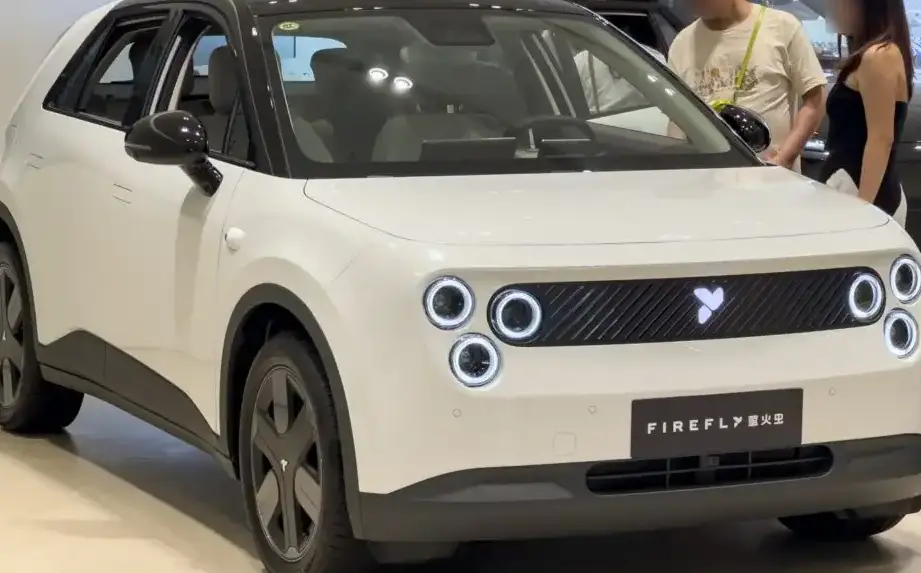
The Firefly is a battery electric vehicle (BEV) hatchback introduced in December 2024 by Firefly. Representing the brand’s initial foray into the rapidly expanding electric vehicle market, the Firefly is positioned as an affordable and practical urban commuter car. The 42.1 kWh variant, producing 143 horsepower, serves as the initial offering in the Firefly lineup, designed to balance range, performance, and cost. It competes with other entry-level EVs like the Nissan Leaf and Chevrolet Bolt, aiming to provide a compelling option for consumers transitioning to electric mobility.
Technical Specifications
| Brand | Firefly |
| Model | Firefly |
| Type (Engine) | 42.1 kWh (143 Hp) |
| Start of production | December, 2024 |
| Powertrain Architecture | BEV (Electric Vehicle) |
| Body type | Hatchback |
| Seats | 5 |
| Doors | 5 |
| Fuel Type | Electricity |
| Acceleration 0 – 100 km/h | 8.1 sec |
| Acceleration 0 – 62 mph | 8.1 sec |
| Acceleration 0 – 60 mph | 7.7 sec |
| Maximum speed | 150 km/h (93.21 mph) |
| Gross battery capacity | 42.1 kWh |
| Battery voltage | 358.4 V |
| Battery technology | Lithium iron phosphate (LiFePO4) |
| Battery weight | 314 kg (692.25 lbs.) |
| Battery location | Below the floor |
| All-electric range (WLTP) | 330 km (205.05 mi) |
| All-electric range (CLTC) | 420 km (260.98 mi) |
| Average Energy consumption (WLTP) | 14.5 kWh/100 km (23.34 kWh/100 mi) / 144 MPGe / 6.9 km/kWh (4.3 mi/kWh) |
| Average Energy consumption (CLTC) | 10.9 kWh/100 km (17.54 kWh/100 mi) / 192 MPGe / 9.2 km/kWh (5.7 mi/kWh) |
| Electric motor power | 143 Hp |
| Electric motor Torque | 200 Nm (147.51 lb.-ft.) |
| Electric motor model/code | TZ160S010 |
| Maximum revolutions of the electric motor | 15500 rpm |
| Electric motor location | Rear axle, Transverse |
| Electric motor type | Synchronous |
| System power | 143 Hp |
| System torque | 200 Nm (147.51 lb.-ft.) |
| Kerb Weight | 1467-1492 kg (3234.18 – 3289.3 lbs.) |
| Max. weight | 1858-1875 kg (4096.19 – 4133.67 lbs.) |
| Max load | 383-391 kg (844.37 – 862.01 lbs.) |
| Trunk (boot) space – minimum | 335 l (11.83 cu. ft.) |
| Trunk (boot) space – maximum | 1253 l (44.25 cu. ft.) |
| Length | 4003 mm (157.6 in.) |
| Width | 1781 mm (70.12 in.) |
| Height | 1557 mm (61.3 in.) |
| Wheelbase | 2615 mm (102.95 in.) |
| Front track | 1533 mm (60.35 in.) |
| Rear (Back) track | 1540 mm (60.63 in.) |
| Front overhang | 680 mm (26.77 in.) |
| Rear overhang | 708 mm (27.87 in.) |
| Ride height (ground clearance) | 142 mm (5.59 in.) |
| Minimum turning circle (turning diameter) | 9.4 m (30.84 ft.) |
| Drivetrain Architecture | One electric motor drives the rear wheels. |
| Drive wheel | Rear wheel drive |
| Number of gears and type of gearbox | 1 gears, automatic transmission |
| Front suspension | Independent, type McPherson with coil spring and anti-roll bar |
| Rear suspension | Independent multi-link spring suspension with stabilizer |
| Front brakes | Ventilated discs |
| Rear brakes | Disc |
| Assisting systems | ABS (Anti-lock braking system) |
| Steering type | Steering rack and pinion |
| Power steering | Electric Steering |
| Tires size | 215/50 R18 |
| Wheel rims size | 18 |
Powertrain & Engine Architecture
The Firefly 42.1 kWh is powered by a single rear-mounted synchronous electric motor, designated TZ160S010, producing 143 horsepower and 200 Nm (147.51 lb.-ft.) of torque. The motor draws power from a 42.1 kWh lithium iron phosphate (LiFePO4) battery pack located under the vehicle floor, contributing to a low center of gravity and improved handling. LiFePO4 chemistry is favored for its enhanced thermal stability and longer cycle life compared to other lithium-ion formulations. The vehicle utilizes a single-speed automatic transmission, typical of most BEVs, delivering seamless acceleration. The battery pack operates at 358.4V. The motor is capable of reaching a maximum of 15,500 rpm.
Driving Characteristics
The rear-wheel-drive configuration of the Firefly 42.1 kWh provides a unique driving experience. Acceleration from 0 to 60 mph is achieved in approximately 7.7 seconds, and 0-100 km/h in 8.1 seconds, making it adequately quick for urban and highway driving. The single-speed transmission offers instant torque delivery, characteristic of electric motors. While not offering the outright performance of higher-powered EVs, the 143 hp variant prioritizes efficiency and a smooth, predictable driving experience. The weight distribution, influenced by the underfloor battery pack, contributes to stable handling.
Equipment & Trim Levels
The base Firefly 42.1 kWh trim comes standard with features such as air conditioning, power windows and locks, a touchscreen infotainment system with Bluetooth connectivity, and a suite of safety features including ABS and electronic stability control. Interior upholstery is cloth, and the dashboard features a minimalist design. Optional extras include a larger touchscreen display, a rearview camera, and advanced driver-assistance systems (ADAS) like lane departure warning and automatic emergency braking. The interior offers a practical and functional layout, prioritizing space and usability.
Chassis & Braking
The Firefly utilizes an independent McPherson strut suspension in the front and an independent multi-link suspension in the rear, providing a comfortable ride and responsive handling. Ventilated disc brakes are fitted to the front wheels, while solid discs are used at the rear. The electric power steering system offers light and precise steering feel. The vehicle’s relatively low weight, ranging from 1467 to 1492 kg (3234.18 – 3289.3 lbs.), contributes to its agility. The standard tire size is 215/50 R18, mounted on 18-inch alloy wheels.
Market Reception & Comparison
Initial reviews of the Firefly 42.1 kWh have been generally positive, with critics praising its affordability, practicality, and smooth driving experience. The WLTP range of 330 km (205.05 mi) is considered competitive within its price segment. Compared to other trims, the 42.1 kWh model offers the most accessible entry point into the Firefly lineup, making it attractive to budget-conscious buyers. Its energy consumption of 14.5 kWh/100 km (23.34 kWh/100 mi) translates to a respectable 144 MPGe. Some reviewers have noted that the interior materials are somewhat basic, but this is considered acceptable given the vehicle’s price point.
Legacy
The Firefly 42.1 kWh represents a significant step for Firefly as it enters the electric vehicle market. The LiFePO4 battery technology is expected to provide long-term reliability and durability. As the used car market matures, the 42.1 kWh variant is likely to remain a popular choice for buyers seeking an affordable and efficient electric hatchback. Its simple powertrain and readily available parts should contribute to relatively low maintenance costs. The success of this initial model will be crucial in establishing Firefly as a credible player in the EV landscape.
