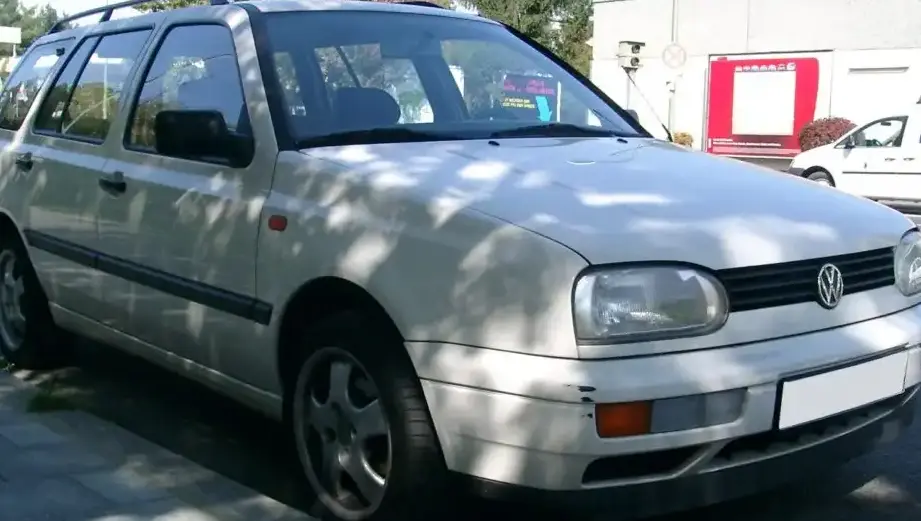
The Volkswagen Golf III Variant 1.6, producing 101 horsepower, was a popular iteration of the Golf III estate (wagon) model, manufactured between 1994 and 1999. Positioned as an entry-level to mid-range offering within the Golf III Variant lineup, it provided a practical and economical option for families and individuals needing increased cargo space. This variant was primarily sold in Europe, where the station wagon body style held significant market share. It utilized the Volkswagen Group’s A3 platform (internally designated 1HX0 for the Variant), shared with models like the SEAT Ibiza, SEAT Cordoba, and the first-generation Audi A3.
Technical Specifications
| Brand | Volkswagen |
| Model | Golf |
| Generation | Golf III Variant |
| Type (Engine) | 1.6 (101 Hp) |
| Start of production | 1994 |
| End of production | 1999 |
| Powertrain Architecture | Internal Combustion engine |
| Body type | Station wagon (estate) |
| Seats | 5 |
| Doors | 5 |
| Fuel consumption (combined) | 7.8 l/100 km (30.2 US mpg, 36.2 UK mpg, 12.8 km/l) |
| Fuel Type | Petrol (Gasoline) |
| Acceleration 0 – 100 km/h | 11.9 sec |
| Acceleration 0 – 62 mph | 11.9 sec |
| Acceleration 0 – 60 mph | 11.3 sec |
| Maximum speed | 185 km/h (114.95 mph) |
| Weight-to-power ratio | 11.8 kg/Hp, 84.9 Hp/tonne |
| Weight-to-torque ratio | 8.2 kg/Nm, 121.8 Nm/tonne |
| Power | 101 Hp @ 5600 rpm |
| Power per litre | 63.3 Hp/l |
| Torque | 145 Nm @ 3800 rpm (106.95 lb.-ft. @ 3800 rpm) |
| Engine layout | Front, Longitudinal |
| Engine Model/Code | AEK, AFT |
| Engine displacement | 1595 cm3 (97.33 cu. in.) |
| Number of cylinders | 4 |
| Engine configuration | Inline |
| Cylinder Bore | 81 mm (3.19 in.) |
| Piston Stroke | 77.4 mm (3.05 in.) |
| Compression ratio | 10.3:1 |
| Number of valves per cylinder | 2 |
| Fuel injection system | Multi-port manifold injection |
| Engine aspiration | Naturally aspirated engine |
| Valvetrain | OHC |
| Engine oil capacity | 4 l (4.23 US qt | 3.52 UK qt) |
| Coolant | 5.6 l (5.92 US qt | 4.93 UK qt) |
| Kerb Weight | 1190 kg (2623.5 lbs.) |
| Max. weight | 1615 kg (3560.47 lbs.) |
| Max load | 425 kg (936.96 lbs.) |
| Trunk (boot) space – minimum | 466 l (16.46 cu. ft.) |
| Trunk (boot) space – maximum | 1425 l (50.32 cu. ft.) |
| Fuel tank capacity | 60 l (15.85 US gal | 13.2 UK gal) |
| Length | 4340 mm (170.87 in.) |
| Width | 1695 mm (66.73 in.) |
| Height | 1430 mm (56.3 in.) |
| Wheelbase | 2475 mm (97.44 in.) |
| Front track | 1478 mm (58.19 in.) |
| Rear (Back) track | 1465 mm (57.68 in.) |
| Drivetrain Architecture | The Internal combustion engine (ICE) drives the front wheels of the vehicle. |
| Drive wheel | Front wheel drive |
| Number of gears and type of gearbox | 5 gears, manual transmission |
| Front suspension | Wishbone |
| Rear suspension | Suspension with traction connecting levers |
| Front brakes | Disc |
| Rear brakes | Drum |
| Assisting systems | ABS (Anti-lock braking system) |
| Steering type | Steering rack and pinion |
| Power steering | Hydraulic Steering |
| Tires size | 185/60 R14 |
| Wheel rims size | 14 |
Powertrain & Engine Architecture
The Golf III Variant 1.6 was powered by the Volkswagen AEK or AFT engine, a 1.6-liter inline-four cylinder gasoline engine. These engines were part of Volkswagen’s EA827 family. The AEK was carbureted, while the AFT featured multi-point fuel injection, offering a slight performance and efficiency advantage. Both engines utilized a single overhead camshaft (OHC) design with two valves per cylinder. The engine’s longitudinal mounting allowed for front-wheel drive via a five-speed manual transmission. The 1.6-liter engine was known for its relative simplicity and durability, though it wasn’t a powerhouse. The fuel injection system (on the AFT variant) was a Bosch Motronic system, controlling fuel delivery based on engine load and speed.
Driving Characteristics
The 1.6-liter engine in the Golf III Variant provided adequate, but not exhilarating, performance. With 101 horsepower, acceleration from 0 to 60 mph took around 11.3 seconds, and top speed was approximately 115 mph. The five-speed manual transmission was well-matched to the engine’s characteristics, offering reasonable gear spacing. Compared to the more powerful 1.8-liter and VR6 variants, the 1.6 felt noticeably slower, particularly when fully loaded or climbing hills. However, the 1.6 offered a more economical driving experience, with combined fuel consumption around 30.2 US mpg. The gear ratios were optimized for fuel efficiency rather than outright performance, resulting in a relaxed cruising experience.
Equipment & Trim Levels
The Golf III Variant 1.6 typically came with a fairly basic level of equipment, reflecting its position as an entry-level model. Standard features generally included power steering, central locking, and a basic stereo system. Interior upholstery was typically cloth, and the dashboard featured a simple, functional design. Optional extras included power windows, air conditioning, alloy wheels, and a sunroof. Higher trim levels, such as the ‘GL’ offered more luxurious appointments, including upgraded upholstery, additional chrome trim, and more comprehensive equipment lists. The Variant’s defining feature, of course, was its spacious cargo area, making it a practical choice for families and those needing to transport larger items.
Chassis & Braking
The Golf III Variant 1.6 utilized a MacPherson strut front suspension and a torsion beam rear suspension. The suspension setup was tuned for comfort and ride quality, rather than sporty handling. Front brakes were ventilated discs, while rear brakes were drums. ABS (Anti-lock Braking System) was often included as standard equipment, enhancing safety. The chassis was relatively lightweight, contributing to the car’s decent fuel economy. Stabilizer bars were fitted to both the front and rear axles, helping to reduce body roll during cornering. The suspension components were generally robust and reliable, though they could require maintenance after extended use.
Market Reception & Comparison
The Golf III Variant 1.6 was generally well-received as a practical and affordable estate car. Critics praised its spacious interior, good fuel economy, and comfortable ride. However, the engine’s lack of power was often noted as a drawback, particularly when compared to the more powerful variants. The 1.8-liter Golf III Variant offered significantly better performance, while the VR6 provided a more luxurious and sporty experience. The 1.9 TDI diesel variant was favored by those prioritizing fuel economy and low-speed torque. In terms of reliability, the 1.6-liter engine was generally considered to be very dependable, though regular maintenance was essential.
Legacy
The Golf III Variant 1.6 remains a relatively common sight on European roads today, testament to its durability and practicality. While not a particularly sought-after model by enthusiasts, it represents a solid and dependable choice for those seeking an affordable and spacious estate car. Parts availability is generally good, and maintenance costs are relatively low. The 1.6-liter engine is known for its longevity, and many examples are still running reliably with over 200,000 miles on the odometer. The Golf III Variant 1.6 holds a place as a practical and economical family car from a significant era in Volkswagen’s history.