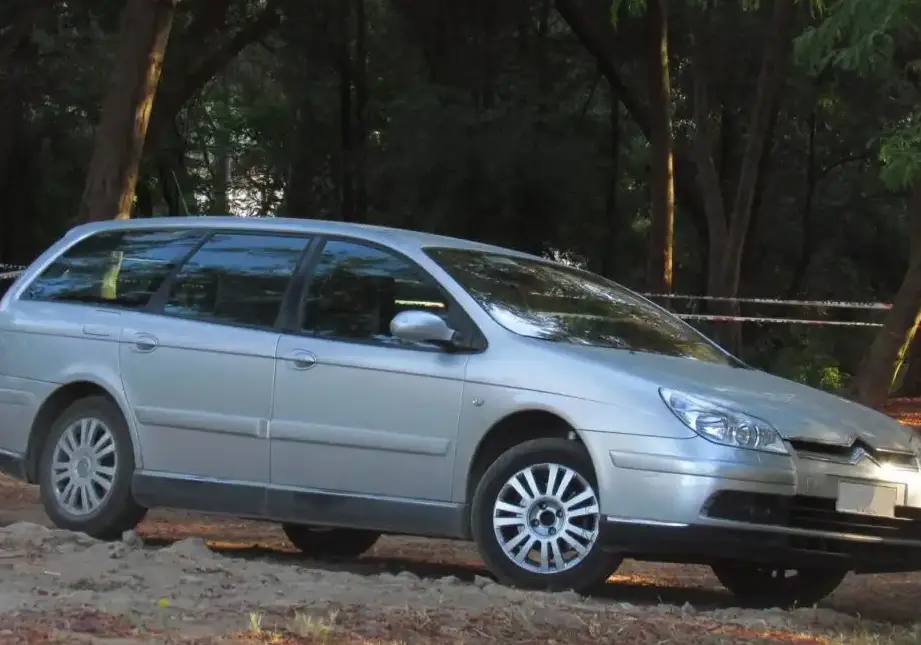
The Citroën C5 I Break, specifically the Phase II model produced from 2004 to 2005, represented a significant offering in the European mid-size station wagon segment. The 1.8i 16V variant, equipped with a 116 horsepower engine and automatic transmission, was positioned as a comfortable and practical choice for families and drivers prioritizing ease of use over outright performance. This version of the C5 Break (estate) sat within the broader C5 I generation (produced from 2001-2008), which aimed to blend comfort, technology, and practicality in a stylish package. The Phase II refresh brought subtle styling updates and improvements to interior materials and equipment.
Technical Specifications
| Brand | Citroën |
| Model | C5 |
| Generation | C5 I Break (Phase II, 2004) |
| Type (Engine) | 1.8i 16V (116 Hp) |
| Start of production | 2004 |
| End of production | 2005 |
| Powertrain Architecture | Internal Combustion engine |
| Body type | Station wagon (estate) |
| Seats | 5 |
| Doors | 5 |
| Fuel consumption (urban) | 11.5 l/100 km (20.5 US mpg, 24.6 UK mpg, 8.7 km/l) |
| Fuel consumption (extra urban) | 6 l/100 km (39.2 US mpg, 47.1 UK mpg, 16.7 km/l) |
| Fuel consumption (combined) | 8 l/100 km (29.4 US mpg, 35.3 UK mpg, 12.5 km/l) |
| Fuel Type | Petrol (Gasoline) |
| Acceleration 0 – 100 km/h | 11.6 sec |
| Acceleration 0 – 62 mph | 11.6 sec |
| Acceleration 0 – 60 mph | 11 sec |
| Maximum speed | 193 km/h (119.92 mph) |
| Emission standard | Euro 3 |
| Weight-to-power ratio | 12.2 kg/Hp, 81.9 Hp/tonne |
| Weight-to-torque ratio | 8.9 kg/Nm, 113 Nm/tonne |
| Power | 116 Hp @ 5500 rpm |
| Power per litre | 66.3 Hp/l |
| Torque | 160 Nm @ 4000 rpm (118.01 lb.-ft. @ 4000 rpm) |
| Engine layout | Front, Transverse |
| Engine Model/Code | 6FZ EW7J4 |
| Engine displacement | 1749 cm3 (106.73 cu. in.) |
| Number of cylinders | 4 |
| Engine configuration | Inline |
| Cylinder Bore | 82.7 mm (3.26 in.) |
| Piston Stroke | 81.4 mm (3.2 in.) |
| Compression ratio | 10.8:1 |
| Number of valves per cylinder | 4 |
| Fuel injection system | Multi-port manifold injection |
| Engine aspiration | Naturally aspirated engine |
| Engine oil capacity | 4.25 l (4.49 US qt | 3.74 UK qt) |
| Coolant | 8.8 l (9.3 US qt | 7.74 UK qt) |
| Kerb Weight | 1416 kg (3121.75 lbs.) |
| Max. weight | 2016 kg (4444.52 lbs.) |
| Max load | 600 kg (1322.77 lbs.) |
| Trunk (boot) space – minimum | 563 l (19.88 cu. ft.) |
| Trunk (boot) space – maximum | 1658 l (58.55 cu. ft.) |
| Fuel tank capacity | 66 l (17.44 US gal | 14.52 UK gal) |
| Max. roof load | 75 kg (165.35 lbs.) |
| Permitted towbar download | 75 kg (165.35 lbs.) |
| Length | 4839 mm (190.51 in.) |
| Width | 1780 mm (70.08 in.) |
| Height | 1511 mm (59.49 in.) |
| Wheelbase | 2750 mm (108.27 in.) |
| Front track | 1528 mm (60.16 in.) |
| Rear (Back) track | 1495 mm (58.86 in.) |
| Front overhang | 1033 mm (40.67 in.) |
| Rear overhang | 1056 mm (41.57 in.) |
| Minimum turning circle | 12.43 m (40.78 ft.) |
| Drivetrain Architecture | Front wheel drive |
| Drive wheel | Front wheel drive |
| Number of gears and type of gearbox | 5 gears, automatic transmission |
| Front suspension | Independent, type McPherson with coil spring and anti-roll bar |
| Rear suspension | Semi-independent, coil spring |
| Front brakes | Ventilated discs |
| Rear brakes | Disc |
| Assisting systems | ABS (Anti-lock braking system) |
| Tires size | 215/55 R15 |
| Wheel rims size | 15 |
Powertrain & Engine Architecture
The 1.8i 16V engine, designated 6FZ (often associated with the EW7J4 engine code developed in collaboration with Peugeot), is a naturally aspirated, inline-four cylinder gasoline engine. It features a multi-point fuel injection system and a double overhead camshaft (DOHC) valvetrain with four valves per cylinder. This configuration allowed for reasonable power output and a relatively broad torque curve. The 116 horsepower peak arrived at 5500 rpm, while the 160 Nm (118 lb-ft) of torque was available at 4000 rpm. The engine’s 10.8:1 compression ratio was typical for the era, balancing performance and fuel efficiency. Paired with this engine was a four-speed automatic transmission, which was a common choice for drivers seeking convenience. This transmission, while providing smooth shifts, wasn’t known for its sportiness or fuel efficiency compared to the available manual gearbox.
Driving Characteristics
The C5 I Break 1.8i Automatic offered a comfortable and relaxed driving experience. Acceleration was adequate for everyday driving, with a 0-60 mph time of around 11 seconds. However, it wasn’t a particularly quick car, and overtaking maneuvers required careful planning. The automatic transmission, while smooth, could feel somewhat sluggish, especially when downshifting. Compared to the manual transmission version, the automatic suffered a slight performance penalty. The 1.8L engine, while sufficient, lacked the punch of the higher-output 2.0L or V6 options available in the C5 range. The gear ratios were tuned for fuel economy and comfort rather than outright performance.
Equipment & Trim Levels
The 1.8i 16V Automatic trim typically included features such as air conditioning, power windows, central locking, and an RDS radio. Higher trim levels added options like leather upholstery, automatic headlights and wipers, and a more sophisticated audio system. Safety features included ABS brakes and front airbags. The interior was generally well-appointed for its class, with comfortable seats and a functional dashboard layout. The Phase II models benefited from improved interior materials compared to earlier versions.
Chassis & Braking
The C5 I Break featured an independent front suspension with McPherson struts and a semi-independent rear suspension with coil springs. This setup provided a comfortable ride, absorbing bumps and imperfections in the road effectively. The front brakes were ventilated discs, while the rear brakes were solid discs. ABS was standard, providing enhanced braking performance and stability. The suspension was tuned for comfort, prioritizing ride quality over sporty handling. Stabilizer bars were fitted to both the front and rear axles to reduce body roll during cornering.
Market Reception & Comparison
The C5 I Break 1.8i Automatic was generally well-received by critics as a practical and comfortable family car. However, some reviewers noted its lack of performance compared to rivals and the somewhat dated feel of the automatic transmission. Fuel economy was considered average for its class. Compared to the 2.0L and V6 variants, the 1.8L offered a more affordable entry point into the C5 range, but at the expense of performance. The 1.9 TDI diesel version was a popular alternative for those prioritizing fuel efficiency and torque.
Legacy
The Citroën C5 I Break 1.8i Automatic has proven to be a relatively reliable car, with the 6FZ engine generally considered durable. However, like any older vehicle, it’s prone to age-related issues such as corrosion and wear and tear on suspension components. The automatic transmission, while generally reliable, can require servicing. Today, these cars are readily available on the used car market at affordable prices, making them an attractive option for budget-conscious buyers seeking a spacious and comfortable station wagon. Parts availability is generally good, and the C5’s relatively simple mechanical design makes it accessible for DIY maintenance.