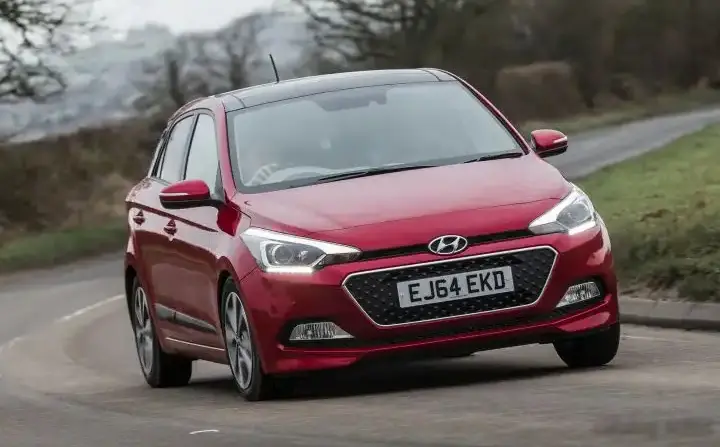
The Hyundai i20 II (GB) 1.1 CRDi 75 hp model, produced between 2014 and 2018, represented an entry-level diesel option within the second generation of Hyundai’s popular subcompact hatchback. Positioned as a fuel-efficient and economical choice, it catered to buyers prioritizing low running costs over outright performance. This variant was primarily sold in the European market, where demand for small, diesel-powered vehicles remained strong. It formed part of the PB/GB series, Hyundai’s second-generation i20, which aimed to improve upon the first generation’s design, refinement, and overall quality.
Technical Specifications
| Brand | Hyundai |
| Model | i20 |
| Generation | i20 II (GB) |
| Type (Engine) | 1.1 CRDi (75 Hp) |
| Start of production | 2014 |
| End of production | 2018 |
| Powertrain Architecture | Internal Combustion engine |
| Body type | Hatchback |
| Seats | 5 |
| Doors | 5 |
| Fuel consumption (urban) | 3.5 – 4.9 l/100 km (67.2 – 48 US mpg, 80.7 – 57.6 UK mpg, 28.6 – 20.4 km/l) |
| Fuel consumption (extra urban) | 3.1 – 3.4 l/100 km (75.9 – 69.2 US mpg, 91.1 – 83.1 UK mpg, 32.3 – 29.4 km/l) |
| Fuel consumption (combined) | 3.3 – 4.0 l/100 km (71.3 – 58.8 US mpg, 85.6 – 70.6 UK mpg, 30.3 – 25 km/l) |
| CO2 emissions | 84 – 103 g/km |
| Fuel Type | Diesel |
| Acceleration 0 – 100 km/h | 16 sec |
| Acceleration 0 – 62 mph | 16 sec |
| Acceleration 0 – 60 mph | 15.2 sec |
| Maximum speed | 159 km/h (98.8 mph) |
| Emission standard | Euro 6 |
| Weight-to-power ratio | 15.2 kg/Hp, 65.6 Hp/tonne |
| Weight-to-torque ratio | 6.4 kg/Nm, 157.5 Nm/tonne |
| Power | 75 Hp @ 4000 rpm |
| Power per litre | 67 Hp/l |
| Torque | 180 Nm @ 1750-2500 rpm (132.76 lb.-ft. @ 1750-2500 rpm) |
| Engine layout | Front, Transverse |
| Engine Model/Code | D3FA |
| Engine displacement | 1120 cm3 (68.35 cu. in.) |
| Number of cylinders | 3 |
| Engine configuration | Inline |
| Cylinder Bore | 75 mm (2.95 in.) |
| Piston Stroke | 84.5 mm (3.33 in.) |
| Compression ratio | 16:1 |
| Number of valves per cylinder | 4 |
| Fuel injection system | Diesel Commonrail |
| Engine aspiration | Turbocharger, Intercooler |
| Engine oil capacity | 4.8 l (5.07 US qt | 4.22 UK qt) |
| Coolant | 6.4 l (6.76 US qt | 5.63 UK qt) |
| Kerb Weight | 1143 kg (2519.88 lbs.) |
| Max. weight | 1680 kg (3703.77 lbs.) |
| Max load | 537 kg (1183.88 lbs.) |
| Trunk (boot) space – minimum | 326 l (11.51 cu. ft.) |
| Trunk (boot) space – maximum | 1042 l (36.8 cu. ft.) |
| Fuel tank capacity | 50 l (13.21 US gal | 11 UK gal) |
| Max. roof load | 70 kg (154.32 lbs.) |
| Length | 4035 mm (158.86 in.) |
| Width | 1734 mm (68.27 in.) |
| Height | 1474 mm (58.03 in.) |
| Wheelbase | 2570 mm (101.18 in.) |
| Front track | 1514-1520 mm (59.61 – 59.84 in.) |
| Rear (Back) track | 1513-1519 mm (59.57 – 59.8 in.) |
| Front overhang | 815 mm (32.09 in.) |
| Rear overhang | 650 mm (25.59 in.) |
| Ride height (ground clearance) | 140 mm (5.51 in.) |
| Minimum turning circle | 10.2 m (33.46 ft.) |
| Drivetrain Architecture | The Internal combustion engine (ICE) drives the front wheels of the vehicle. |
| Drive wheel | Front wheel drive |
| Number of gears and type of gearbox | 6 gears, manual transmission |
| Front suspension | Independent type McPherson |
| Rear suspension | Semi-independent, coil spring |
| Front brakes | Ventilated discs |
| Rear brakes | Disc |
| Assisting systems | ABS (Anti-lock braking system) |
| Steering type | Steering rack and pinion |
| Power steering | Electric Steering |
| Tires size | 185/65 R15; 195/55 R16 |
| Wheel rims size | 6.0J x 15; 6.0J x 16 |
INTRODUCTION
The Hyundai i20 II (GB) 1.1 CRDi 75 hp, launched in 2014, was a key component of Hyundai’s strategy to gain market share in the European small car segment. Building on the success of the first-generation i20, the second generation offered a more refined and sophisticated package. The 1.1 CRDi engine was specifically chosen for its fuel efficiency and low emissions, appealing to cost-conscious buyers and those facing increasingly stringent environmental regulations. This model occupied the lower end of the i20 range, serving as the entry point into the diesel lineup. It was designed to compete with rivals like the Volkswagen Polo, Ford Fiesta, and Renault Clio.
Powertrain & Engine Architecture
The heart of this i20 variant is the Hyundai D3FA 1.1-liter three-cylinder diesel engine. This engine utilizes a common-rail direct injection system, delivering fuel at extremely high pressure for improved combustion efficiency and reduced emissions. The D3FA engine is a turbocharged engine, employing a small turbocharger and intercooler to boost power output. The engine’s architecture features four valves per cylinder (DOHC) and a compression ratio of 16:1. The engine produces 75 horsepower at 4000 rpm and 180 Nm (132.76 lb-ft) of torque between 1750 and 2500 rpm. The engine is transversely mounted at the front of the vehicle. The 1.1 CRDi was typically paired with a six-speed manual transmission, although an automatic transmission was available in some markets. The automatic transmission is a conventional torque converter type, prioritizing smooth shifts over outright performance.
Driving Characteristics
The 1.1 CRDi 75 hp i20 prioritizes fuel economy over spirited acceleration. The engine delivers adequate power for urban driving and moderate highway speeds, but it can feel strained when fully loaded or attempting quick overtaking maneuvers. The six-speed manual transmission helps to keep the engine in its optimal torque band, but the relatively low horsepower output means that the car requires frequent downshifts when climbing hills or accelerating. Compared to higher-output i20 variants, such as those equipped with the 1.4-liter gasoline engine, the 1.1 CRDi feels noticeably slower. However, the engine’s strong low-end torque makes it surprisingly tractable in everyday driving conditions. The automatic transmission, while offering convenience, further diminishes acceleration performance due to its less efficient power transfer.
Equipment & Trim Levels
The 1.1 CRDi 75 hp i20 typically came equipped with a reasonable level of standard equipment, though it was generally less lavish than higher-spec models. Standard features often included air conditioning, power steering, central locking, electric front windows, and a basic audio system with USB connectivity. Safety features such as ABS, ESP (Electronic Stability Program), and multiple airbags were also standard. Higher trim levels, such as SE or Premium, added features like alloy wheels, rear electric windows, a more advanced audio system, and climate control. Optional extras included a panoramic sunroof, parking sensors, and a navigation system.
Chassis & Braking
The i20 II (GB) utilized a McPherson strut front suspension and a semi-independent torsion beam rear suspension. This setup provided a comfortable ride quality, well-suited for everyday driving. The front brakes were ventilated discs, while the rear brakes were typically solid discs. The steering was electrically assisted, providing light and precise control. The suspension was tuned for comfort rather than sporty handling, resulting in a slight degree of body roll during cornering. The relatively lightweight nature of the 1.1 CRDi variant helped to mitigate the effects of the softer suspension setup.
Market Reception & Comparison
The Hyundai i20 II 1.1 CRDi 75 hp was generally well-received by automotive critics for its fuel efficiency and low running costs. However, its performance was often criticized as being underwhelming, particularly when compared to more powerful rivals. Fuel economy figures consistently ranked among the best in its class, making it an attractive option for budget-conscious buyers. Compared to the 1.2-liter gasoline engine variant, the 1.1 CRDi offered significantly better fuel economy but at the cost of performance. The 1.4-liter gasoline engine provided a more engaging driving experience but was less economical. Reliability proved to be generally good, with few reported issues specific to the 1.1 CRDi engine.
Legacy
The Hyundai i20 II 1.1 CRDi 75 hp remains a popular choice in the used car market, particularly for those seeking an economical and reliable small car. The D3FA engine has proven to be durable and relatively maintenance-free, although regular servicing is essential to ensure long-term reliability. While not a performance car, the 1.1 CRDi i20 offers a practical and affordable transportation solution. Its fuel efficiency and low emissions continue to make it a relevant option in today’s environmentally conscious automotive landscape. The model helped solidify Hyundai’s reputation for building well-equipped and reliable vehicles at a competitive price point.