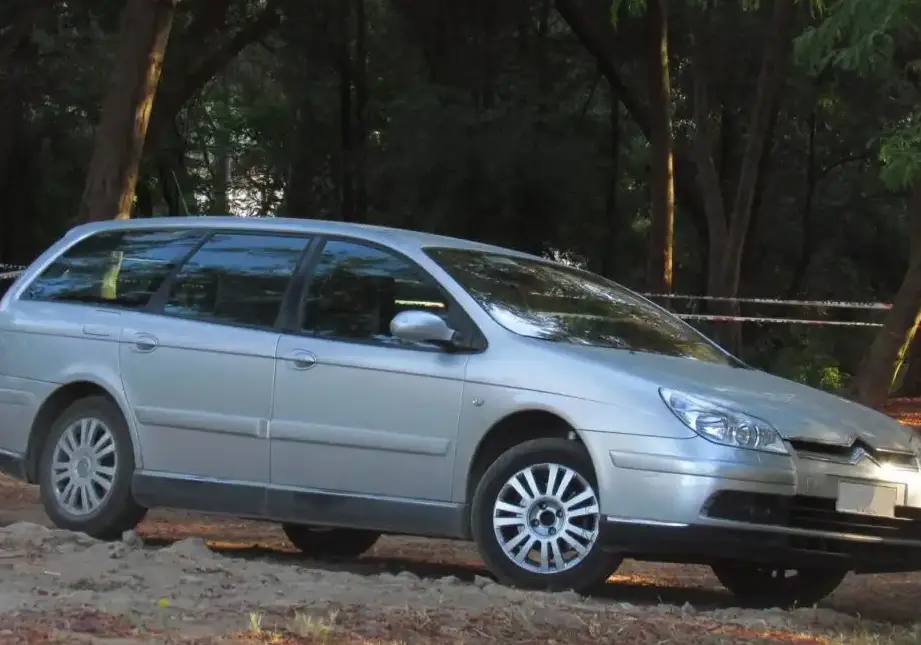
The Citroën C5 I Break (Phase II), produced from 2004 to 2008, represented a significant evolution of Citroën’s large family car. This variant, specifically the 2.0i 16V model producing 140 horsepower, occupied a middle ground within the C5 Break lineup, offering a balance between performance, fuel economy, and comfort. Positioned above the base 1.8-liter engine and below the more powerful 3.0-liter V6, the 2.0i 16V catered to buyers seeking a capable and refined estate car for long-distance travel and family duties. It was a key offering in the European market, where station wagons (breaks) remained highly popular.
Technical Specifications
| Brand | Citroën |
| Model | C5 |
| Generation | C5 I Break (Phase II, 2004) |
| Type (Engine) | 2.0i 16V (140 Hp) |
| Start of production | 2004 |
| End of production | 2008 |
| Powertrain Architecture | Internal Combustion engine |
| Body type | Station wagon (estate) |
| Seats | 5 |
| Doors | 5 |
| Fuel consumption (urban) | 11.1 l/100 km (21.2 US mpg, 25.4 UK mpg, 9 km/l) |
| Fuel consumption (extra urban) | 6.3 l/100 km (37.3 US mpg, 44.8 UK mpg, 15.9 km/l) |
| Fuel consumption (combined) | 8 l/100 km (29.4 US mpg, 35.3 UK mpg, 12.5 km/l) |
| CO2 emissions | 190 g/km |
| Fuel Type | Petrol (Gasoline) |
| Acceleration 0 – 100 km/h | 9.3 sec |
| Acceleration 0 – 62 mph | 9.3 sec |
| Acceleration 0 – 60 mph | 8.8 sec |
| Maximum speed | 205 km/h (127.38 mph) |
| Emission standard | Euro 4 |
| Weight-to-power ratio | 10.2 kg/Hp, 98.1 Hp/tonne |
| Weight-to-torque ratio | 7.1 kg/Nm, 140.2 Nm/tonne |
| Power | 140 Hp @ 6000 rpm |
| Power per litre | 70.1 Hp/l |
| Torque | 200 Nm @ 4000 rpm (147.51 lb.-ft. @ 4000 rpm) |
| Engine layout | Front, Transverse |
| Engine Model/Code | RFJ EW10A |
| Engine displacement | 1997 cm3 (121.86 cu. in.) |
| Number of cylinders | 4 |
| Engine configuration | Inline |
| Cylinder Bore | 85 mm (3.35 in.) |
| Piston Stroke | 88 mm (3.46 in.) |
| Compression ratio | 10.8:1 |
| Number of valves per cylinder | 4 |
| Fuel injection system | Multi-port manifold injection |
| Engine aspiration | Naturally aspirated engine |
| Engine oil capacity | 5 l (5.28 US qt | 4.4 UK qt) |
| Coolant | 8.8 l (9.3 US qt | 7.74 UK qt) |
| Kerb Weight | 1427 kg (3146 lbs.) |
| Max. weight | 2027 kg (4468.77 lbs.) |
| Max load | 600 kg (1322.77 lbs.) |
| Trunk (boot) space – minimum | 563 l (19.88 cu. ft.) |
| Trunk (boot) space – maximum | 1658 l (58.55 cu. ft.) |
| Fuel tank capacity | 66 l (17.44 US gal | 14.52 UK gal) |
| Max. roof load | 75 kg (165.35 lbs.) |
| Permitted trailer load with brakes (12%) | 1500 kg (3306.93 lbs.) |
| Permitted trailer load without brakes | 720 kg (1587.33 lbs.) |
| Permitted towbar download | 75 kg (165.35 lbs.) |
| Length | 4839 mm (190.51 in.) |
| Width | 1780 mm (70.08 in.) |
| Height | 1511 mm (59.49 in.) |
| Wheelbase | 2750 mm (108.27 in.) |
| Front track | 1528 mm (60.16 in.) |
| Rear (Back) track | 1495 mm (58.86 in.) |
| Front overhang | 1033 mm (40.67 in.) |
| Rear overhang | 1056 mm (41.57 in.) |
| Minimum turning circle (turning diameter) | 12.43 m (40.78 ft.) |
| Drivetrain Architecture | The Internal combustion engine (ICE) drives the front wheels of the vehicle. |
| Drive wheel | Front wheel drive |
| Number of gears and type of gearbox | 5 gears, manual transmission |
| Front suspension | Independent, type McPherson with coil spring and anti-roll bar |
| Rear suspension | Semi-independent, coil spring |
| Front brakes | Ventilated discs |
| Rear brakes | Disc |
| Assisting systems | ABS (Anti-lock braking system) |
| Steering type | Steering rack and pinion |
| Power steering | Hydraulic Steering |
| Tires size | 215/55 R15 |
| Wheel rims size | 15 |
Powertrain & Engine Architecture
The heart of this C5 variant is the EW10A engine, a 2.0-liter inline-four cylinder petrol engine. This engine, designated RFJ in Citroën’s nomenclature, is a naturally aspirated unit featuring a 10.8:1 compression ratio and a multi-port fuel injection system. The 16-valve cylinder head, with four valves per cylinder, contributes to its respectable power output. The EW10A engine is known for its relatively smooth operation and durability. It’s a design shared with Peugeot and, for a time, was also used in some Ford models as part of a joint venture. The engine’s 200 Nm of torque, delivered at 4000 rpm, provides adequate pulling power for everyday driving and highway cruising. The engine is transversely mounted in the front of the vehicle, driving the front wheels. The standard transmission for this model was a five-speed manual gearbox, although a four-speed automatic transmission was also available, impacting performance and fuel economy.
Driving Characteristics
The 2.0i 16V C5 Break offered a comfortable and composed driving experience. While not a sports car, the 140 horsepower engine provided sufficient power for confident overtaking and maintaining highway speeds. Acceleration from 0 to 60 mph took around 8.8 seconds, which was respectable for the time. The five-speed manual transmission allowed drivers to make the most of the engine’s powerband, while the optional automatic, though convenient, resulted in slightly slower acceleration and increased fuel consumption. The C5’s renowned hydropneumatic suspension (though evolving towards more conventional setups in later Phase II models) provided a remarkably smooth ride, absorbing bumps and imperfections in the road with ease. Steering was light and precise, making the car easy to maneuver in urban environments.
Equipment & Trim Levels
The 2.0i 16V C5 Break typically came equipped with a reasonable level of standard features. These included power windows, central locking, air conditioning, and an RDS stereo. Higher trim levels, such as Exclusive, added features like leather upholstery, automatic climate control, alloy wheels, and a trip computer. Optional extras included a sunroof, parking sensors, and a premium sound system. Interior upholstery was generally cloth on the base models, with leather available as an upgrade. The dashboard layout was functional and ergonomically designed, with clear instrumentation and intuitive controls.
Chassis & Braking
The C5 Break featured independent front suspension with McPherson struts and a coil spring and anti-roll bar. The rear suspension was a semi-independent torsion beam setup, which provided a good balance between ride comfort and handling. Braking was handled by ventilated discs at the front and solid discs at the rear, providing adequate stopping power. ABS (Anti-lock Braking System) was standard, enhancing safety in emergency braking situations. The C5’s chassis was designed to prioritize comfort and stability, rather than outright sportiness.
Market Reception & Comparison
The Citroën C5 I Break 2.0i 16V was generally well-received by automotive critics. It was praised for its comfortable ride, spacious interior, and practical estate car body style. However, some critics noted that the engine, while adequate, wasn’t particularly exciting. Compared to the 1.8-liter version, the 2.0i 16V offered a noticeable performance improvement, making it a more suitable choice for drivers who frequently carried passengers or luggage. Compared to the more expensive 3.0-liter V6, the 2.0i 16V provided a more affordable option with reasonable fuel economy. Fuel economy figures of around 29.4 US mpg combined were competitive for its class.
Legacy
The Citroën C5 I Break 2.0i 16V has proven to be a relatively reliable vehicle, with the EW10A engine being known for its durability. However, like all cars of this age, regular maintenance is crucial to prevent issues. Common problems can include wear and tear on suspension components and occasional electrical glitches. On the used car market, these C5 Breaks represent a good value proposition for buyers seeking a comfortable, spacious, and practical estate car. Parts availability is generally good, and the car’s relatively simple mechanical design makes it relatively easy to maintain and repair. The C5 Break continues to be appreciated by those who value its unique blend of French comfort and practicality.