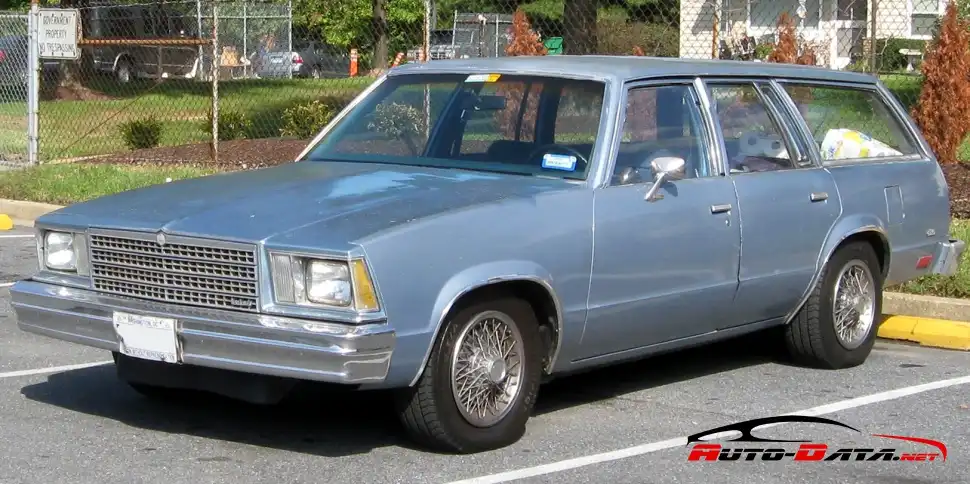
The Chevrolet Malibu IV Station Wagon, produced for a limited run between 1978 and 1979, represented a somewhat unusual offering from Chevrolet during a period of increasing downsizing in the American automotive industry. This generation Malibu, built on the A-body platform, was available in a variety of configurations, including a two-door coupe, a four-door sedan, and the station wagon body style. The 4.4-liter V8 engine paired with a three-speed automatic transmission was a mid-range option, positioned between the smaller six-cylinder engines and the more potent, though less common, larger displacement V8s. This particular variant aimed to provide a balance of family practicality, reasonable performance, and a degree of comfort for the American driver.
Technical Specifications
| Brand | Chevrolet |
| Model | Malibu |
| Generation | Malibu IV Station Wagon |
| Type (Engine) | 4.4 V8 (125 Hp) CAT Automatic |
| Start of production | 1978 |
| End of production | 1979 |
| Powertrain Architecture | Internal Combustion engine |
| Body type | Station wagon (estate) |
| Seats | 6 |
| Doors | 5 |
| Fuel Type | Petrol (Gasoline) |
| Weight-to-power ratio | 12.4 kg/Hp, 80.9 Hp/tonne |
| Weight-to-torque ratio | 5.3 kg/Nm, 189 Nm/tonne |
| Power | 125 Hp @ 3800 rpm |
| Power per litre | 28.5 Hp/l |
| Torque | 292 Nm @ 2400 rpm, 215.37 lb.-ft. @ 2400 rpm |
| Engine layout | Front, Longitudinal |
| Engine displacement | 4389 cm3, 267.83 cu. in. |
| Number of cylinders | 8 |
| Engine configuration | V-engine |
| Cylinder Bore | 88.9 mm, 3.5 in. |
| Piston Stroke | 88.4 mm, 3.48 in. |
| Compression ratio | 8.2:1 |
| Number of valves per cylinder | 2 |
| Fuel injection system | Carburettor |
| Engine aspiration | Naturally aspirated engine |
| Valvetrain | OHV |
| Engine oil capacity | 4 l, 4.23 US qt | 3.52 UK qt |
| Kerb Weight | 1545 kg, 3406.14 lbs |
| Trunk (boot) space – minimum | 1133 l, 40.01 cu. ft |
| Trunk (boot) space – maximum | 2050 l, 72.4 cu. ft |
| Fuel tank capacity | 69 l, 18.23 US gal | 15.18 UK gal |
| Length | 4911 mm, 193.35 in |
| Width | 1816 mm, 71.5 in |
| Height | 1384 mm, 54.49 in |
| Wheelbase | 2745 mm, 108.07 in |
| Front track | 1486 mm, 58.5 in |
| Rear (Back) track | 1467 mm, 57.76 in |
| Front overhang | 915 mm, 36.02 in |
| Rear overhang | 1251 mm, 49.25 in |
| Ride height (ground clearance) | 145 mm, 5.71 in |
| Minimum turning circle (turning diameter) | 13.0 m, 42.65 ft |
| Approach angle | 20° |
| Departure angle | 15° |
| Ramp-over (brakeover) angle | 14° |
| Drivetrain Architecture | The Internal combustion engine (ICE) drives the rear wheels of the vehicle. |
| Drive wheel | Rear wheel drive |
| Number of gears and type of gearbox | 3 gears, automatic transmission |
| Front suspension | Independent, type McPherson with coil spring and anti-roll bar |
| Rear suspension | dependent spring suspension, Transverse stabilizer, Trailing arm |
| Front brakes | Ventilated discs |
| Rear brakes | Drum |
| Steering type | Steering rack and pinion |
| Tires size | 195/75 R14 |
| Wheel rims size | 6.0J x 14 |
Powertrain & Engine Architecture
The heart of this Malibu variant was the 4.4-liter (268 cubic inch) Chevrolet small-block V8 engine. While often referred to as a 350 due to its approximate displacement, this engine was a slightly downsized version. It featured a cast iron block and cylinder heads, with a two-barrel carburetor managing fuel delivery. The engine utilized an overhead valve (OHV) valvetrain, a relatively simple and robust design common in American V8s of the era. The catalytic converter (“CAT” in the model designation) was a relatively new addition, mandated by increasingly stringent emissions regulations. The three-speed automatic transmission, a Turbo-Hydramatic 350, was a staple of General Motors vehicles for decades, known for its durability and smooth operation. This transmission was selected for its ease of use and suitability for family-oriented vehicles.
Driving Characteristics
The 125 horsepower and 215 lb-ft of torque produced by the 4.4L V8, while adequate, didn’t make the Malibu station wagon a performance machine. Acceleration was best described as leisurely, with a 0-60 mph time likely in the 11-12 second range. The automatic transmission, while smooth, had relatively wide gear ratios, prioritizing fuel economy over spirited driving. Compared to the available six-cylinder engines, the V8 offered more effortless cruising, particularly when fully loaded with passengers and cargo. However, it lacked the responsiveness of the larger displacement V8s offered in other Malibu trims. The rear-wheel-drive configuration provided a traditional driving feel, but also meant that handling was not as precise as more modern front-wheel-drive vehicles.
Equipment & Trim Levels
The 1.8L Automatic Malibu station wagon typically came with a fairly standard level of equipment for the late 1970s. This included cloth upholstery, a basic AM radio, and manual windows and locks. Air conditioning was a popular option, as was power steering. The station wagon configuration itself added features like a rear window wiper and a fold-flat rear seat for increased cargo versatility. Interior trim was generally functional and durable, with a focus on practicality rather than luxury. Optional extras could include upgraded sound systems, cruise control, and different exterior color combinations.
Chassis & Braking
The Malibu IV station wagon utilized a body-on-frame construction, a common practice for American cars of the time. The front suspension was independent, employing McPherson struts with coil springs and an anti-roll bar. The rear suspension was a more traditional solid axle setup with coil springs and a transverse stabilizer. This configuration provided a comfortable ride, but wasn’t particularly sporty. Braking duties were handled by ventilated discs at the front and drum brakes at the rear. While adequate for normal driving, the braking system lacked the stopping power and modulation of more modern systems.
Market Reception & Comparison
The 4.4L V8/Automatic Malibu station wagon was generally viewed as a sensible and practical choice for families. Critics acknowledged its spacious interior and comfortable ride, but often noted its lack of performance. Fuel economy, even for the late 1970s, was not a strong point. Compared to the six-cylinder versions, the V8 offered more power but at the cost of increased fuel consumption. Against the larger V8-powered Malibus, it represented a more affordable option, but with significantly less performance. The station wagon body style itself was becoming less popular as minivans and sport utility vehicles began to gain traction in the American market.
Legacy
The Chevrolet Malibu IV Station Wagon with the 4.4L V8 and automatic transmission is now a relatively rare sight on the road. While not particularly collectible, well-maintained examples are appreciated by enthusiasts of classic American cars. The 350 small-block V8 is known for its durability and relative ease of repair, making it a popular choice for restoration projects. The automatic transmission, while aging, is also generally reliable if properly maintained. Today, these Malibus represent a snapshot of a bygone era in American automotive history, a time when large, comfortable station wagons were a common sight on family vacations and grocery runs.