
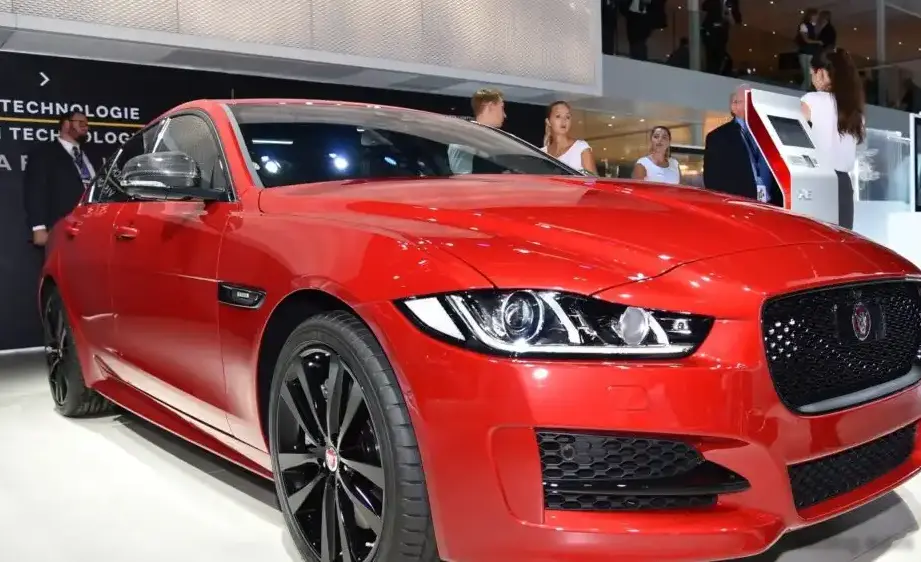
The Jaguar XE S 3.0, produced from 2017 to 2018, represented a performance-oriented variant within the first generation (X760) of the XE executive sedan. Positioned as a near-top-tier trim, it offered a significant step up in power and driving experience compared to the base 2.0-liter models, while remaining a more accessible performance option than the range-topping Project 8. The X760 platform aimed to deliver Jaguar’s traditional sporting dynamics in a more compact and efficient package, competing with established rivals like the BMW 3 Series, Audi A4, and Mercedes-Benz C-Class.
Technical Specifications
| Brand | Jaguar |
| Model | XE |
| Generation | XE (X760) |
| Type (Engine) | S 3.0 (380 Hp) Automatic |
| Start of production | 2017 |
| End of production | 2018 |
| Powertrain Architecture | Internal Combustion engine |
| Body type | Sedan |
| Seats | 5 |
| Doors | 4 |
| Fuel consumption (economy) – urban (NEDC) | 11.6 l/100 km (20.3 US mpg, 24.4 UK mpg, 8.6 km/l) |
| Fuel consumption (economy) – extra urban (NEDC) | 6.1 l/100 km (38.6 US mpg, 46.3 UK mpg, 16.4 km/l) |
| Fuel consumption (economy) – combined (NEDC) | 8.1 l/100 km (29 US mpg, 34.9 UK mpg, 12.3 km/l) |
| CO2 emissions (NEDC) | 194 g/km |
| Fuel Type | Petrol (Gasoline) |
| Acceleration 0 – 100 km/h | 5 sec |
| Acceleration 0 – 62 mph | 5 sec |
| Acceleration 0 – 60 mph | 4.8 sec |
| Maximum speed | 250 km/h (155.34 mph), Electronically limited |
| Emission standard | Euro 6 |
| Weight-to-power ratio | 4.4 kg/Hp, 229.6 Hp/tonne |
| Weight-to-torque ratio | 3.7 kg/Nm, 271.9 Nm/tonne |
| Power | 380 Hp @ 6500 rpm |
| Power per litre | 126.9 Hp/l |
| Torque | 450 Nm @ 3500-5000 rpm (331.9 lb.-ft. @ 3500-5000 rpm) |
| Engine layout | Front, Longitudinal |
| Engine Model/Code | 306PS |
| Engine displacement | 2995 cm3 (182.77 cu. in.) |
| Number of cylinders | 6 |
| Engine configuration | V-engine |
| Cylinder Bore | 84.5 mm (3.33 in.) |
| Piston Stroke | 89 mm (3.5 in.) |
| Compression ratio | 10.5:1 |
| Number of valves per cylinder | 4 |
| Fuel injection system | Direct injection |
| Engine aspiration | Supercharger, Intercooler |
| Valvetrain | DOHC |
| Engine oil capacity | 7.25 l (7.66 US qt | 6.38 UK qt) |
| Coolant | 7.8 l (8.24 US qt | 6.86 UK qt) |
| Kerb Weight | 1655 kg (3648.65 lbs.) |
| Max. weight | 2230 kg (4916.31 lbs.) |
| Max load | 575 kg (1267.66 lbs.) |
| Trunk (boot) space – minimum | 455 l (16.07 cu. ft.) |
| Fuel tank capacity | 63 l (16.64 US gal | 13.86 UK gal) |
| Length | 4672 mm (183.94 in.) |
| Width | 1850 mm (72.83 in.) |
| Width with mirrors folded | 1967 mm (77.44 in.) |
| Width including mirrors | 2075 mm (81.69 in.) |
| Height | 1416 mm (55.75 in.) |
| Wheelbase | 2835 mm (111.61 in.) |
| Front track | 1597-1602 mm (62.87 – 63.07 in.) |
| Rear (Back) track | 1573-1603 mm (61.93 – 63.11 in.) |
| Front overhang | 841 mm (33.11 in.) |
| Rear overhang | 996 mm (39.21 in.) |
| Ride height (ground clearance) | 110 mm (4.33 in.) |
| Minimum turning circle (turning diameter) | 11.2 m (36.75 ft.) |
| Drivetrain Architecture | The Internal combustion engine (ICE) drives the rear wheels of the vehicle. |
| Drive wheel | Rear wheel drive |
| Number of gears and type of gearbox | 8 gears, automatic transmission |
| Front suspension | Double wishbone, Transverse stabilizer |
| Rear suspension | Independent multi-link spring suspension with stabilizer |
| Front brakes | Ventilated discs, 350 mm |
| Rear brakes | Ventilated discs |
| Assisting systems | ABS (Anti-lock braking system) |
| Steering type | Steering rack and pinion |
| Power steering | Electric Steering |
| Tires size | Front wheel tires: 225/40 R19; 235/35 R20 Rear wheel tires: 255/35 R19; 265/30 R20 |
| Wheel rims size | Front wheel rims: 7.5J x 19; 8J x 20 Rear wheel rims: 8.5J x 19; 9J x 20 |
Powertrain & Engine Architecture
The heart of the XE S 3.0 is Jaguar’s 3.0-liter supercharged V6 engine, internally designated as the 306PS unit. This engine is a member of the AJ-126 family, known for its robust construction and smooth power delivery. It features a sixth-generation Eaton supercharger, providing instant boost and eliminating much of the turbo lag associated with turbocharged engines. Direct fuel injection ensures precise fuel metering, optimizing combustion efficiency and power output. The engine utilizes a dual overhead camshaft (DOHC) valvetrain with four valves per cylinder, maximizing airflow and contributing to its 380 horsepower and 450 Nm (331.9 lb-ft) of torque. The engine is longitudinally mounted, driving the rear wheels. The transmission is an eight-speed automatic gearbox, known for its quick shifts and smooth operation. This transmission was sourced from ZF and is widely used across various premium automotive brands.
Driving Characteristics
The combination of the supercharged V6 and the eight-speed automatic transmission delivers a compelling driving experience. Acceleration from 0-60 mph takes just 4.8 seconds, and the car feels responsive and eager in all driving situations. The automatic transmission is well-tuned, providing smooth gear changes and quick downshifts when needed. While not as raw or engaging as a manual transmission, the automatic offers a good balance of performance and convenience. The gear ratios are optimized for both acceleration and highway cruising. Compared to the 2.0-liter four-cylinder models, the S 3.0 offers a significantly more powerful and refined driving experience. It also feels more planted and stable at higher speeds, thanks to its increased weight and more sophisticated suspension setup.
Equipment & Trim Levels
The XE S 3.0 typically came well-equipped as standard. Key features included leather upholstery, a touchscreen infotainment system with navigation, automatic climate control, and a suite of safety features such as autonomous emergency braking and lane departure warning. Optional extras included a panoramic sunroof, premium sound system, and adaptive cruise control. The interior design was generally considered stylish and modern, with a focus on driver ergonomics. The S trim level also featured unique exterior styling cues, such as a sportier front bumper and side skirts.
Chassis & Braking
The XE S 3.0 utilizes a double wishbone front suspension and an independent multi-link rear suspension, providing a comfortable yet controlled ride. The suspension is tuned to balance handling and comfort, offering a good compromise for everyday driving. Stabilizer bars are fitted to both the front and rear axles to reduce body roll during cornering. The braking system consists of ventilated discs all around, providing ample stopping power. The front brakes measure 350mm in diameter. Anti-lock braking system (ABS) is standard, enhancing safety and control in emergency braking situations.
Market Reception & Comparison
The XE S 3.0 was generally well-received by automotive critics, who praised its powerful engine, refined ride, and stylish interior. However, some critics noted that the XE’s infotainment system was not as intuitive or user-friendly as those offered by its German rivals. In terms of fuel economy, the S 3.0 is less efficient than the 2.0-liter models, achieving around 29 US mpg in combined driving. However, the performance gains are considered worth the trade-off by many enthusiasts. Compared to the XE 25t (2.0-liter turbocharged four-cylinder), the S 3.0 offers a more substantial power increase and a more luxurious driving experience.
Legacy
The Jaguar XE S 3.0 has proven to be a relatively reliable vehicle, with the supercharged V6 engine generally holding up well over time. However, like any complex vehicle, it is important to follow the recommended maintenance schedule. Common issues reported by owners include occasional electrical glitches and wear and tear on suspension components. On the used car market, the XE S 3.0 represents a good value for those seeking a performance-oriented luxury sedan. Its combination of power, refinement, and style makes it a compelling alternative to its German competitors.
