
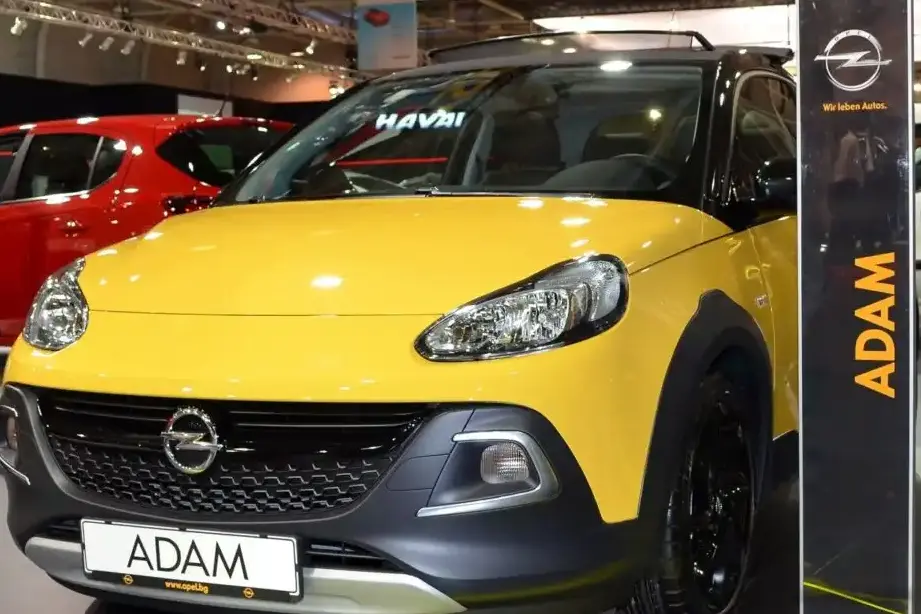
The Opel Adam Rocks 1.2 (70 hp) is a subcompact city car produced by the German manufacturer Opel between 2014 and 2014. Positioned as a more rugged and stylish variant of the standard Opel Adam, the Rocks featured a raised ride height, plastic body cladding, and a convertible-style roll-top canvas roof. This particular 1.2-liter, 70 horsepower configuration served as the entry-level engine option for the Rocks model, targeting buyers seeking a fashionable and economical urban vehicle. It was part of the first generation Adam (A14), built on the General Motors Gamma platform.
Technical Specifications
| Brand | Opel |
| Model | Adam |
| Generation | Adam |
| Type (Engine) | Rocks 1.2 (70 Hp) |
| Start of production | 2014 |
| End of production | 2014 |
| Powertrain Architecture | Internal Combustion engine |
| Body type | Hatchback |
| Seats | 4 |
| Doors | 3 |
| Fuel consumption (urban) | 7.2 l/100 km (32.7 US mpg, 39.2 UK mpg, 13.9 km/l) |
| Fuel consumption (extra urban) | 4.3 l/100 km (54.7 US mpg, 65.7 UK mpg, 23.3 km/l) |
| Fuel consumption (combined) | 5.3 l/100 km (44.4 US mpg, 53.3 UK mpg, 18.9 km/l) |
| CO2 emissions | 125 g/km |
| Fuel Type | Petrol (Gasoline) |
| Acceleration 0 – 100 km/h | 14.9 sec |
| Acceleration 0 – 62 mph | 14.9 sec |
| Acceleration 0 – 60 mph | 14.2 sec |
| Maximum speed | 165 km/h (102.53 mph) |
| Emission standard | Euro 5 |
| Weight-to-power ratio | 14.4 kg/Hp, 69.2 Hp/tonne |
| Weight-to-torque ratio | 8.8 kg/Nm, 113.7 Nm/tonne |
| Power | 70 Hp @ 5600 rpm |
| Power per litre | 57 Hp/l |
| Torque | 115 Nm @ 4000 rpm (84.82 lb.-ft. @ 4000 rpm) |
| Engine layout | Front, Transverse |
| Engine Model/Code | A12XER |
| Engine displacement | 1229 cm3 (75 cu. in.) |
| Number of cylinders | 4 |
| Engine configuration | Inline |
| Cylinder Bore | 73.4 mm (2.89 in.) |
| Piston Stroke | 72.6 mm (2.86 in.) |
| Compression ratio | 10.5:1 |
| Fuel injection system | Multi-port manifold injection |
| Engine aspiration | Naturally aspirated engine |
| Engine oil capacity | 4 l (4.23 US qt | 3.52 UK qt) |
| Kerb Weight | 1011-1026 kg (2228.87 – 2261.94 lbs.) |
| Max. weight | 1455-1470 kg (3207.73 – 3240.8 lbs.) |
| Max load | 444 kg (978.85 lbs.) |
| Fuel tank capacity | 35 l (9.25 US gal | 7.7 UK gal) |
| Max. roof load | 50 kg (110.23 lbs.) |
| Length | 3698 mm (145.59 in.) |
| Width | 1720 mm (67.72 in.) |
| Width including mirrors | 1966 mm (77.4 in.) |
| Height | 1484 mm (58.43 in.) |
| Wheelbase | 2311 mm (90.98 in.) |
| Front track | 1472 mm (57.95 in.) |
| Rear track | 1464 mm (57.64 in.) |
| Minimum turning circle | 10.17-11.06 m (33.37 – 36.29 ft.) |
| Drivetrain Architecture | The Internal combustion engine (ICE) drives the front wheels of the vehicle. |
| Drive wheel | Front wheel drive |
| Number of gears | 5 gears, manual transmission |
| Assisting systems | ABS (Anti-lock braking system) |
| Steering type | Steering rack and pinion |
Introduction
The Opel Adam Rocks 1.2 (70 hp) was introduced in 2014 as a more adventurous take on the standard Opel Adam. It aimed to capitalize on the growing popularity of small, stylish city cars with a touch of crossover appeal. The “Rocks” designation signified its slightly more rugged aesthetic and the inclusion of a unique, partially open-top design with a retractable canvas roof panel. This variant occupied the entry-level position in the Rocks lineup, offering a more affordable option compared to the higher-powered 1.4-liter engine choices. It was designed to appeal to younger buyers and those seeking a fashionable and economical vehicle for urban environments.
Powertrain & Engine Architecture
The heart of the Adam Rocks 1.2 (70 hp) is the Opel A12XER engine, a 1.2-liter inline four-cylinder petrol engine. This engine is part of Opel’s Family 0 small engine family. It utilizes multi-point fuel injection and a single overhead camshaft (SOHC) valvetrain with two valves per cylinder. The engine produces 70 horsepower at 5600 rpm and 115 Nm (84.82 lb-ft) of torque at 4000 rpm. The engine is naturally aspirated, meaning it doesn’t employ a turbocharger or supercharger. The engine is transversely mounted at the front of the vehicle. The 70 hp version was paired exclusively with a five-speed manual transmission, designed for fuel efficiency and ease of use in city driving. The transmission’s gear ratios were optimized for low-speed maneuverability and acceptable acceleration.
Driving Characteristics
The driving experience in the Adam Rocks 1.2 (70 hp) is best described as adequate for urban commuting. With 70 horsepower propelling a vehicle weighing between 1011 and 1026 kg, acceleration is not a strong point. The 0-60 mph time of around 14.2 seconds reflects this. However, the engine is relatively responsive at lower speeds, making it suitable for navigating city streets. The five-speed manual transmission allows drivers to keep the engine in its optimal power band, but frequent downshifting is often required for overtaking or climbing hills. Compared to the 1.4-liter versions of the Adam Rocks, this variant offers significantly less power and acceleration, but it compensates with improved fuel economy. The suspension is tuned for comfort, providing a reasonably smooth ride on typical road surfaces.
Equipment & Trim Levels
The Adam Rocks 1.2 (70 hp) typically came with a base level of equipment, focusing on essential features. Standard equipment included air conditioning, power steering, electric front windows, and an audio system with USB connectivity. Safety features included ABS brakes, electronic stability control, and front airbags. The interior featured cloth upholstery and a relatively simple dashboard layout. Optional extras included alloy wheels, a panoramic sunroof (in addition to the roll-top canvas roof), upgraded audio systems, and parking sensors. The interior trim levels were generally basic, reflecting the car’s entry-level positioning. The exterior styling included distinctive plastic body cladding and a raised ride height, differentiating it from the standard Adam.
Chassis & Braking
The Adam Rocks 1.2 (70 hp) utilizes a MacPherson strut front suspension and a torsion beam rear suspension. The torsion beam rear suspension is a cost-effective solution commonly found in small cars. The braking system consists of disc brakes on the front wheels and drum brakes on the rear wheels. ABS (Anti-lock Braking System) is standard, providing enhanced braking performance and stability. The steering is rack and pinion, offering precise and responsive handling. The suspension setup is tuned for comfort and ride quality, prioritizing a smooth driving experience over sporty handling. Stabilizer bars were included to reduce body roll during cornering, but the overall handling characteristics are geared towards everyday usability rather than performance driving.
Market Reception & Comparison
The Opel Adam Rocks 1.2 (70 hp) received mixed reviews from automotive critics. While praised for its stylish design and fuel efficiency, it was often criticized for its lack of power and relatively slow acceleration. Compared to the 1.4-liter versions of the Adam Rocks, the 1.2-liter model offered significantly lower performance but a more affordable price point. Fuel economy was a strong point, with combined fuel consumption figures around 5.3 l/100 km (44.4 US mpg). In terms of reliability, the A12XER engine is generally considered to be a reliable unit, but potential buyers should be aware of potential issues with the timing chain. The Adam Rocks competed with other small city cars such as the Fiat 500, Volkswagen up!, and Toyota Aygo.
Legacy
The Opel Adam Rocks 1.2 (70 hp) represents a niche offering within the broader Opel Adam range. While production was limited, the model remains a popular choice among used car buyers seeking a stylish and economical city car. The A12XER engine, while not particularly powerful, is known for its reliability and fuel efficiency. Today, these vehicles are relatively affordable to purchase and maintain, making them an attractive option for first-time car buyers or those seeking a practical and fashionable urban vehicle. The Adam Rocks, in general, helped to establish Opel as a brand capable of producing stylish and innovative small cars.
