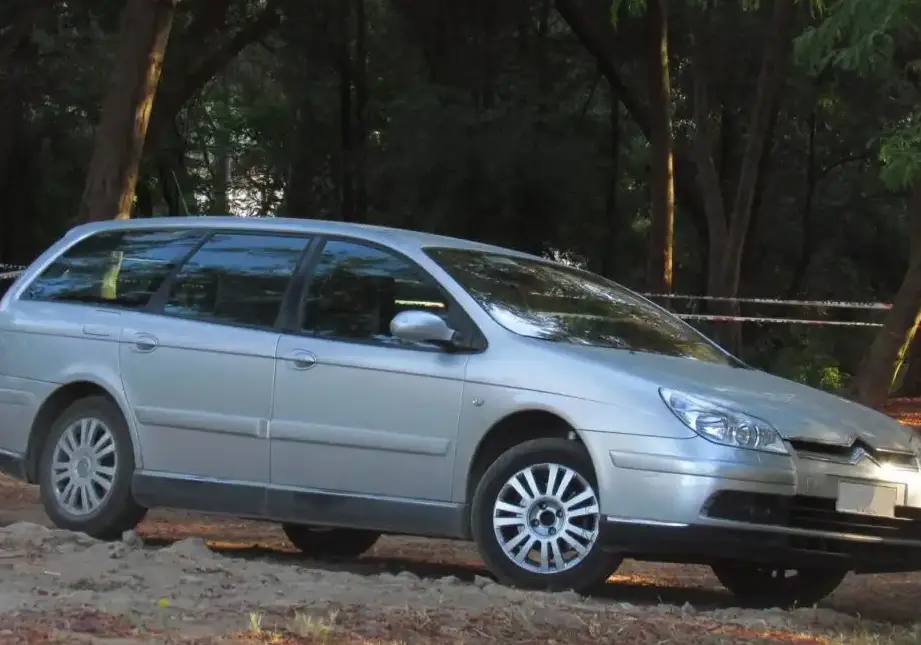
The Citroën C5 I Break (Phase II), specifically the 2.2 HDi Biturbo 170 hp variant with an automatic transmission, represents a sophisticated offering within the large family car segment. Produced from 2007 to 2008, this model year falls within the second phase of the first-generation C5 Break (estate) lifecycle. Positioned as a mid-to-high range trim, it aimed to provide a blend of performance, comfort, and practicality for buyers seeking a refined diesel-powered wagon. The C5 I Break competed with vehicles like the Ford Mondeo Estate, Peugeot 607 SW, and Volkswagen Passat Variant.
Technical Specifications
| Brand | Citroen |
| Model | C5 |
| Generation | C5 I Break (Phase II, 2004) |
| Type (Engine) | 2.2 HDi Biturbo (170 Hp) FAP Automatic |
| Start of production | 2007 |
| End of production | 2008 |
| Powertrain Architecture | Internal Combustion engine |
| Body type | Station wagon (estate) |
| Seats | 5 |
| Doors | 5 |
| Fuel consumption (urban) | 10.5 l/100 km (22.4 US mpg, 26.9 UK mpg, 9.5 km/l) |
| Fuel consumption (extra urban) | 5.8 l/100 km (40.6 US mpg, 48.7 UK mpg, 17.2 km/l) |
| Fuel consumption (combined) | 7.5 l/100 km (31.4 US mpg, 37.7 UK mpg, 13.3 km/l) |
| Fuel Type | Diesel |
| Acceleration 0 – 100 km/h | 10.5 sec |
| Acceleration 0 – 62 mph | 10.5 sec |
| Acceleration 0 – 60 mph | 10 sec |
| Maximum speed | 217 km/h (134.84 mph) |
| Emission standard | Euro 4 |
| Weight-to-power ratio | 9.6 kg/Hp, 103.7 Hp/tonne |
| Weight-to-torque ratio | 4.4 kg/Nm, 225.6 Nm/tonne |
| Power | 170 Hp @ 4000 rpm |
| Power per litre | 78 Hp/l |
| Torque | 370 Nm @ 1500 rpm (272.9 lb.-ft. @ 1500 rpm) |
| Engine layout | Front, Transverse |
| Engine Model/Code | 4HT DW12BTED4 |
| Engine displacement | 2179 cm3 (132.97 cu. in.) |
| Number of cylinders | 4 |
| Engine configuration | Inline |
| Cylinder Bore | 85 mm (3.35 in.) |
| Piston Stroke | 96 mm (3.78 in.) |
| Compression ratio | 16.6:1 |
| Number of valves per cylinder | 4 |
| Fuel injection system | Diesel Commonrail |
| Engine aspiration | BiTurbo, Intercooler |
| Valvetrain | DOHC |
| Engine oil capacity | 5.25 l (5.55 US qt | 4.62 UK qt) |
| Coolant | 10.7 l (11.31 US qt | 9.41 UK qt) |
| Kerb Weight | 1640 kg (3615.58 lbs.) |
| Max. weight | 2180 kg (4806.08 lbs.) |
| Max load | 540 kg (1190.5 lbs.) |
| Trunk (boot) space – minimum | 563 l (19.88 cu. ft.) |
| Trunk (boot) space – maximum | 1658 l (58.55 cu. ft.) |
| Fuel tank capacity | 67 l (17.7 US gal | 14.74 UK gal) |
| Max. roof load | 75 kg (165.35 lbs.) |
| Permitted towbar download | 75 kg (165.35 lbs.) |
| Length | 4839 mm (190.51 in.) |
| Width | 1780 mm (70.08 in.) |
| Height | 1511 mm (59.49 in.) |
| Wheelbase | 2750 mm (108.27 in.) |
| Front track | 1528 mm (60.16 in.) |
| Rear (Back) track | 1495 mm (58.86 in.) |
| Front overhang | 1033 mm (40.67 in.) |
| Rear overhang | 1056 mm (41.57 in.) |
| Minimum turning circle | 12.43 m (40.78 ft.) |
| Drivetrain Architecture | Front wheel drive |
| Number of gears | 6 |
| Type of gearbox | automatic transmission |
| Front suspension | Independent, type McPherson with coil spring and anti-roll bar |
| Rear suspension | Semi-independent, coil spring |
| Front brakes | Ventilated discs |
| Rear brakes | Disc |
| Assisting systems | ABS (Anti-lock braking system) |
| Tires size | 215/55 R16 |
| Wheel rims size | 16 |
Powertrain & Engine Architecture
The heart of this C5 Break is the 4HT DW12BTED4 engine, a 2.2-liter inline-four diesel. This engine is notable for its biturbo configuration, employing two turbochargers to enhance both low-end torque and high-end power. The use of a common rail direct injection system, delivering fuel at extremely high pressure, optimizes combustion efficiency and reduces emissions. The engine produces 170 horsepower at 4000 rpm and a substantial 370 Nm (272.9 lb-ft) of torque at just 1500 rpm. This torque output is a key characteristic of modern diesel engines, providing strong pulling power for effortless cruising and towing. The engine also features a Diesel Particulate Filter (DPF), denoted by the “FAP” in the model name, to further reduce particulate matter emissions, meeting Euro 4 standards. The automatic transmission is a six-speed unit, designed to work in harmony with the engine’s torque curve, providing smooth and efficient gear changes.
Driving Characteristics
The 2.2 HDi Biturbo automatic C5 Break offers a relaxed and refined driving experience. The abundance of low-end torque means that strong acceleration is available from relatively low engine speeds, making overtaking and merging onto highways easy. While not a sports car, the 10.5-second 0-62 mph acceleration is respectable for a large family estate. The automatic transmission contributes to the ease of driving, particularly in urban environments. Compared to the manual transmission versions, the automatic offers less driver involvement but greater convenience. Compared to higher-output versions of the C5, such as those with the V6 petrol engine, this diesel variant prioritizes fuel economy and torque over outright horsepower. The gear ratios are tuned for efficiency and comfortable cruising, rather than aggressive acceleration.
Equipment & Trim Levels
The 2.2 HDi Biturbo automatic trim typically included a generous level of standard equipment. This often encompassed features like automatic climate control, power windows and mirrors, a CD stereo system, and alloy wheels. Higher-spec versions could be equipped with options such as leather upholstery, a sunroof, parking sensors, and a more advanced navigation system. Interior upholstery was generally cloth, though leather was available as an upgrade. The dashboard layout was typical of Citroën at the time, featuring a functional and ergonomic design. Safety features included ABS, multiple airbags, and electronic stability control.
Chassis & Braking
The C5 I Break utilizes a McPherson strut front suspension and a semi-independent coil spring rear suspension. This setup prioritizes ride comfort, a hallmark of Citroën vehicles. The suspension is tuned to absorb bumps and imperfections in the road, providing a smooth and comfortable ride for passengers. Braking is handled by ventilated discs at the front and solid discs at the rear. ABS (Anti-lock Braking System) is standard, enhancing braking performance and stability, particularly in adverse conditions. Stabilizer bars are fitted to both the front and rear axles to reduce body roll during cornering.
Market Reception & Comparison
The Citroën C5 I Break 2.2 HDi Biturbo was generally well-received by automotive critics. It was praised for its comfortable ride, spacious interior, and fuel-efficient engine. The automatic transmission was considered smooth and responsive. However, some critics noted that the interior styling, while functional, lacked the visual flair of some competitors. Compared to other trims in the C5 lineup, the 2.2 HDi Biturbo offered a compelling balance of performance and economy. It was more expensive than the lower-powered diesel variants but offered significantly more performance. Fuel economy was a strong point, with combined figures around 31.4 US mpg, making it an attractive option for high-mileage drivers.
Legacy
The 4HT DW12BTED4 engine, while generally reliable, can be susceptible to issues with the DPF if not properly maintained. Regular servicing and the use of high-quality diesel fuel are crucial for ensuring long-term reliability. The automatic transmission, if serviced according to the manufacturer’s recommendations, is also generally durable. Today, the C5 I Break 2.2 HDi Biturbo represents a relatively affordable and practical used car option. Its spacious interior, comfortable ride, and fuel efficiency continue to appeal to buyers seeking a versatile family estate. However, potential buyers should be aware of the potential maintenance costs associated with the DPF and ensure that the vehicle has been well-maintained throughout its life.