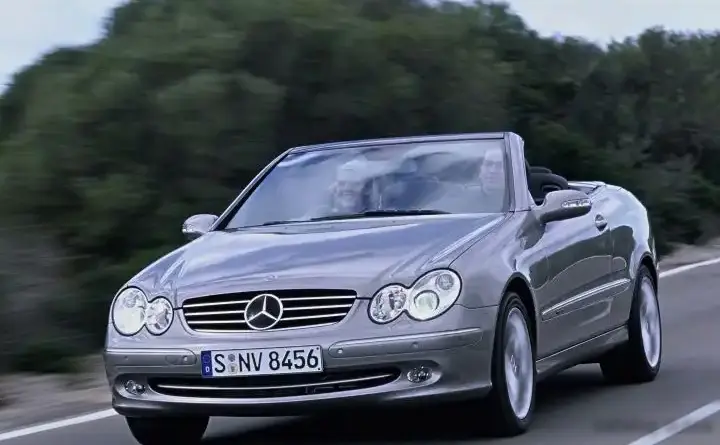
The Mercedes-Benz CLK 240, produced between March 2003 and May 2005, was a key variant within the A209 generation of the CLK-Class. Positioned as a mid-range offering in the lineup, it provided a balance between performance and affordability within the luxury coupe/convertible segment. The A209 CLK-Class represented a significant evolution over its predecessor (the C208), boasting a more refined interior, improved chassis dynamics, and updated engine technology. The CLK 240 specifically targeted buyers seeking a comfortable and stylish grand tourer with a naturally aspirated V6 engine.
Technical Specifications
| Brand | Mercedes-Benz |
| Model | CLK |
| Generation | CLK (A209) |
| Type (Engine) | CLK 240 (170 Hp) |
| Start of production | March, 2003 |
| End of production | May, 2005 |
| Powertrain Architecture | Internal Combustion engine |
| Body type | Cabriolet |
| Seats | 4 |
| Doors | 2 |
| Fuel consumption (economy) – urban (NEDC) | 16.1 l/100 km (14.6 US mpg, 17.5 UK mpg, 6.2 km/l) |
| Fuel consumption (economy) – extra urban (NEDC) | 7.9 l/100 km (29.8 US mpg, 35.8 UK mpg, 12.7 km/l) |
| Fuel consumption (economy) – combined (NEDC) | 10.9 l/100 km (21.6 US mpg, 25.9 UK mpg, 9.2 km/l) |
| CO2 emissions (NEDC) | 262 g/km |
| Fuel Type | Petrol (Gasoline) |
| Acceleration 0 – 100 km/h | 9.7 sec |
| Acceleration 0 – 62 mph | 9.7 sec |
| Acceleration 0 – 60 mph | 9.2 sec |
| Maximum speed | 232 km/h (144.16 mph) |
| Emission standard | Euro 4 |
| Weight-to-power ratio | 9.6 kg/Hp, 104.6 Hp/tonne |
| Weight-to-torque ratio | 6.8 kg/Nm, 147.7 Nm/tonne |
| Power | 170 Hp @ 5500 rpm |
| Power per litre | 65.5 Hp/l |
| Torque | 240 Nm @ 4500 rpm (177.01 lb.-ft. @ 4500 rpm) |
| Engine layout | Front, Longitudinal |
| Engine Model/Code | M 112.912 |
| Engine displacement | 2597 cm3 (158.48 cu. in.) |
| Number of cylinders | 6 |
| Engine configuration | V-engine |
| Cylinder Bore | 89.9 mm (3.54 in.) |
| Piston Stroke | 68.2 mm (2.69 in.) |
| Compression ratio | 10.5:1 |
| Number of valves per cylinder | 3 |
| Fuel injection system | Multi-port manifold injection |
| Engine aspiration | Naturally aspirated engine |
| Valvetrain | SOHC |
| Engine oil capacity | 8 l (8.45 US qt | 7.04 UK qt) |
| Coolant | 10.5 l (11.1 US qt | 9.24 UK qt) |
| Kerb Weight | 1625 kg (3582.51 lbs.) |
| Max. weight | 2155 kg (4750.96 lbs.) |
| Max load | 530 kg (1168.45 lbs.) |
| Trunk (boot) space – minimum | 276 l (9.75 cu. ft.) |
| Trunk (boot) space – maximum | 390 l (13.77 cu. ft.) |
| Fuel tank capacity | 62 l (16.38 US gal | 13.64 UK gal) |
| Permitted trailer load with brakes (12%) | 1500 kg (3306.93 lbs.) |
| Permitted trailer load without brakes | 750 kg (1653.47 lbs.) |
| Length | 4638 mm (182.6 in.) |
| Width | 1740 mm (68.5 in.) |
| Width including mirrors | 1991 mm (78.39 in.) |
| Height | 1413 mm (55.63 in.) |
| Wheelbase | 2715 mm (106.89 in.) |
| Front track | 1493 mm (58.78 in.) |
| Rear (Back) track | 1474 mm (58.03 in.) |
| Front overhang | 840 mm (33.07 in.) |
| Rear overhang | 1083 mm (42.64 in.) |
| Drag coefficient (Cd) | 0.30 |
| Minimum turning circle (turning diameter) | 10.76 m (35.3 ft.) |
| Drivetrain Architecture | The Internal combustion engine (ICE) drives the rear wheels of the vehicle. |
| Drive wheel | Rear wheel drive |
| Number of gears and type of gearbox | 6 gears, manual transmission |
| Front suspension | Independent type McPherson, Transverse stabilizer |
| Rear suspension | Independent multi-link suspension, Transverse stabilizer |
| Front brakes | Ventilated discs, 300×28 mm |
| Rear brakes | Disc, 290×10 mm |
| Assisting systems | ABS (Anti-lock braking system) |
| Steering type | Steering rack and pinion |
| Power steering | Hydraulic Steering |
| Tires size | Front wheel tires: 205/55 R16 Rear wheel tires: 225/50 R16 |
| Wheel rims size | Front wheel rims: 7J x 16 Rear wheel rims: 8J x 16 |
Powertrain & Engine Architecture
The CLK 240 was powered by the M112.912, a 2.6-liter naturally aspirated V6 engine. This engine was part of Mercedes-Benz’s modular V6 and V8 engine family, known for its smooth operation and relatively simple design. The M112 featured a single overhead camshaft (SOHC) design per cylinder bank, three valves per cylinder (two intake, one exhaust), and a multi-port fuel injection system. The engine produced 170 horsepower at 5500 rpm and 240 Nm (177 lb-ft) of torque at 4500 rpm. The engine’s longitudinal mounting and rear-wheel drive configuration were typical for Mercedes-Benz vehicles of this era. The standard transmission was a 6-speed manual, although a 5-speed automatic transmission was also available, impacting acceleration and fuel economy.
Driving Characteristics
The CLK 240 with the manual transmission offered a reasonably engaging driving experience. While not overtly sporty, the V6 provided adequate power for comfortable cruising and occasional spirited driving. The 0-60 mph time of around 9.2 seconds was respectable for the period. The automatic transmission, while offering convenience, did slightly diminish acceleration and responsiveness. The suspension, tuned for comfort, provided a smooth ride, absorbing road imperfections effectively. Steering was precise but lacked significant feedback. Compared to the more powerful CLK 320 or the performance-oriented AMG variants, the CLK 240 prioritized refinement and fuel efficiency over outright speed.
Equipment & Trim Levels
The CLK 240 typically came standard with features such as automatic climate control, power windows and locks, a multi-function steering wheel, and a basic audio system. Upholstery was generally cloth, with leather options available as an upgrade. Common optional extras included a premium sound system, sunroof, heated seats, and parking sensors. The interior design was typical of Mercedes-Benz, emphasizing quality materials and a luxurious ambiance. Trim levels were relatively simple, with options primarily focused on adding convenience and comfort features.
Chassis & Braking
The CLK 240 utilized an independent suspension system, with McPherson struts at the front and a multi-link setup at the rear. This configuration provided a good balance between ride comfort and handling. Brakes were ventilated discs at the front and solid discs at the rear, equipped with ABS (Anti-lock Braking System) as standard. The chassis was designed to provide a stable and predictable driving experience, prioritizing safety and comfort over aggressive cornering. Stabilizer bars were fitted front and rear to reduce body roll.
Market Reception & Comparison
The CLK 240 was generally well-received by automotive critics as a comfortable and stylish grand tourer. However, some reviewers noted that the engine lacked the punch of its larger displacement siblings. Fuel economy was considered average for its class. Compared to the CLK 320, the 240 offered a more affordable entry point into the CLK range, but at the expense of performance. The 240 also offered a more refined experience than the diesel variants available in Europe. The automatic transmission was often criticized for being somewhat sluggish compared to the manual.
Legacy
The M112 engine family, including the 2.6-liter variant in the CLK 240, is generally considered reliable, although regular maintenance is crucial. Common issues include oil leaks and occasional problems with the electronic ignition system. Today, the CLK 240 represents an affordable entry point into Mercedes-Benz ownership. Well-maintained examples are sought after by enthusiasts who appreciate the classic Mercedes-Benz styling and comfortable driving experience. The availability of parts is generally good, making it a relatively easy car to maintain. However, as with any older vehicle, potential buyers should be aware of the possibility of age-related issues and ensure a thorough inspection before purchase.