
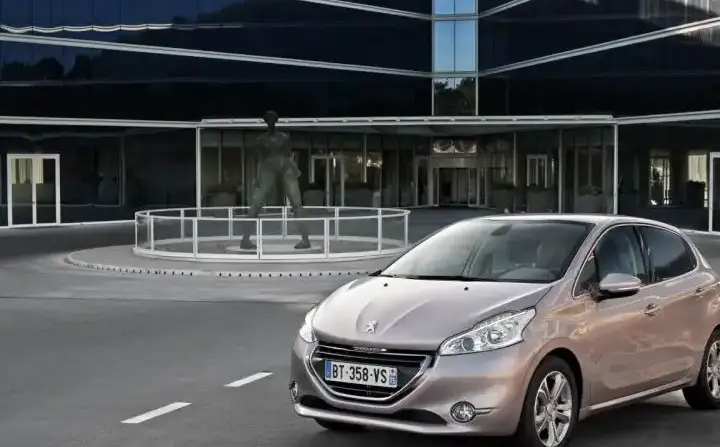
Technical Specifications
| Brand | Peugeot |
| Model | 208 |
| Generation | 208 I (Phase I, 2012) |
| Type (Engine) | 1.4 e-HDi (68 Hp) FAP STT |
| Start of production | 2012 |
| End of production | 2015 |
| Powertrain Architecture | Internal Combustion engine |
| Body type | Hatchback |
| Seats | 5 |
| Doors | 3-5 |
| Fuel consumption (urban) | 3.6 l/100 km (65.3 US mpg / 78.5 UK mpg) |
| Fuel consumption (extra urban) | 3.2 l/100 km (73.5 US mpg / 88.3 UK mpg) |
| Fuel consumption (combined) | 3.4 l/100 km (69.2 US mpg / 83.1 UK mpg) |
| Fuel Type | Diesel |
| Acceleration 0 – 100 km/h | 16.2 sec |
| Acceleration 0 – 62 mph | 16.2 sec |
| Acceleration 0 – 60 mph | 15.4 sec |
| Maximum speed | 165 km/h (102.53 mph) |
| Emission standard | Euro 5 |
| Weight-to-power ratio | 15.6 kg/Hp |
| Weight-to-torque ratio | 6.6 kg/Nm |
| Power | 68 Hp @ 4000 rpm |
| Torque | 160 Nm @ 1750 rpm (118.01 lb.-ft. @ 1750 rpm) |
| Engine layout | Front, Transverse |
| Engine Model/Code | 8HR DV4C |
| Engine displacement | 1397 cm3 (85.25 cu. in.) |
| Number of cylinders | 4 |
| Engine configuration | Inline |
| Number of valves per cylinder | 2 |
| Fuel injection system | Diesel Commonrail |
| Engine aspiration | Turbocharger, Intercooler |
| Engine oil capacity | 3.75 l (3.96 US qt | 3.3 UK qt) |
| Coolant capacity | 6 l (6.34 US qt | 5.28 UK qt) |
| Kerb Weight | 1060 kg (2336.9 lbs.) |
| Max. weight | 1580 kg (3483.3 lbs.) |
| Max load | 520 kg (1146.4 lbs.) |
| Trunk (boot) space – minimum | 285 l (10.06 cu. ft.) |
| Trunk (boot) space – maximum | 1076 l (38 cu. ft.) |
| Fuel tank capacity | 50 l (13.21 US gal | 11 UK gal) |
| Length | 3962 mm (155.98 in.) |
| Width | 1829 mm (72.01 in.) |
| Height | 1460 mm (57.48 in.) |
| Wheelbase | 2538 mm (99.92 in.) |
| Minimum turning circle | 10.4 m (34.12 ft.) |
| Drivetrain Architecture | Front wheel drive |
| Number of gears | 5 |
| Gearbox type | Manual transmission |
| Front suspension | Independent type McPherson |
| Rear suspension | Semi-independent, coil spring |
| Front brakes | Ventilated discs |
| Rear brakes | Drum |
| Assisting systems | ABS (Anti-lock braking system) |
| Steering type | Steering rack and pinion |
The Peugeot 208 1.4 e-HDi was introduced in 2012 as part of the first generation of the 208, replacing the popular 207. It was designed to offer a compelling blend of fuel efficiency, practicality, and affordability. The “e-HDi” designation signified the inclusion of Peugeot’s micro-hybrid technology, featuring a stop-start system that automatically shut off the engine when idling, reducing fuel consumption and emissions. This variant occupied the lower end of the 208 powertrain range, serving as the gateway to the model for budget-conscious buyers. It was a key offering in the European market, where diesel engines and fuel economy were highly valued.
Powertrain & Engine Architecture
At the heart of the 208 1.4 e-HDi lies the DV4C engine, specifically the 8HR variant. This is a 1.4-liter, four-cylinder diesel engine utilizing common rail direct injection. The engine benefits from a turbocharger with an intercooler, which helps to improve power and torque delivery. The engine produces 68 horsepower at 4000 rpm and 160 Nm (118 lb-ft) of torque at 1750 rpm. The e-HDi system incorporates a reversible starter-alternator, enabling the stop-start functionality. This system recovers energy during deceleration and uses it to quickly restart the engine when needed. The engine is paired with a five-speed manual transmission, chosen for its simplicity and contribution to fuel efficiency. The transmission’s gear ratios are optimized for maximizing fuel economy rather than providing sporty acceleration.
Driving Characteristics
The 1.4 e-HDi 208 is not known for its blistering performance. Acceleration from 0 to 60 mph takes around 15.4 seconds, and its top speed is 102.53 mph. The focus is firmly on economy and usability. The engine provides adequate power for everyday driving, but it requires frequent gear changes to maintain momentum, especially when overtaking or climbing hills. The manual transmission, while precise, can feel a little notchy. The stop-start system operates seamlessly in most conditions, but can occasionally feel slightly abrupt. Compared to higher-output versions of the 208, such as the 1.6 THP petrol engine, the 1.4 e-HDi offers significantly less power and a more utilitarian driving experience. However, it surpasses those models in fuel economy.
Equipment & Trim Levels
The 1.4 e-HDi typically came equipped with a basic level of standard features. These generally included power steering, central locking, electric front windows, and an audio system with USB connectivity. Safety features such as ABS, ESP (Electronic Stability Program), and multiple airbags were also standard. Higher trim levels, such as Active or Allure, added features like air conditioning, alloy wheels, cruise control, and a touchscreen infotainment system. Interior upholstery was typically cloth, with a functional and durable design. Optional extras included parking sensors, a panoramic sunroof, and upgraded audio systems.
Chassis & Braking
The 208 1.4 e-HDi utilizes a McPherson strut front suspension and a semi-independent coil spring rear suspension. This setup provides a comfortable ride quality, although it’s not particularly sporty. The front brakes are ventilated discs, while the rear brakes are drums. This configuration was chosen to keep costs down and maintain acceptable braking performance for the vehicle’s weight and power output. The steering is a rack and pinion system, providing reasonable precision and feedback. The relatively light weight of the 1.4 e-HDi (around 1060 kg or 2337 lbs) contributes to its fuel efficiency and helps to offset the engine’s modest power output.
Market Reception & Comparison
The Peugeot 208 1.4 e-HDi was generally well-received by critics for its exceptional fuel economy and low running costs. It was often praised as an ideal choice for urban commuters and those seeking a practical and affordable vehicle. However, its lack of performance was a common criticism. Compared to the petrol-powered 208 variants, the 1.4 e-HDi offered significantly better fuel economy but less excitement. Against other diesel-powered competitors, such as the Volkswagen Polo 1.6 TDI, the 208 1.4 e-HDi offered a competitive price point and a stylish design, but the Polo was often considered to have a more refined driving experience. Reliability was generally good, with few major issues reported.
Legacy
The 1.4 e-HDi powertrain proved to be relatively reliable, with the DV4C engine being a well-established and durable unit. On the used car market, these models continue to be popular among buyers seeking an economical and practical vehicle. However, potential buyers should be aware of the potential for diesel particulate filter (DPF) issues, particularly if the vehicle has primarily been used for short journeys. Regular servicing and the use of quality diesel fuel are essential for maintaining the DPF’s functionality. The 208 1.4 e-HDi represents a significant step in Peugeot’s efforts to improve fuel efficiency and reduce emissions, and it remains a viable option for those prioritizing economy and practicality.
