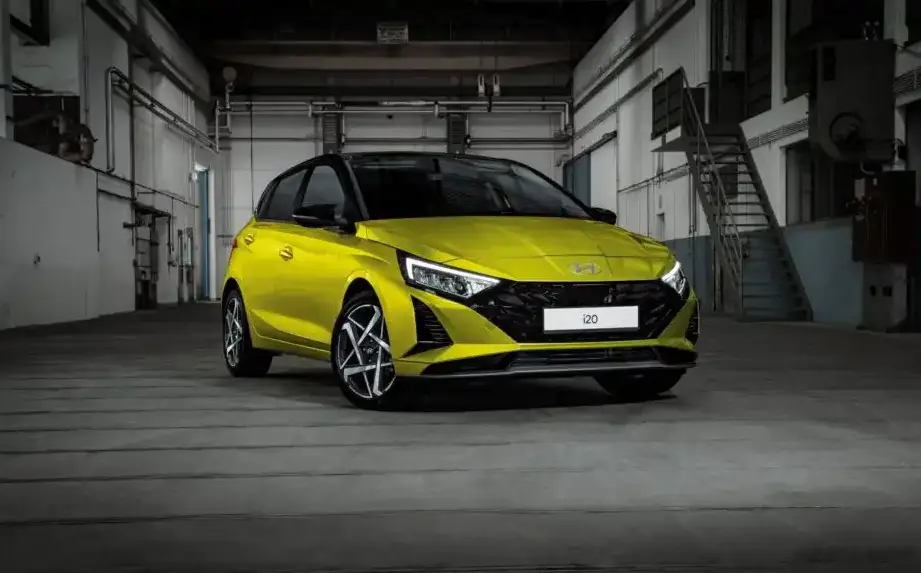
The Hyundai i20 III (facelift, introduced in May 2023) 1.0 T-GDi represents a key entry point into the third generation of Hyundai’s popular subcompact hatchback. Positioned as a fuel-efficient and technologically equipped option, this variant features a turbocharged three-cylinder engine producing 100 horsepower. It’s designed to appeal to buyers seeking a modern, affordable, and practical vehicle for urban driving. The facelift brought styling updates and enhanced technology features to the i20 range, solidifying its position in the competitive European and global small car segments. This specific configuration is primarily marketed in Europe and other regions where smaller, fuel-efficient vehicles are in high demand.
Technical Specifications
| Brand | Hyundai |
| Model | i20 |
| Generation | i20 III (facelift 2023) |
| Type (Engine) | 1.0 T-GDi (100 Hp) |
| Start of production | May, 2023 |
| Powertrain Architecture | Internal Combustion engine |
| Body type | Hatchback |
| Seats | 5 |
| Doors | 5 |
| Fuel Type | Petrol (Gasoline) |
| Acceleration 0 – 100 km/h | 10.4 sec |
| Acceleration 0 – 62 mph | 10.4 sec |
| Acceleration 0 – 60 mph | 9.9 sec |
| Maximum speed | 188 km/h (116.82 mph) |
| Emission standard | Euro 6D |
| Weight-to-power ratio | 10.7 kg/Hp, 93.9 Hp/tonne |
| Weight-to-torque ratio | 6.2 kg/Nm, 161.5 Nm/tonne |
| Power | 100 Hp @ 4500-6000 rpm |
| Power per litre | 100.2 Hp/l |
| Torque | 172 Nm @ 1500-4000 rpm (126.86 lb.-ft. @ 1500-4000 rpm) |
| Engine layout | Front, Transverse |
| Engine Model/Code | G3LE |
| Engine displacement | 998 cm3 (60.9 cu. in.) |
| Number of cylinders | 3 |
| Engine configuration | Inline |
| Cylinder Bore | 71 mm (2.8 in.) |
| Piston Stroke | 84 mm (3.31 in.) |
| Compression ratio | 10.5:1 |
| Number of valves per cylinder | 4 |
| Fuel injection system | Direct injection |
| Engine aspiration | Turbocharger, Intercooler |
| Valvetrain | DOHC |
| Engine oil capacity | 3.6 l (3.8 US qt | 3.17 UK qt) |
| Coolant | 5.77 l (6.1 US qt | 5.08 UK qt) |
| Kerb Weight | 1065-1175 kg (2347.92 – 2590.43 lbs.) |
| Max. weight | 1600 kg (3527.4 lbs.) |
| Max load | 425-535 kg (936.96 – 1179.47 lbs.) |
| Trunk (boot) space – minimum | 352 l (12.43 cu. ft.) |
| Trunk (boot) space – maximum | 1165 l (41.14 cu. ft.) |
| Fuel tank capacity | 40 l (10.57 US gal | 8.8 UK gal) |
| Max. roof load | 70 kg (154.32 lbs.) |
| Permitted trailer load with brakes (12%) | 1110 kg (2447.13 lbs.) |
| Permitted trailer load without brakes | 450 kg (992.08 lbs.) |
| Length | 4065 mm (160.04 in.) |
| Width | 1775 mm (69.88 in.) |
| Height | 1450 mm (57.09 in.) |
| Wheelbase | 2580 mm (101.57 in.) |
| Front track | 1531-1539 mm (60.28 – 60.59 in.) |
| Rear (Back) track | 1536-1543 mm (60.47 – 60.75 in.) |
| Minimum turning circle | 10.4 m (34.12 ft.) |
| Drivetrain Architecture | ICE, Front wheel drive |
| Drive wheel | Front wheel drive |
| Number of gears and type of gearbox | 6 gears, manual transmission |
| Front suspension | Independent type McPherson |
| Rear suspension | Torsion |
| Front brakes | Ventilated discs, 280 mm |
| Rear brakes | Disc, 262 mm |
| Assisting systems | ABS (Anti-lock braking system) |
| Steering type | Steering rack and pinion |
| Power steering | Electric Steering |
| Tires size | 195/55 R16; 215/45 R17 |
| Wheel rims size | 6.0J x 16; 7.0J x 17 |
Powertrain & Engine Architecture
The heart of the i20 1.0 T-GDi is the Hyundai-Kia G3LE engine, a 998cc turbocharged three-cylinder petrol engine. This engine is part of Hyundai’s ‘Kappa’ family of engines, known for their compact size and efficiency. The G3LE utilizes direct fuel injection, a technology that improves fuel economy and reduces emissions by injecting fuel directly into the combustion chamber. The engine also features a twin-scroll turbocharger with an intercooler, which helps to minimize turbo lag and maximize power output. The DOHC (Dual Overhead Camshaft) valvetrain further enhances engine breathing and performance. The engine’s relatively high compression ratio of 10.5:1 contributes to its efficiency. This engine is paired with a 6-speed manual transmission, optimized for fuel efficiency and smooth gear changes. The transmission’s gear ratios are tuned to provide adequate acceleration while maintaining low engine speeds for highway cruising.
Driving Characteristics
The 100 horsepower and 172 Nm (126.86 lb-ft) of torque delivered by the 1.0 T-GDi engine provide adequate performance for everyday driving. Acceleration from 0-60 mph takes approximately 9.9 seconds, and the top speed is around 116.82 mph. While not a performance-oriented variant, the turbocharger provides a noticeable boost in power during acceleration, making it feel more responsive than naturally aspirated engines of similar displacement. Compared to higher-output versions of the i20, such as those with larger engines, this variant prioritizes fuel economy over outright speed. The manual transmission allows for greater driver control, but the gear ratios are geared towards efficiency rather than sporty driving. The relatively light weight of the i20 helps to offset the modest power output, resulting in a reasonably agile driving experience.
Equipment & Trim Levels
The i20 1.0 T-GDi typically comes with a good level of standard equipment, reflecting Hyundai’s commitment to value. Standard features often include air conditioning, a touchscreen infotainment system with smartphone integration (Apple CarPlay and Android Auto), Bluetooth connectivity, and a suite of safety features such as ABS, ESC (Electronic Stability Control), and multiple airbags. Higher trim levels add features like alloy wheels, a rear-view camera, parking sensors, and more advanced safety systems. Interior upholstery is typically cloth, with options for upgraded materials on higher trims. The dashboard layout is modern and functional, with a focus on ease of use.
Chassis & Braking
The i20 utilizes a McPherson strut front suspension and a torsion beam rear suspension. This setup provides a good balance between ride comfort and handling. The front brakes are ventilated discs, providing ample stopping power, while the rear brakes are discs. The electric power steering offers light and precise steering feel, making it easy to maneuver in urban environments. The chassis is designed to be lightweight, contributing to the car’s overall efficiency and agility. Stabilizer bars are included to reduce body roll during cornering.
Market Reception & Comparison
The Hyundai i20 1.0 T-GDi has been well-received in the market as a practical and affordable small car. Critics have praised its fuel efficiency, comfortable ride, and generous equipment levels. Compared to other trims in the i20 lineup, this variant offers a good balance between price and performance. It’s a compelling alternative to rivals such as the Volkswagen Polo, Ford Fiesta, and Renault Clio. The 1.0 T-GDi generally offers better fuel economy than larger-engined versions of the i20, but it lacks the same level of performance. Reliability has been generally good, with few reported issues with the engine or transmission.
Legacy
The 1.0 T-GDi engine has proven to be a reliable and durable powertrain in the Hyundai i20. While long-term reliability data is still accumulating, early indications suggest that the engine is capable of providing years of trouble-free service with proper maintenance. On the used car market, the i20 1.0 T-GDi represents a good value proposition, offering a modern and well-equipped small car at an affordable price. Its fuel efficiency and relatively low running costs make it an attractive option for budget-conscious buyers. The engine’s compact size and efficiency have also made it a popular choice for other Hyundai and Kia models.