
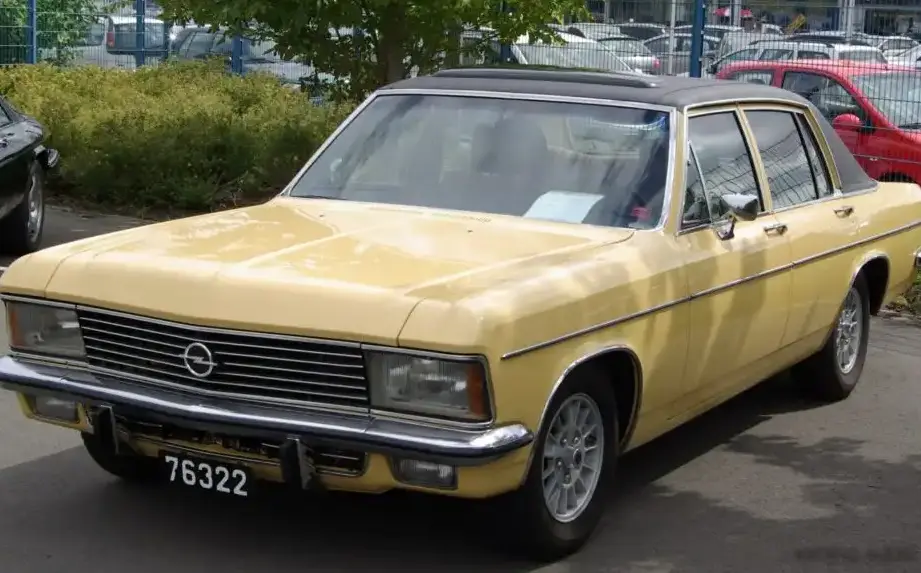
The Opel Admiral B 2.8, produced between 1969 and 1975, represented a significant evolution in Opel’s flagship sedan range. Positioned as a luxury vehicle within the German market, the Admiral B aimed to compete with offerings from BMW and Mercedes-Benz, though at a more accessible price point. The 2.8-liter variant, developing 146 horsepower, was a key engine option during the model’s lifespan, offering a balance of performance and refinement. It was part of the broader Admiral B series (A69), which also included a smaller 2.6-liter engine. The Admiral B was Opel’s top-of-the-line model, offering a spacious interior and comfortable ride, appealing to families and executives alike.
Technical Specifications
| Brand | Opel |
| Model | Admiral |
| Generation | Admiral B |
| Type (Engine) | 2.8 (146 Hp) |
| Start of production | 1969 |
| End of production | 1975 |
| Powertrain Architecture | Internal Combustion engine |
| Body type | Sedan |
| Seats | 5 |
| Doors | 4 |
| Fuel Type | Petrol (Gasoline) |
| Maximum speed | 182 km/h (113.09 mph) |
| Weight-to-power ratio | 10.2 kg/Hp, 97.7 Hp/tonne |
| Weight-to-torque ratio | 6.7 kg/Nm, 149.2 Nm/tonne |
| Power | 146 Hp |
| Power per litre | 52.4 Hp/l |
| Torque | 223 Nm @ 3600-3800 rpm (164.48 lb.-ft. @ 3600-3800 rpm) |
| Engine Model/Code | 28H |
| Engine displacement | 2784 cm3 (169.89 cu. in.) |
| Number of cylinders | 6 |
| Engine configuration | Inline |
| Cylinder Bore | 92 mm (3.62 in.) |
| Piston Stroke | 69.8 mm (2.75 in.) |
| Compression ratio | 9.5:1 |
| Fuel injection system | Carburettor |
| Engine aspiration | Naturally aspirated engine |
| Valvetrain | SOHC |
| Engine oil capacity | 4.5 l (4.76 US qt | 3.96 UK qt) |
| Kerb Weight | 1495 kg (3295.91 lbs.) |
| Max. weight | 1980 kg (4365.15 lbs.) |
| Max load | 485 kg (1069.24 lbs.) |
| Trunk (boot) space – maximum | 475 l (16.77 cu. ft.) |
| Fuel tank capacity | 80 l (21.13 US gal | 17.6 UK gal) |
| Length | 4907 mm (193.19 in.) |
| Width | 1852 mm (72.91 in.) |
| Height | 1450 mm (57.09 in.) |
| Wheelbase | 2845 mm (112.01 in.) |
| Front track | 1505 mm (59.25 in.) |
| Rear (Back) track | 1505 mm (59.25 in.) |
| Ride height (ground clearance) | 150 mm (5.91 in.) |
| Drag coefficient (Cd) | 0.45 |
| Minimum turning circle (turning diameter) | 11.8 m (38.71 ft.) |
| Drivetrain Architecture | The Internal combustion engine (ICE) drives the rear wheels of the vehicle. |
| Drive wheel | Rear wheel drive |
| Number of gears and type of gearbox | 4 gears, manual transmission |
| Front brakes | Ventilated discs |
| Rear brakes | Drum |
Powertrain & Engine Architecture
The heart of the Admiral B 2.8 was the 2784cc inline-six cylinder engine, designated the 28H. This engine utilized a single overhead camshaft (SOHC) valvetrain, operating with a compression ratio of 9.5:1. Fuel delivery was managed by a carburetor, a common setup for the era, rather than fuel injection. The engine produced 146 horsepower and 223 Nm (164.48 lb-ft) of torque, peaking between 3600 and 3800 rpm. The engine’s design prioritized smooth operation and reasonable power output over outright performance. The 28H engine was known for its durability, though it required regular maintenance to ensure optimal running condition. The standard transmission for the 2.8-liter model was a four-speed manual gearbox, providing direct control over the rear wheels.
Driving Characteristics
The Admiral B 2.8, with its 146 hp and manual transmission, offered a respectable driving experience for its time. Acceleration was adequate, allowing for a 0-60 mph time in the neighborhood of 10-11 seconds. The four-speed manual gearbox provided a reasonable spread of ratios, though it lacked the versatility of more modern transmissions. The rear-wheel-drive configuration contributed to a balanced feel, but also required careful handling in adverse weather conditions. Compared to the smaller 2.6-liter engine, the 2.8 offered noticeably more power and torque, making it more suitable for highway cruising and carrying a full load of passengers. The suspension, while comfortable, was not particularly sporty, prioritizing ride quality over sharp handling.
Equipment & Trim Levels
The Admiral B 2.8 was well-equipped for a vehicle of its era. Standard features included comfortable cloth upholstery, a wood-trimmed dashboard, and a comprehensive instrument panel. Power steering and power-assisted brakes were often included, enhancing the driving experience. Optional extras included a sunroof, a radio with an antenna, and upgraded interior trim. The Admiral B was positioned as a premium offering, and its interior reflected this with quality materials and attention to detail. The trim levels were relatively simple, with the 2.8-liter model representing the higher end of the range.
Chassis & Braking
The Admiral B featured a traditional body-on-frame construction, providing a robust and durable chassis. The suspension consisted of independent front suspension with coil springs and a live axle with leaf springs at the rear. Braking duties were handled by ventilated disc brakes at the front and drum brakes at the rear. While adequate for the vehicle’s weight and performance, the braking system lacked the stopping power of more modern setups. The steering was a recirculating ball system, providing a relatively heavy but precise feel.
Market Reception & Comparison
The Opel Admiral B 2.8 was generally well-received by automotive critics in Europe. It was praised for its spacious interior, comfortable ride, and robust engine. However, it was also criticized for its somewhat dated styling and lack of cutting-edge technology compared to some of its competitors. Compared to the smaller 2.6-liter Admiral, the 2.8 offered a significant performance upgrade, but at a higher price point. Fuel economy was typical for a large-displacement, carbureted engine of the era, averaging around 18-22 mpg. Reliability was generally good, but regular maintenance was essential to prevent issues.
Legacy
The Opel Admiral B 2.8, while not a groundbreaking vehicle, holds a significant place in Opel’s history as a luxurious and well-built sedan. The 28H engine proved to be durable and reliable, and many examples are still on the road today. In the used car market, the Admiral B 2.8 is sought after by classic car enthusiasts who appreciate its vintage styling and comfortable driving experience. Parts availability can be a challenge, but a dedicated community of owners and suppliers helps to keep these vehicles running. The Admiral B represents a bygone era of automotive engineering, characterized by robust construction and a focus on driver comfort.
