
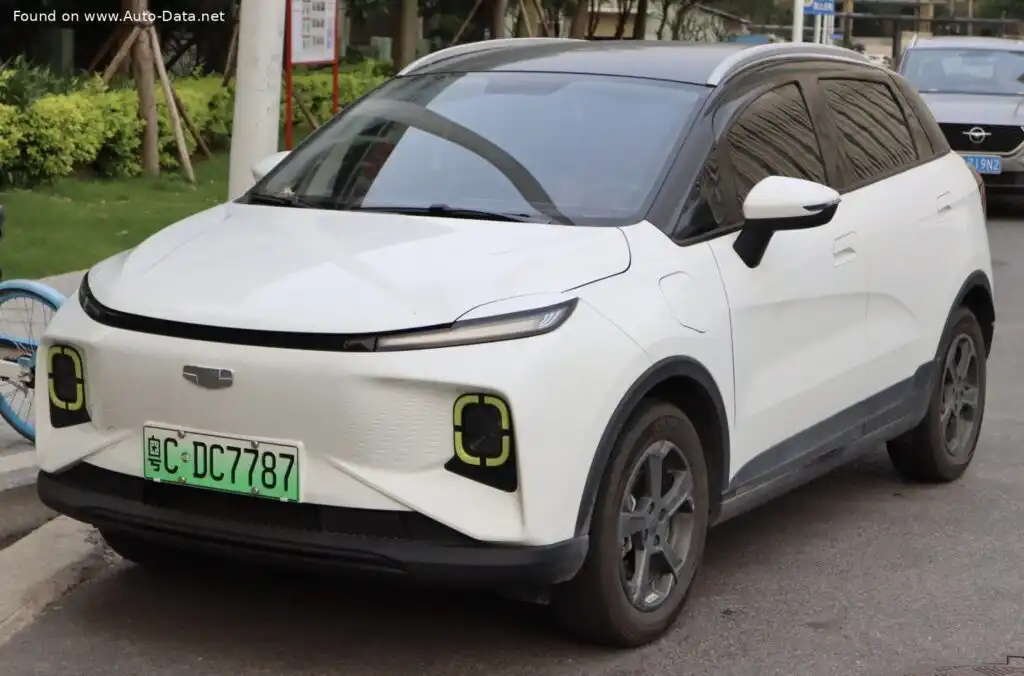
The Geometry E, specifically the 39.3 kWh (82 hp) electric variant, represents an entry point into the burgeoning electric vehicle market from the Chinese manufacturer Geometry, a sub-brand of Geely. Introduced in 2022, this model is a compact SUV/Crossover designed to offer affordable electric mobility, primarily targeting urban commuters and first-time EV buyers. It’s positioned as a practical and efficient vehicle within Geometry’s initial lineup, aiming to compete with other entry-level electric crossovers. The E utilizes a dedicated electric vehicle platform and showcases Geometry’s commitment to accessible EV technology.
Technical Specifications
| Brand | Geometry |
| Model | E |
| Generation | E |
| Type (Engine) | 39.3 kWh (82 Hp) Electric |
| Start of production | 2022 |
| Powertrain Architecture | BEV (Electric Vehicle) |
| Body type | SUV, Crossover |
| Seats | 5 |
| Doors | 5 |
| Fuel Type | Electricity |
| Weight-to-power ratio | 16.2 kg/Hp, 61.9 Hp/tonne |
| Weight-to-torque ratio | 10.2 kg/Nm, 98.1 Nm/tonne |
| Gross battery capacity | 39.3 kWh |
| Battery technology | Lithium iron phosphate (LiFePO4) |
| Battery location | Below the floor |
| All-electric range (CLTC) | 401 km (249.17 mi) |
| Electric motor power | 82 Hp |
| Electric motor Torque | 130 Nm (95.88 lb.-ft.) |
| Electric motor location | Front, Transverse |
| Electric motor type | Synchronous |
| System power | 82 Hp |
| System torque | 130 Nm (95.88 lb.-ft.) |
| Kerb Weight | 1325 kg (2921.12 lbs.) |
| Trunk (boot) space – minimum | 356 l (12.57 cu. ft.) |
| Trunk (boot) space – maximum | 1000 l (35.31 cu. ft.) |
| Length | 4006 mm (157.72 in.) |
| Width | 1765 mm (69.49 in.) |
| Height | 1550 mm (61.02 in.) |
| Wheelbase | 2485 mm (97.83 in.) |
| Ride height (ground clearance) | 165 mm (6.5 in.) |
| Drivetrain Architecture | One electric motor drives the front wheels. |
| Drive wheel | Front wheel drive |
| Number of gears and type of gearbox | 1 gears, automatic transmission |
| Front suspension | Independent type McPherson |
| Rear suspension | Torsion |
| Front brakes | Disc |
| Rear brakes | Disc |
| Assisting systems | ABS (Anti-lock braking system) |
| Steering type | Steering rack and pinion |
| Power steering | Electric Steering |
| Tires size | 205/60 R16 |
| Wheel rims size | 16 |
Powertrain & Engine Architecture
The Geometry E 39.3 kWh utilizes a front-wheel-drive, Battery Electric Vehicle (BEV) powertrain. The heart of the system is a single synchronous electric motor producing 82 horsepower and 130 Nm (95.88 lb.-ft.) of torque. This motor is transversely mounted, optimizing space within the front engine bay. The vehicle is powered by a 39.3 kWh Lithium Iron Phosphate (LiFePO4) battery pack, strategically positioned under the floor to lower the center of gravity and improve handling. LiFePO4 chemistry is favored for its inherent thermal stability and longer cycle life compared to other lithium-ion variants, though it typically offers slightly lower energy density. The single-speed automatic transmission is a direct-drive system, common in EVs, delivering instant torque to the front wheels. The vehicle’s electronic control unit (ECU) manages power delivery, regenerative braking, and battery thermal management.
Driving Characteristics
The 82 hp output and single-speed automatic transmission of the Geometry E 39.3 kWh result in a driving experience geared towards efficiency and ease of use rather than outright performance. Acceleration is adequate for urban driving, with a focus on smooth and linear power delivery. The single-gear ratio means there’s no traditional shifting, providing a seamless driving experience. Compared to potential higher-powered variants (if offered), this version prioritizes range and affordability. While not sporty, the low center of gravity afforded by the underfloor battery pack contributes to stable handling. Regenerative braking is present, allowing drivers to recapture energy during deceleration and extend the vehicle’s range. The steering is electrically assisted, providing a light and responsive feel.
Equipment & Trim Levels
The base Geometry E 39.3 kWh trim typically includes standard features such as air conditioning, power windows, a touchscreen infotainment system (size varies by market), Bluetooth connectivity, and basic safety features like ABS and airbags. Interior upholstery is generally cloth, with a functional and durable design. Higher trim levels, if available, may add features like a larger touchscreen, a rearview camera, parking sensors, and upgraded interior materials. Optional extras could include a panoramic sunroof, alloy wheels, and advanced driver-assistance systems (ADAS) such as lane departure warning and automatic emergency braking. The dashboard layout is typically minimalist, emphasizing the vehicle’s modern and tech-focused design.
Chassis & Braking
The Geometry E utilizes a McPherson strut independent suspension system at the front, providing a comfortable ride and responsive handling. The rear suspension employs a torsion beam setup, a cost-effective solution that balances ride quality and space efficiency. The braking system consists of disc brakes on all four wheels, providing adequate stopping power. ABS (Anti-lock Braking System) is standard, enhancing safety during emergency braking situations. The steering system is a rack and pinion type with electric power assistance, offering a light and precise steering feel. The vehicle rides on 16-inch wheels with 205/60 R16 tires, balancing ride comfort and rolling resistance.
Market Reception & Comparison
The Geometry E 39.3 kWh has been generally well-received as an affordable and practical entry-level EV. Critics have praised its spacious interior, comfortable ride, and decent range for urban commuting. However, some have noted its relatively modest power output and basic interior appointments. Compared to other EVs in its price range, the Geometry E offers a competitive range and a well-equipped feature set. Its LiFePO4 battery chemistry is seen as a positive attribute, offering enhanced safety and longevity. Fuel economy, expressed as energy consumption, is competitive with other EVs, typically around 13-15 kWh per 100 kilometers (depending on driving conditions). Reliability data is still emerging, but early reports suggest a generally reliable powertrain.
Legacy
The Geometry E 39.3 kWh represents a significant step in making electric vehicles more accessible to a wider audience. Its affordable price point and practical features have helped to broaden the appeal of EVs, particularly in emerging markets. The use of LiFePO4 battery technology demonstrates a commitment to safety and longevity. As the EV market continues to evolve, the Geometry E is likely to be remembered as a pioneering model that helped to democratize electric mobility. Its long-term reliability will be a key factor in its continued success in the used car market, and its impact on the adoption of EVs is expected to be substantial.
