Technical Specifications
| Brand | Peugeot |
| Model | 208 |
| Generation | 208 I (Phase II, 2015) |
| Type (Engine) | 1.2 PureTech (110 Hp) |
| Start of production | 2015 |
| End of production | 2018 |
| Powertrain Architecture | Internal Combustion engine |
| Body type | Hatchback |
| Seats | 5 |
| Doors | 3-5 |
| Fuel consumption (urban) | 5.6 l/100 km (42 US mpg, 50.4 UK mpg, 17.9 km/l) |
| Fuel consumption (extra urban) | 3.8 l/100 km (61.9 US mpg, 74.3 UK mpg, 26.3 km/l) |
| Fuel consumption (combined) | 4.5 l/100 km (52.3 US mpg, 62.8 UK mpg, 22.2 km/l) |
| CO2 emissions | 103 g/km |
| Fuel Type | Petrol (Gasoline) |
| Acceleration 0 – 100 km/h | 9.6 sec |
| Acceleration 0 – 62 mph | 9.6 sec |
| Acceleration 0 – 60 mph | 9.1 sec |
| Maximum speed | 190 km/h (118.06 mph) |
| Emission standard | Euro 6 |
| Weight-to-power ratio | 9.6 kg/Hp, 103.8 Hp/tonne |
| Weight-to-torque ratio | 5.2 kg/Nm, 193.4 Nm/tonne |
| Power | 110 Hp @ 5500 rpm |
| Power per litre | 91.7 Hp/l |
| Torque | 205 Nm @ 1500 rpm (151.2 lb.-ft. @ 1500 rpm) |
| Engine layout | Front, Transverse |
| Engine Model/Code | HNV EB2DTM |
| Engine displacement | 1199 cm3 (73.17 cu. in.) |
| Number of cylinders | 3 |
| Engine configuration | Inline |
| Number of valves per cylinder | 4 |
| Fuel injection system | Direct injection |
| Engine aspiration | Turbocharger, Intercooler |
| Engine oil capacity | 3.5 l (3.7 US qt | 3.08 UK qt) |
| Coolant capacity | 6 l (6.34 US qt | 5.28 UK qt) |
| Kerb Weight | 1060 kg (2336.9 lbs.) |
| Max. weight | 1600 kg (3527.4 lbs.) |
| Max load | 540 kg (1190.5 lbs.) |
| Trunk (boot) space – minimum | 285 l (10.06 cu. ft.) |
| Trunk (boot) space – maximum | 1076 l (38 cu. ft.) |
| Fuel tank capacity | 50 l (13.21 US gal | 11 UK gal) |
| Permitted trailer load with brakes (12%) | 960 kg (2116.44 lbs.) |
| Length | 3973 mm (156.42 in.) |
| Width | 1829 mm (72.01 in.) |
| Width including mirrors | 2004 mm (78.9 in.) |
| Height | 1460 mm (57.48 in.) |
| Wheelbase | 2538 mm (99.92 in.) |
| Front track | 1475-1470 mm (58.07 – 57.87 in.) |
| Rear (Back) track | 1471-1467 mm (57.91 – 57.76 in.) |
| Ride height (ground clearance) | 123-129 mm (4.84 – 5.08 in.) |
| Minimum turning circle (turning diameter) | 10.4 m (34.12 ft.) |
| Drivetrain Architecture | The Internal combustion engine (ICE) drives the front wheels of the vehicle. |
| Drive wheel | Front wheel drive |
| Number of gears and type of gearbox | 5 gears, manual transmission |
| Front suspension | Independent type McPherson |
| Rear suspension | Elastic beam |
| Front brakes | Ventilated discs |
| Rear brakes | Disc |
| Assisting systems | ABS (Anti-lock braking system) |
| Steering type | Steering rack and pinion |
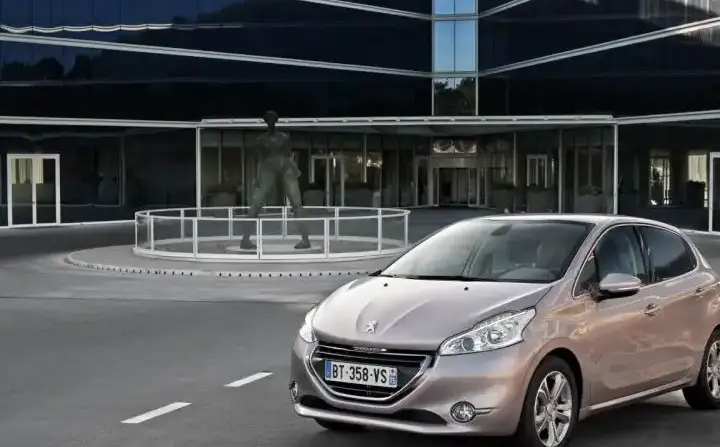
The Peugeot 208 I (Phase II), specifically the 1.2 PureTech 110 horsepower variant, was a significant model in Peugeot’s European lineup from 2015 to 2018. This refresh of the first-generation 208, built on the PF1 platform (also known as the 1HX0/A3 platform shared with Citroën and Opel/Vauxhall), aimed to modernize the vehicle with updated styling, improved fuel efficiency, and enhanced technology. The 1.2 PureTech 110 hp model occupied a mid-range position within the 208 range, offering a balance between performance, economy, and affordability. It sat above the lower-powered 1.0-liter and 1.2-liter (68-82 hp) models, and below the sportier GT Line variants.
Powertrain & Engine Architecture
The 1.2 PureTech 110 hp variant is powered by the PSA Group’s EB2DTM engine. This is a compact, three-cylinder, turbocharged gasoline engine featuring direct fuel injection and an intercooler. The engine’s design prioritizes lightweight construction and reduced internal friction, contributing to its efficiency. The engine produces 110 horsepower at 5500 rpm and 205 Nm (151.2 lb.-ft.) of torque at a low 1500 rpm, providing good low-end responsiveness. A timing chain, rather than a belt, is used for valve timing, intended to reduce long-term maintenance costs. The standard transmission was a five-speed manual, chosen for its balance of cost and efficiency. The gear ratios are optimized for fuel economy, with a focus on providing usable torque in everyday driving situations.
Driving Characteristics
The 1.2 PureTech 110 hp engine delivers a noticeable performance improvement over the base-level 208 engines. While not designed for outright speed, it provides adequate power for highway merging and overtaking maneuvers. The turbocharger does exhibit some lag at lower engine speeds, but the readily available torque helps to mitigate this. The five-speed manual transmission is generally smooth, although the gear ratios are spaced to favor fuel economy over aggressive acceleration. A 0-60 mph time of around 9.1 seconds is representative of its performance. The 208’s relatively light weight contributes to a nimble and engaging driving experience, making it enjoyable to drive in urban and rural environments.
Equipment & Trim Levels
The 1.2 PureTech 110 hp model typically included standard features such as air conditioning, power windows, central locking, and a basic audio system with USB connectivity. Higher trim levels added features like alloy wheels, a touchscreen infotainment system with Bluetooth connectivity, cruise control, and rear parking sensors. Interior upholstery was generally cloth, with options for upgraded materials and trim finishes available on higher-spec models. Safety equipment included ABS, Electronic Stability Program (ESP), and multiple airbags.
Chassis & Braking
The 208 I utilizes a McPherson strut front suspension and an elastic beam rear suspension. This configuration provides a good compromise between ride comfort and handling precision. The front brakes are ventilated discs, offering good stopping power, while the rear brakes are solid discs. The steering system is a rack and pinion type, providing responsive and accurate steering feel. The 208’s lightweight construction further enhances its handling characteristics, making it feel agile and responsive in corners.
Market Reception & Comparison
The 1.2 PureTech 110 hp variant of the Peugeot 208 received generally positive reviews from automotive critics. It was praised for its fuel efficiency, responsive engine, and comfortable ride quality. Compared to the lower-powered engines, the 110 hp version offered a significant improvement in performance without sacrificing fuel economy. When compared to the diesel variants, such as the 1.6 BlueHDi, the 1.2 PureTech offered a more refined and quieter driving experience, although with slightly higher fuel consumption. The 1.2 PureTech engine proved to be a popular choice among buyers seeking a well-rounded and economical hatchback.
Legacy
The 1.2 PureTech engine has become a cornerstone of the PSA Group (now Stellantis) powertrain lineup, and has generally proven to be a reliable engine. However, early iterations of the engine were subject to reports of timing chain issues, leading to recalls and warranty repairs. Subsequent revisions addressed these concerns, improving the engine’s long-term durability. Today, the 208 I 1.2 PureTech 110 hp remains a viable option in the used car market, offering a compelling combination of style, efficiency, and affordability. Its relatively low running costs and readily available parts contribute to its continued appeal.