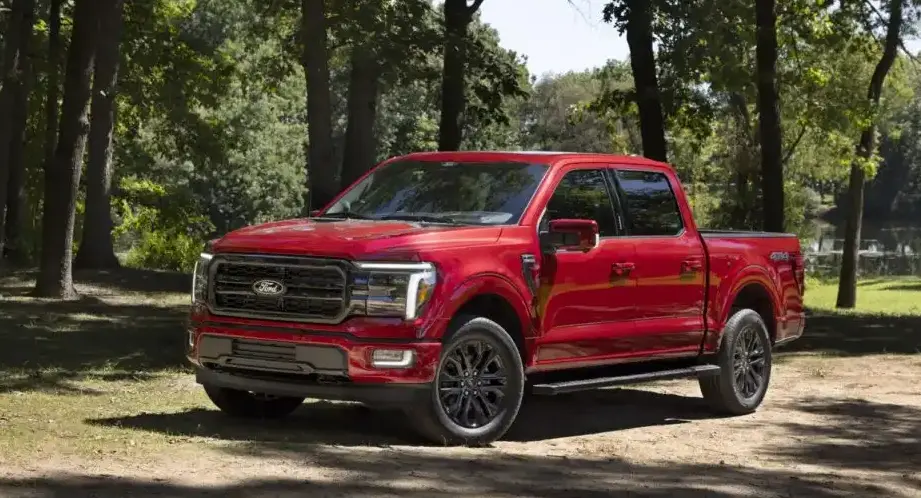
The Ford F-150 XIV SuperCrew, specifically the 2.7 EcoBoost V6 variant introduced with the 2023 facelift, represents a significant offering within the best-selling full-size pickup truck lineage in the United States. Production began in September 2023, continuing Ford’s long-standing tradition of providing a diverse range of configurations to meet varying customer needs. This particular iteration slots into the mid-range of the F-150 lineup, balancing capability with a focus on fuel efficiency and a more accessible price point compared to the higher-output engine options. It builds upon the foundation of the fourteenth-generation F-150 (2021-present), incorporating styling and technology updates from the 2023 refresh.
Technical Specifications
| Brand | Ford |
| Model | F-Series F-150 |
| Generation | F-Series F-150 XIV SuperCrew (facelift 2023) |
| Type (Engine) | 2.7 EcoBoost V6 (325 Hp) SelectShift |
| Start of production | September, 2023 |
| Powertrain Architecture | Internal Combustion engine |
| Body type | Pick-up |
| Seats | 5-6 |
| Doors | 4 |
| Fuel consumption (economy) – urban (EPA) | 12.4 l/100 km (19 US mpg, 22.8 UK mpg, 8.1 km/l) |
| Fuel consumption (economy) – extra urban (EPA) | 9.4 l/100 km (25 US mpg, 30.1 UK mpg, 10.6 km/l) |
| Fuel consumption (economy) – combined (EPA) | 11.2 l/100 km (21 US mpg, 25.2 UK mpg, 8.9 km/l) |
| Fuel Type | Petrol (Gasoline) |
| Weight-to-power ratio | 6.5 kg/Hp, 152.9 Hp/tonne |
| Weight-to-torque ratio | 3.9 kg/Nm, 254.9 Nm/tonne |
| Power | 325 Hp @ 5000 rpm |
| Power per litre | 120.4 Hp/l |
| Torque | 542 Nm @ 3000 rpm (399.76 lb.-ft. @ 3000 rpm) |
| Engine layout | Front, Longitudinal |
| Engine Model/Code | EcoBoost |
| Engine displacement | 2700 cm3 (164.76 cu. in.) |
| Number of cylinders | 6 |
| Engine configuration | V-engine |
| Cylinder Bore | 83 mm (3.27 in.) |
| Piston Stroke | 83 mm (3.27 in.) |
| Compression ratio | 10:1 |
| Number of valves per cylinder | 4 |
| Fuel injection system | Direct injection and Multi-port manifold injection |
| Engine aspiration | Twin-Turbo, Intercooler |
| Valvetrain | DOHC, Ti-VCT |
| Engine oil capacity | 5.7 l (6.02 US qt | 5.02 UK qt) |
| Coolant | 14.3 l (15.11 US qt | 12.58 UK qt) |
| Kerb Weight | 2126 kg (4687.03 lbs.) |
| Max. weight | 2915 kg (6426.47 lbs.) |
| Max load | 789 kg (1739.45 lbs.) |
| Trunk (boot) space – minimum | 1495 l (52.8 cu. ft.) |
| Fuel tank capacity | 136 l (35.93 US gal | 29.92 UK gal) |
| Permitted trailer load with brakes (12%) | 3719 kg (8198.99 lbs.) |
| Length | 5893 mm (232.01 in.) |
| Width | 2029 mm (79.88 in.) |
| Width with mirrors folded | 2123 mm (83.58 in.) |
| Width including mirrors | 2431 mm (95.71 in.) |
| Height | 1915 mm (75.39 in.) |
| Wheelbase | 3693 mm (145.39 in.) |
| Front track | 1725 mm (67.91 in.) |
| Rear (Back) track | 1735 mm (68.31 in.) |
| Front overhang | 950 mm (37.4 in.) |
| Rear overhang | 1250 mm (49.21 in.) |
| Ride height (ground clearance) | 208 mm (8.19 in.) |
| Minimum turning circle (turning diameter) | 14.6 m (47.9 ft.) |
| Approach angle | 21° |
| Departure angle | 18.6° |
| Ramp-over (brakeover) angle | 17.1° |
| Drivetrain Architecture | The Internal combustion engine (ICE) drives the rear wheels of the vehicle. |
| Drive wheel | Rear wheel drive |
| Number of gears and type of gearbox | 10 gears, automatic transmission SelectShift |
| Front suspension | Double wishbone, Independent coil spring |
| Rear suspension | Rigid axle suspension, Leaf spring |
| Front brakes | Ventilated discs, 350×34 mm |
| Rear brakes | Ventilated discs, 336×20 mm |
| Assisting systems | ABS (Anti-lock braking system) |
| Steering type | Steering rack and pinion |
| Power steering | Electric Steering |
| Tires size | 245/70 R17; 265/70 R17; 265/60 R18; 265/70 R18; 275/65 R18; 275/60 R20; 275/50 R22 |
| Wheel rims size | 17; 18; 20; 22 |
Powertrain & Engine Architecture
The heart of this F-150 variant is Ford’s 2.7-liter EcoBoost V6 engine. This engine, internally designated as part of the EcoBoost family, utilizes a twin-turbocharged configuration to deliver a balance of power and efficiency. The engine employs direct fuel injection combined with multi-port fuel injection, optimizing combustion under various load conditions. The valvetrain features a double overhead camshaft (DOHC) design with Twin Independent Variable Camshaft Timing (Ti-VCT), allowing for precise control of valve timing to maximize performance and fuel economy. The 10-speed SelectShift automatic transmission is standard, providing a wide range of gear ratios for optimized acceleration and towing capability. This transmission is known for its smooth shifts and intelligent shift programming.
Driving Characteristics
The 2.7 EcoBoost V6 with the 10-speed automatic delivers a comfortable and capable driving experience. While not as overtly powerful as the 3.5L EcoBoost or the 5.0L V8 options, it provides ample torque (542 Nm or 399.76 lb-ft) for everyday driving and towing. The 10-speed transmission helps keep the engine in its optimal power band, resulting in responsive acceleration. Compared to a manual transmission equipped F-150, the automatic prioritizes ease of use and convenience, making it ideal for commuting and towing. The gear ratios are tuned for both fuel efficiency and towing capacity, offering a good balance between the two. The rear-wheel-drive configuration provides a traditional truck feel, while four-wheel drive is available as an option for enhanced traction.
Equipment & Trim Levels
The 2.7 EcoBoost engine was available across several F-150 trim levels, including XL, XLT, Lariat, and King Ranch. Standard equipment typically included features like Ford’s SYNC 4 infotainment system, a rearview camera, and basic safety features. Higher trim levels added features such as leather upholstery, heated and ventilated seats, a premium sound system, and advanced driver-assistance technologies. Optional extras included the FX4 Off-Road Package, a tow package, and various appearance packages.
Chassis & Braking
The F-150 XIV SuperCrew utilizes a high-strength steel frame and an aluminum-alloy body, contributing to its overall durability and reduced weight. The front suspension features an independent double-wishbone design with coil springs, while the rear suspension employs a rigid axle with leaf springs. Braking duties are handled by ventilated discs at all four corners, with larger rotors available on higher trim levels. Anti-lock brakes (ABS) are standard. The suspension is tuned to provide a comfortable ride while maintaining good handling characteristics, even when carrying a load.
Market Reception & Comparison
The 2.7 EcoBoost F-150 received generally positive reviews from automotive critics. It was praised for its fuel efficiency, smooth ride, and ample torque. Compared to the larger engine options, it offered a more affordable entry point into the F-150 lineup. Fuel economy figures of 21 US mpg combined were competitive for a full-size pickup truck. Reliability has been generally good, although some owners have reported issues with the turbochargers. Compared to the 3.5L EcoBoost, the 2.7L offered a more economical option, while the 5.0L V8 provided a more traditional V8 driving experience.
Legacy
The 2.7 EcoBoost engine has become a popular choice for F-150 buyers seeking a balance of power, efficiency, and capability. The powertrain has proven to be relatively reliable, and parts availability is good. On the used car market, these models represent a good value, offering a capable and well-equipped pickup truck at a reasonable price. The 2023 facelift further enhanced the F-150’s appeal, solidifying its position as a leading full-size pickup truck in the United States.