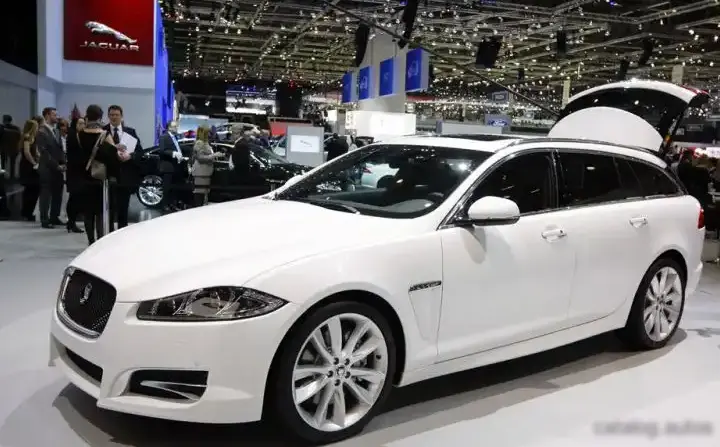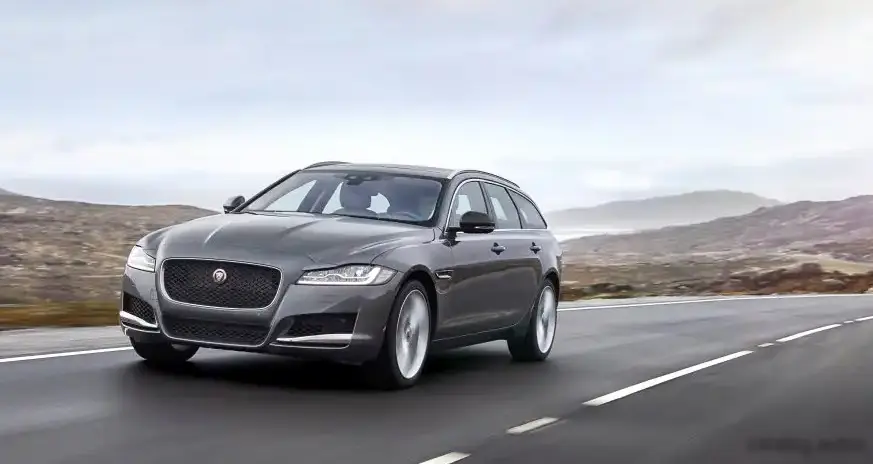
The Jaguar XF Sportbrake (X260) E-Performance 2.0d (163 hp) was a diesel-powered station wagon produced between 2019 and October 2020. Positioned as a more efficient and accessible entry point into the XF Sportbrake range, it offered a blend of practicality, luxury, and relatively economical operation. This variant was part of the X260 generation, which represented a significant step forward for Jaguar in terms of technology and build quality, competing directly with premium estate cars from German manufacturers like Audi, BMW, and Mercedes-Benz. The “E-Performance” designation denoted Jaguar’s efforts to improve fuel efficiency and reduce emissions across its range.
Technical Specifications
| Brand | Jaguar |
| Model | XF |
| Generation | XF Sportbrake (X260) |
| Type (Engine) | E-Performance 2.0d (163 Hp) |
| Start of production | 2019 |
| End of production | October, 2020 |
| Powertrain Architecture | Internal Combustion engine |
| Body type | Station wagon (estate) |
| Seats | 5 |
| Doors | 5 |
| Fuel consumption (urban) | 6.4 l/100 km (36.8 US mpg, 44.1 UK mpg, 15.6 km/l) |
| Fuel consumption (extra urban) | 4.4 l/100 km (53.5 US mpg, 64.2 UK mpg, 22.7 km/l) |
| Fuel consumption (combined) | 5.1 l/100 km (46.1 US mpg, 55.4 UK mpg, 19.6 km/l) |
| CO2 emissions | 135 g/km |
| Fuel Type | Diesel |
| Acceleration 0 – 100 km/h | 10 sec |
| Acceleration 0 – 62 mph | 10 sec |
| Acceleration 0 – 60 mph | 9.5 sec |
| Maximum speed | 219 km/h (136.08 mph) |
| Emission standard | Euro 6d-Temp |
| Weight-to-power ratio | 10.1 kg/Hp, 98.7 Hp/tonne |
| Weight-to-torque ratio | 4.3 kg/Nm, 230 Nm/tonne |
| Power | 163 Hp @ 4000 rpm |
| Power per litre | 81.5 Hp/l |
| Torque | 380 Nm @ 1750-2500 rpm (280.27 lb.-ft. @ 1750-2500 rpm) |
| Engine layout | Front, Longitudinal |
| Engine Model/Code | Ingenium / 204DTD |
| Engine displacement | 1999 cm3 (121.99 cu. in.) |
| Number of cylinders | 4 |
| Engine configuration | Inline |
| Cylinder Bore | 83 mm (3.27 in.) |
| Piston Stroke | 92.4 mm (3.64 in.) |
| Compression ratio | 15.5:1 |
| Number of valves per cylinder | 4 |
| Fuel injection system | Diesel Commonrail |
| Engine aspiration | Turbocharger, Intercooler |
| Engine oil capacity | 6.5 l (6.87 US qt | 5.72 UK qt) |
| Kerb Weight | 1652 kg (3642.04 lbs.) |
| Max. weight | 2260 kg (4982.45 lbs.) |
| Max load | 608 kg (1340.41 lbs.) |
| Fuel tank capacity | 55 l (14.53 US gal | 12.1 UK gal) |
| Permitted trailer load with brakes (12%) | 2000 kg (4409.25 lbs.) |
| Permitted trailer load without brakes | 750 kg (1653.47 lbs.) |
| Length | 4955 mm (195.08 in.) |
| Width | 1987 mm (78.23 in.) |
| Width including mirrors | 2091 mm (82.32 in.) |
| Height | 1496 mm (58.9 in.) |
| Wheelbase | 2960 mm (116.54 in.) |
| Front track | 1605 mm (63.19 in.) |
| Rear (Back) track | 1607 mm (63.27 in.) |
| Minimum turning circle | 11.94 m (39.17 ft.) |
| Drivetrain Architecture | Rear wheel drive |
| Drive wheel | Rear wheel drive |
| Number of gears and type of gearbox | 6 gears, manual transmission |
| Front brakes | Disc |
| Rear brakes | Disc |
| Assisting systems | ABS (Anti-lock braking system) |
| Tires size | 225/55 R17; 245/45 R18 |
| Wheel rims size | 7.5J x 17; 8J x 18 |
INTRODUCTION
The Jaguar XF Sportbrake (X260) E-Performance 2.0d, produced from 2019 to 2020, represented Jaguar’s attempt to broaden the appeal of its executive estate car. Built on the X260 platform – shared with the XF saloon – the Sportbrake offered the same sophisticated styling and luxurious interior, but with the added practicality of a larger cargo area. The 2.0d variant, powered by Jaguar Land Rover’s Ingenium engine, was positioned as the entry-level model, prioritizing fuel efficiency and lower running costs over outright performance. It aimed to attract buyers who desired the XF’s prestige and refinement but didn’t require the power of the higher-spec engines.
Powertrain & Engine Architecture
At the heart of the XF Sportbrake 2.0d lies Jaguar Land Rover’s Ingenium engine family. Specifically, it utilizes the 204DTD code, a 2.0-liter inline-four cylinder diesel engine. This engine is characterized by its all-aluminum construction, designed to reduce weight and improve thermal efficiency. It employs a sophisticated turbocharger with variable geometry, coupled with an intercooler, to deliver 163 horsepower at 4000 rpm and a substantial 380 Nm (280 lb-ft) of torque between 1750 and 2500 rpm. The engine features a high-pressure direct injection common rail system, operating at pressures up to 2,200 bar, for precise fuel delivery and optimized combustion. The 6-speed manual transmission was standard, chosen for its efficiency and driver engagement, although an 8-speed automatic was available as an option. The engine is longitudinally mounted, driving the rear wheels.
Driving Characteristics
The 163 hp 2.0d powertrain in the XF Sportbrake delivers a comfortable and refined driving experience, but it’s not focused on outright speed. Acceleration from 0-60 mph takes around 9.5 seconds, and while adequate for everyday driving, it’s noticeably slower than the more powerful XF variants. The engine’s strong low-end torque makes it feel responsive in typical driving situations, providing sufficient power for overtaking and merging onto highways. The manual transmission, while engaging, requires frequent shifting to maintain momentum, especially when fully loaded. Compared to the higher-output 2.0d (180 hp) or the 3.0-liter V6 models, the 163 hp version prioritizes fuel economy over performance. The gear ratios are tuned for efficiency, resulting in a relaxed cruising experience but less urgency when accelerating.
Equipment & Trim Levels
The XF Sportbrake 2.0d typically came equipped with a generous level of standard features. Interior appointments included leather upholstery (often grained leather as standard), a leather-wrapped steering wheel, and aluminum trim accents. The infotainment system featured an 8-inch touchscreen display with navigation, Bluetooth connectivity, and a premium sound system. Standard safety equipment included autonomous emergency braking, lane departure warning, and front and rear parking sensors. Optional extras included a panoramic sunroof, heated and cooled front seats, a head-up display, and adaptive cruise control. Trim levels varied by market, but generally, the 2.0d served as the base model, with higher trims offering more luxurious appointments and advanced technology features.
Chassis & Braking
The XF Sportbrake utilizes a sophisticated chassis design, featuring a double wishbone front suspension and a multi-link rear suspension. This setup provides a comfortable ride quality while maintaining good handling characteristics. The 2.0d variant typically featured slightly softer spring rates compared to the higher-performance models, prioritizing ride comfort over ultimate handling precision. Braking duties are handled by disc brakes on all four wheels, with ABS (Anti-lock Braking System) and electronic brakeforce distribution as standard. Stabilizer bars are fitted front and rear to reduce body roll during cornering. The rear suspension geometry was tuned to accommodate the increased weight and load-carrying capacity of the estate body style.
Market Reception & Comparison
The Jaguar XF Sportbrake 2.0d was generally well-received by automotive critics, who praised its refined driving experience, luxurious interior, and practical estate car body style. However, some reviewers noted that the 163 hp engine felt underpowered for a car of its size and weight, particularly when fully loaded. Compared to its rivals – the Audi A6 Avant, BMW 5 Series Touring, and Mercedes-Benz E-Class Estate – the XF Sportbrake offered a compelling blend of style, luxury, and value. Its fuel economy was competitive, averaging around 46.1 US mpg in combined driving, and its reliability record has been generally good, although some owners have reported issues with the diesel particulate filter (DPF). The 2.0d variant was often seen as a more sensible and economical alternative to the more expensive and powerful XF models.
Legacy
The Jaguar XF Sportbrake 2.0d (163 hp) represents a significant step in Jaguar’s efforts to offer a more diverse and efficient range of vehicles. While it wasn’t the fastest or most dynamic XF variant, it provided a compelling option for buyers who prioritized practicality, comfort, and fuel economy. On the used car market, these models offer a relatively affordable entry point into Jaguar ownership, and the Ingenium engine has proven to be generally reliable, provided it has been properly maintained. The DPF system remains a potential area of concern, requiring regular servicing and occasional regeneration. Overall, the XF Sportbrake 2.0d remains a stylish and capable estate car that continues to appeal to a wide range of buyers.