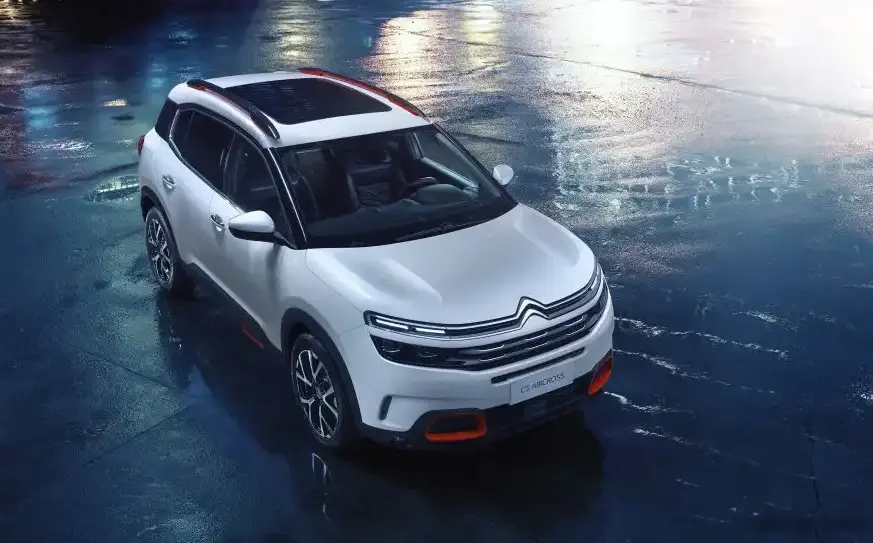
The Citroën C5 I (Phase II), produced from 2004 to 2008, represented a significant evolution of Citroën’s large family car. The 2.0 HDi 136 horsepower variant, equipped with a six-speed manual transmission, occupied a crucial mid-range position within the C5 lineup, offering a balance between fuel efficiency, performance, and equipment. This model was primarily aimed at European markets, where diesel engines and sophisticated suspension systems were highly valued. It built upon the foundation of the initial C5 I (launched in 2001), addressing some early criticisms and refining the overall driving experience.
Technical Specifications
| Brand | Citroën |
| Model | C5 |
| Generation | C5 I (Phase II, 2004) |
| Type (Engine) | 2.0 HDi (136 Hp) FAP |
| Start of production | 2004 |
| End of production | 2008 |
| Powertrain Architecture | Internal Combustion engine |
| Body type | Sedan |
| Seats | 5 |
| Doors | 4 |
| Fuel consumption (urban) | 7.8 l/100 km (30.2 US mpg, 36.2 UK mpg, 12.8 km/l) |
| Fuel consumption (extra urban) | 5 l/100 km (47 US mpg, 56.5 UK mpg, 20 km/l) |
| Fuel consumption (combined) | 6 l/100 km (39.2 US mpg, 47.1 UK mpg, 16.7 km/l) |
| CO2 emissions | 158 g/km |
| Fuel Type | Diesel |
| Acceleration 0 – 100 km/h | 9.8 sec |
| Acceleration 0 – 62 mph | 9.8 sec |
| Acceleration 0 – 60 mph | 9.3 sec |
| Maximum speed | 205 km/h (127.38 mph) |
| Emission standard | Euro 4 |
| Weight-to-power ratio | 10.9 kg/Hp, 91.5 Hp/tonne |
| Weight-to-torque ratio | 4.6 kg/Nm, 215.3 Nm/tonne |
| Power | 136 Hp @ 4000 rpm |
| Power per litre | 68.1 Hp/l |
| Torque | 320 Nm @ 2000 rpm (236.02 lb.-ft. @ 2000 rpm) |
| Engine layout | Front, Transverse |
| Engine Model/Code | RHR DW10BTED4 |
| Engine displacement | 1997 cm3 (121.86 cu. in.) |
| Number of cylinders | 4 |
| Engine configuration | Inline |
| Cylinder Bore | 85 mm (3.35 in.) |
| Piston Stroke | 88 mm (3.46 in.) |
| Compression ratio | 17.6:1 |
| Number of valves per cylinder | 4 |
| Fuel injection system | Diesel Commonrail |
| Engine aspiration | Turbocharger, Intercooler |
| Valvetrain | DOHC |
| Engine oil capacity | 5.25 l (5.55 US qt | 4.62 UK qt) |
| Coolant | 10.7 l (11.31 US qt | 9.41 UK qt) |
| Kerb Weight | 1486 kg (3276.07 lbs.) |
| Max. weight | 2006 kg (4422.47 lbs.) |
| Max load | 520 kg (1146.4 lbs.) |
| Trunk (boot) space – minimum | 471 l (16.63 cu. ft.) |
| Trunk (boot) space – maximum | 1315 l (46.44 cu. ft.) |
| Fuel tank capacity | 67 l (17.7 US gal | 14.74 UK gal) |
| Max. roof load | 75 kg (165.35 lbs.) |
| Permitted trailer load with brakes (12%) | 1700 kg (3747.86 lbs.) |
| Permitted trailer load without brakes | 730 kg (1609.37 lbs.) |
| Permitted towbar download | 75 kg (165.35 lbs.) |
| Length | 4745 mm (186.81 in.) |
| Width | 1780 mm (70.08 in.) |
| Height | 1476 mm (58.11 in.) |
| Wheelbase | 2750 mm (108.27 in.) |
| Front track | 1528 mm (60.16 in.) |
| Rear (Back) track | 1495 mm (58.86 in.) |
| Front overhang | 1033 mm (40.67 in.) |
| Rear overhang | 962 mm (37.87 in.) |
| Minimum turning circle | 12.43 m (40.78 ft.) |
| Drivetrain Architecture | The Internal combustion engine (ICE) drives the front wheels of the vehicle. |
| Drive wheel | Front wheel drive |
| Number of gears and type of gearbox | 6 gears, manual transmission |
| Front suspension | Independent, type McPherson with coil spring and anti-roll bar |
| Rear suspension | Semi-independent, coil spring |
| Front brakes | Ventilated discs |
| Rear brakes | Disc |
| Assisting systems | ABS (Anti-lock braking system) |
| Tires size | 215/55 R16 |
| Wheel rims size | 16 |
INTRODUCTION
The Citroën C5 I Phase II 2.0 HDi 136, produced between 2004 and 2008, was a key variant in Citroën’s popular C5 range. Positioned as a mainstream offering, it slotted between the lower-powered 1.8 HDi and the more expensive 2.2 HDi models. The Phase II update brought cosmetic revisions, improved interior quality, and refinements to the suspension system. Built on the PSA Group’s 1HX0 platform (also shared with the Peugeot 607), the C5 aimed to provide a comfortable and practical family car experience, emphasizing ride quality and advanced technology for its time.
Powertrain & Engine Architecture
At the heart of this C5 variant lies the DW10BTED4 engine, a 2.0-liter four-cylinder diesel engine. This engine, commonly found in PSA Group vehicles, is characterized by its robust construction and relatively simple design. The ‘RHR’ engine code specifically denotes this configuration. It utilizes a common rail direct injection system, delivering fuel at extremely high pressure for improved combustion efficiency and reduced emissions. The engine features a single overhead camshaft (SOHC) design operating four valves per cylinder (DOHC). A turbocharger with an intercooler is employed to boost power output and improve torque across a wider rev range. The six-speed manual transmission, a BE4 type, was the standard offering for this model, providing well-spaced gear ratios for both fuel economy and performance.
Driving Characteristics
The 2.0 HDi 136 offered a respectable driving experience, prioritizing comfort and fuel efficiency over outright performance. With 136 horsepower and 320 Nm (236 lb-ft) of torque, acceleration from 0-60 mph took around 9.3 seconds, making it competitive within its class. The engine delivered strong low-end torque, making it easy to drive in everyday situations. The six-speed gearbox allowed for relaxed cruising on the highway, while still providing enough gears for spirited driving. Compared to the lower-powered 1.8 HDi, the 2.0 HDi offered noticeably more punch, particularly when overtaking. However, it lacked the extra refinement and power of the 2.2 HDi. The C5’s renowned hydropneumatic suspension (depending on trim level) contributed to a remarkably smooth and comfortable ride, absorbing bumps and imperfections in the road with ease.
Equipment & Trim Levels
The 2.0 HDi 136 typically came equipped with a reasonable level of standard features. These included air conditioning, power windows, central locking, and an RDS stereo. Higher trim levels, such as Exclusive, added features like automatic climate control, alloy wheels, rain-sensing wipers, and a trip computer. Interior upholstery was typically cloth, with leather options available as an upgrade. The dashboard layout was functional and ergonomically designed, with a focus on ease of use. Optional extras included a navigation system, parking sensors, and a panoramic sunroof.
Chassis & Braking
The C5 I featured a MacPherson strut front suspension and a semi-independent torsion beam rear suspension. Higher-spec models often benefited from Citroën’s advanced Hydractive suspension system, which used hydraulic fluid and electronic control to adjust the damping characteristics in real-time, providing an even more refined ride. Braking duties were handled by ventilated discs at the front and solid discs at the rear. Anti-lock Braking System (ABS) was standard, enhancing safety and control during emergency braking. The C5’s chassis was designed to prioritize comfort and stability, rather than sporty handling.
Market Reception & Comparison
The Citroën C5 I 2.0 HDi 136 was generally well-received by automotive critics. It was praised for its comfortable ride, fuel efficiency, and spacious interior. However, some critics noted that the interior design was somewhat dated compared to its rivals. Compared to the 1.8 HDi, the 2.0 HDi offered a significant performance upgrade without a substantial increase in fuel consumption. Against the 2.2 HDi, it represented a more affordable option, albeit with slightly less power and refinement. The C5’s main competitors included the Ford Mondeo, Volkswagen Passat, and Peugeot 607.
Legacy
The DW10BTED4 engine, in its various iterations, proved to be a durable and reliable powerplant. While not without its potential issues (such as diesel particulate filter clogging and occasional turbocharger failures), it generally offered good long-term reliability with proper maintenance. Today, the C5 I 2.0 HDi 136 can be found as an affordable used car, offering a comfortable and practical transportation option. Its reputation for ride quality and fuel efficiency continues to appeal to buyers seeking a well-rounded family car. However, potential buyers should be aware of the age-related issues common to older diesel vehicles, such as potential problems with the DPF and injection system.