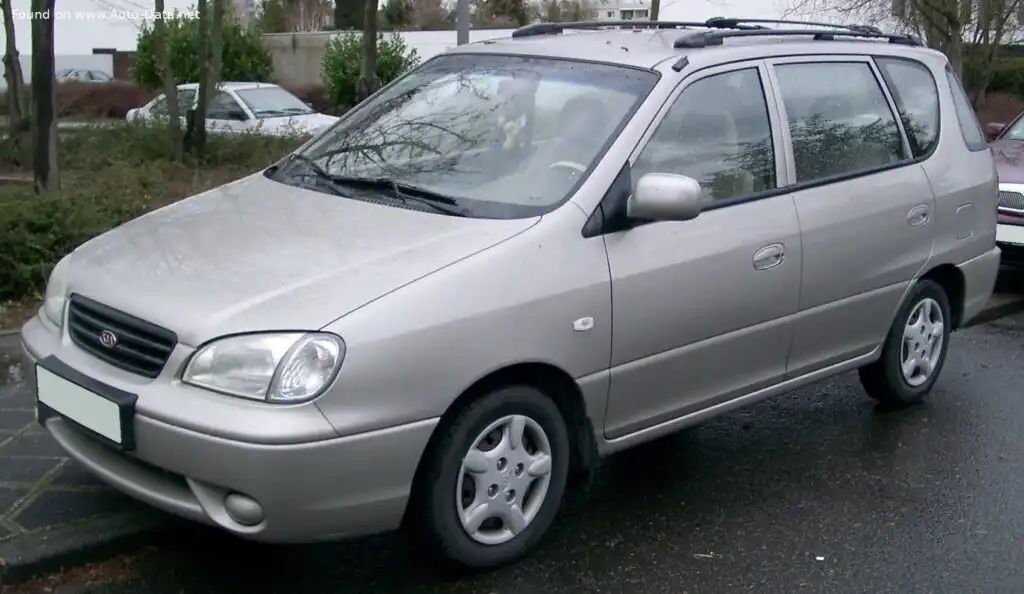
The Kia Carens II 2.0 CRDi, produced between 2006 and 2010, represented a significant step forward for Kia in the European and Asian MPV (Multi-Purpose Vehicle) market. Positioned as a practical and spacious family vehicle, the Carens II aimed to compete with established players like the Renault Scenic and Citroën Xsara Picasso. This particular variant, equipped with the 2.0-liter CRDi diesel engine producing 140 horsepower, was a mid-range offering within the Carens II lineup, balancing fuel efficiency with adequate performance for everyday driving. It was primarily sold in Europe and select Asian markets, where diesel engines were favored for their economy and torque.
Technical Specifications
| Brand | Kia |
| Model | Carens |
| Generation | Carens II |
| Type (Engine) | 2.0 CRDi (140 Hp) |
| Start of production | 2006 |
| End of production | 2010 |
| Powertrain Architecture | Internal Combustion engine |
| Body type | MPV |
| Seats | 7 |
| Doors | 5 |
| Fuel consumption (urban) | 7.8 l/100 km (30.2 US mpg) |
| Fuel consumption (extra urban) | 5.2 l/100 km (45.2 US mpg) |
| Fuel Type | Diesel |
| Acceleration 0 – 100 km/h | 11 sec |
| Acceleration 0 – 62 mph | 11 sec |
| Acceleration 0 – 60 mph | 10.5 sec |
| Maximum speed | 187 km/h (116.2 mph) |
| Weight-to-power ratio | 11.5 kg/Hp |
| Weight-to-torque ratio | 5.3 kg/Nm |
| Power | 140 Hp @ 4000 rpm |
| Torque | 305 Nm @ 1800 rpm (224.96 lb.-ft. @ 1800 rpm) |
| Engine layout | Front, Transverse |
| Engine Model/Code | D4EA |
| Engine displacement | 1991 cm3 (121.5 cu. in.) |
| Number of cylinders | 4 |
| Engine configuration | Inline |
| Cylinder Bore | 83 mm (3.27 in.) |
| Piston Stroke | 92 mm (3.62 in.) |
| Compression ratio | 17.3:1 |
| Number of valves per cylinder | 4 |
| Fuel injection system | Diesel Commonrail |
| Engine aspiration | Turbocharger, Intercooler |
| Engine oil capacity | 5.9 l (6.23 US qt | 5.19 UK qt) |
| Coolant capacity | 8 l (8.45 US qt | 7.04 UK qt) |
| Kerb Weight | 1610 kg (3549.44 lbs.) |
| Max. weight | 2275 kg (5015.52 lbs.) |
| Max load | 665 kg (1466.07 lbs.) |
| Trunk (boot) space – minimum | 400 l (14.13 cu. ft.) |
| Trunk (boot) space – maximum | 2106 l (74.37 cu. ft.) |
| Fuel tank capacity | 60 l (15.85 US gal | 13.2 UK gal) |
| Length | 4545 mm (178.94 in.) |
| Width | 1820 mm (71.65 in.) |
| Height | 1650 mm (64.96 in.) |
| Wheelbase | 2690 mm (105.91 in.) |
| Front track | 1575 mm (62.01 in.) |
| Rear track | 1570 mm (61.81 in.) |
| Drivetrain | Front wheel drive |
| Number of gears | 6 |
| Gearbox type | Manual transmission |
| Front suspension | Independent, McPherson with coil spring and anti-roll bar |
| Rear suspension | Independent multi-link with stabilizer |
| Front brakes | Disc |
| Rear brakes | Disc |
| Assisting systems | ABS (Anti-lock braking system) |
| Tires size | 205/60 R16 |
| Wheel rims size | 16 |
Powertrain & Engine Architecture
The heart of the Carens II 2.0 CRDi was the Kia-developed D4EA engine. This 1991cc, four-cylinder diesel engine utilized a second-generation common-rail direct injection system, delivering fuel at extremely high pressure for improved combustion efficiency and reduced emissions. The engine featured a single overhead camshaft (SOHC) design with four valves per cylinder. A turbocharger with an intercooler was employed to boost power output and provide increased torque at lower engine speeds. The 140 horsepower output was achieved at 4000 rpm, while the substantial 305 Nm (224.96 lb-ft) of torque was available from just 1800 rpm, making it well-suited for hauling passengers and cargo. The engine was paired with a six-speed manual transmission, providing a good balance between fuel economy and driver control. While an automatic transmission was offered in some markets with this engine, the manual was more common.
Driving Characteristics
The 2.0 CRDi engine in the Carens II provided a noticeable step up in performance compared to the lower-powered 1.6 gasoline variants. Acceleration to 60 mph took around 10.5 seconds, and the car felt capable on the highway, with a top speed of 116.2 mph. The high torque output meant that overtaking maneuvers were relatively effortless, even with a full load of passengers. The six-speed manual transmission allowed drivers to keep the engine in its optimal power band, maximizing efficiency and responsiveness. Compared to higher-output versions of the 2.0 CRDi (some reaching 150 hp), this 140 hp version offered a slightly more relaxed driving experience, prioritizing fuel economy over outright performance. The gear ratios were tuned for everyday usability, rather than sporty acceleration.
Equipment & Trim Levels
The 2.0 CRDi variant of the Carens II typically came with a reasonable level of standard equipment. This included air conditioning, power windows, central locking, and an integrated audio system. Higher trim levels added features such as alloy wheels, fog lights, a sunroof, and upgraded interior upholstery. Interior materials were generally durable and practical, reflecting the car’s family-oriented focus. Optional extras included a navigation system, leather seats, and parking sensors. The dashboard layout was functional and straightforward, with easy-to-read instrumentation.
Chassis & Braking
The Carens II utilized a front-wheel-drive platform with independent suspension at all four corners. The front suspension employed a McPherson strut design, while the rear featured a multi-link setup. This configuration provided a comfortable ride quality, absorbing bumps and imperfections in the road surface effectively. Disc brakes were fitted on all four wheels, providing adequate stopping power. Anti-lock Braking System (ABS) was standard, enhancing safety during emergency braking situations. Stabilizer bars were included both front and rear to reduce body roll during cornering.
Market Reception & Comparison
The Kia Carens II 2.0 CRDi was generally well-received by automotive critics as a practical and affordable MPV. Its spacious interior, comfortable ride, and fuel-efficient diesel engine were praised. However, some reviewers noted that the interior styling was somewhat bland and that the handling wasn’t as engaging as some of its competitors. Compared to the gasoline-powered versions, the 2.0 CRDi offered significantly better fuel economy and torque, making it a popular choice for drivers who covered long distances. Against rivals like the Renault Scenic and Citroën Xsara Picasso, the Carens II offered a competitive price point and a generous warranty, which helped to attract buyers.
Legacy
The Kia Carens II 2.0 CRDi has proven to be a relatively reliable vehicle in the used car market. The D4EA engine is known for its durability, provided it has been properly maintained. Common issues include wear and tear on the turbocharger and potential problems with the fuel injection system. However, these issues are generally not catastrophic and can be addressed with routine maintenance and timely repairs. Today, the Carens II 2.0 CRDi remains a viable option for budget-conscious buyers seeking a spacious and practical MPV. Its fuel efficiency and relatively low running costs continue to make it an attractive proposition.