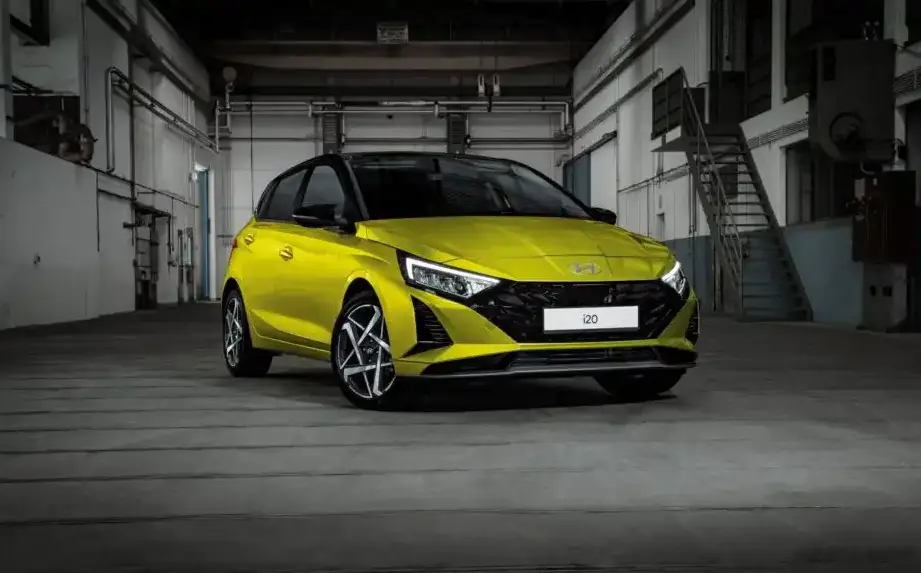
The Hyundai i20 III (facelift, introduced in May 2024) 1.2-liter (79 horsepower) represents the entry point into the third generation of Hyundai’s popular subcompact hatchback. Positioned as an affordable and efficient option, this variant plays a crucial role in attracting budget-conscious buyers in the European and Asian markets, where the i20 competes with vehicles like the Volkswagen Polo, Toyota Yaris, and Kia Rio. While Hyundai has expanded its presence in the North American market with SUVs and sedans, the i20 remains primarily a global model, not officially sold in the United States. This specific engine and transmission combination is geared towards maximizing fuel economy and providing a comfortable, if not particularly sporty, driving experience.
Technical Specifications
| Brand | Hyundai |
| Model | i20 |
| Generation | i20 III (facelift 2023) |
| Type (Engine) | 1.2 (79 Hp) |
| Start of production | May, 2024 |
| Powertrain Architecture | Internal Combustion engine |
| Body type | Hatchback |
| Seats | 5 |
| Doors | 5 |
| Combined fuel consumption (WLTP) | 5.3-5.7 l/100 km (44.4 – 41.3 US mpg, 53.3 – 49.6 UK mpg, 18.9 – 17.5 km/l) |
| CO2 emissions (WLTP) | 120-128 g/km |
| Fuel Type | Petrol (Gasoline) |
| Acceleration 0 – 100 km/h | 13.7 sec |
| Acceleration 0 – 62 mph | 13.7 sec |
| Acceleration 0 – 60 mph | 13 sec |
| Maximum speed | 166 km/h (103.15 mph) |
| Emission standard | Euro 6e |
| Weight-to-power ratio | 12.8 kg/Hp, 78 Hp/tonne |
| Weight-to-torque ratio | 9 kg/Nm, 111.5 Nm/tonne |
| Power | 79 Hp @ 6000 rpm |
| Power per litre | 66 Hp/l |
| Torque | 113 Nm @ 4200 rpm (83.34 lb.-ft. @ 4200 rpm) |
| Engine layout | Front, Transverse |
| Engine Model/Code | G4LF |
| Engine displacement | 1197 cm3 (73.05 cu. in.) |
| Number of cylinders | 4 |
| Engine configuration | Inline |
| Cylinder Bore | 71 mm (2.8 in.) |
| Piston Stroke | 75.5 mm (2.97 in.) |
| Number of valves per cylinder | 4 |
| Fuel injection system | Multi-port manifold injection |
| Engine aspiration | Naturally aspirated engine |
| Engine oil capacity | 3.4 l (3.59 US qt | 2.99 UK qt) |
| Coolant | 4.66 l (4.92 US qt | 4.1 UK qt) |
| Kerb Weight | 1013-1133 kg (2233.28 – 2497.84 lbs.) |
| Max. weight | 1560 kg (3439.21 lbs.) |
| Max load | 427-547 kg (941.37 – 1205.93 lbs.) |
| Trunk (boot) space – minimum | 352 l (12.43 cu. ft.) |
| Trunk (boot) space – maximum | 1165 l (41.14 cu. ft.) |
| Fuel tank capacity | 40 l (10.57 US gal | 8.8 UK gal) |
| Max. roof load | 70 kg (154.32 lbs.) |
| Permitted trailer load with brakes (12%) | 610 kg (1344.82 lbs.) |
| Permitted towbar download | 75 kg (165.35 lbs.) |
| Length | 4065 mm (160.04 in.) |
| Width | 1775 mm (69.88 in.) |
| Height | 1450 mm (57.09 in.) |
| Wheelbase | 2580 mm (101.57 in.) |
| Front track | 1545 mm (60.83 in.) |
| Rear (Back) track | 1549 mm (60.98 in.) |
| Front overhang | 825 mm (32.48 in.) |
| Rear overhang | 660 mm (25.98 in.) |
| Ride height (ground clearance) | 140 mm (5.51 in.) |
| Drivetrain Architecture | The Internal combustion engine (ICE) drives the front wheels of the vehicle. |
| Drive wheel | Front wheel drive |
| Number of gears and type of gearbox | 5 gears, manual transmission |
| Front suspension | Independent type McPherson |
| Rear suspension | Torsion |
| Front brakes | Ventilated discs |
| Rear brakes | Disc |
| Assisting systems | ABS (Anti-lock braking system) |
| Steering type | Steering rack and pinion |
| Power steering | Electric Steering |
| Tires size | 185/65 R15 |
| Wheel rims size | 6.0J x 15 |
Powertrain & Engine Architecture
The heart of this i20 variant is the Hyundai G4LF 1.2-liter inline-four cylinder engine. This engine is a naturally aspirated unit, meaning it doesn’t rely on a turbocharger or supercharger for forced induction. It utilizes multi-point fuel injection, a relatively simple and reliable system where fuel is sprayed into the intake manifold before the intake valves. The engine produces 79 horsepower at 6000 rpm and 113 Nm (83.34 lb-ft) of torque at 4200 rpm. The G4LF engine is known for its durability and relatively low maintenance requirements. It features a single overhead camshaft (SOHC) valvetrain with four valves per cylinder. The engine is paired with a 5-speed manual transmission, which is the standard offering for this trim level. The transmission is chosen for its simplicity and cost-effectiveness, contributing to the overall affordability of the vehicle.
Driving Characteristics
The 1.2-liter i20 is not designed for performance. Acceleration from 0 to 100 km/h (0-62 mph) takes approximately 13.7 seconds, and the top speed is 166 km/h (103 mph). The focus is on fuel efficiency and ease of driving. The 5-speed manual transmission offers a reasonable spread of gears, but the engine feels strained when pushed hard, particularly when overtaking. The gear ratios are optimized for economy rather than outright speed. Compared to higher-spec i20 models with more powerful engines, this variant feels noticeably slower and less refined. However, for urban commuting and everyday driving, the 1.2-liter engine provides adequate power and a smooth, predictable driving experience.
Equipment & Trim Levels
The 1.2-liter i20 typically serves as the base trim level, offering a functional but not overly luxurious interior. Standard features generally include air conditioning, power windows, central locking, and a basic audio system with USB connectivity. Safety features such as ABS, airbags, and stability control are also standard. Interior upholstery is typically cloth, and the dashboard features a simple, straightforward design. Optional extras, depending on the market, could include alloy wheels, a touchscreen infotainment system, and parking sensors. The trim level is designed to appeal to buyers prioritizing value and practicality.
Chassis & Braking
The i20 utilizes a front-wheel-drive layout with an independent McPherson strut suspension at the front and a torsion beam suspension at the rear. This suspension setup provides a comfortable ride quality, although it’s not particularly sporty. The front brakes are ventilated discs, while the rear brakes are discs. The braking system is adequate for the vehicle’s weight and performance, and ABS is standard. The steering is electrically assisted, providing light and easy steering feel.
Market Reception & Comparison
The 1.2-liter i20 is generally well-regarded for its fuel efficiency and affordability. Critics often point to its lack of power as a drawback, but acknowledge that it’s sufficient for its intended purpose. Compared to other trims in the i20 lineup, such as those with larger engines, the 1.2-liter version offers significantly better fuel economy but sacrifices performance. It competes directly with other entry-level subcompact hatchbacks, offering a compelling value proposition in terms of price and features.
Legacy
The G4LF 1.2-liter engine has proven to be a reliable and durable powerplant in various Hyundai and Kia models. While not known for its exciting performance, it has earned a reputation for longevity and low maintenance costs. In the used car market, the 1.2-liter i20 is often seen as a sensible and economical choice, particularly for first-time car buyers or those seeking a low-cost runabout. Its simplicity and proven reliability make it a relatively easy vehicle to maintain, and parts availability is generally good.