
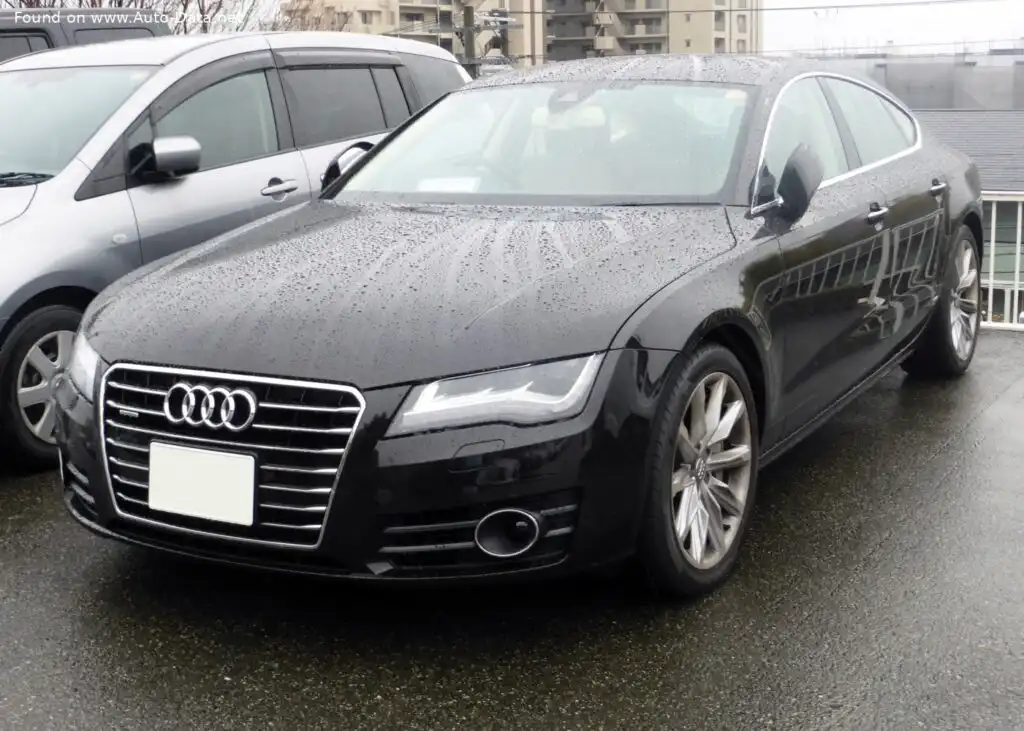
The Audi A7 Sportback (C7) 2.8 FSI V6 with the Multitronic transmission represents a compelling blend of luxury, performance, and efficiency within the A7 range. Produced from October 2010 to 2014, this variant occupied a middle ground in the lineup, offering a step up from the base 2.0 TFSI engine while remaining more accessible than the flagship 3.0 TDI and 4.2 FSI models. The C7 generation A7, built on the Volkswagen Group’s PL46 platform (also known as the A6/A7/A8 platform), aimed to redefine the four-door coupe segment with its sleek, Sportback design and sophisticated technology.
Technical Specifications
| Brand | Audi |
| Model | A7 |
| Generation | A7 Sportback (C7) |
| Type (Engine) | 2.8 FSI V6 (204 Hp) Multitronic |
| Start of production | October, 2010 |
| End of production | 2014 |
| Powertrain Architecture | Internal Combustion engine |
| Body type | Liftback |
| Seats | 5 |
| Doors | 5 |
| Fuel consumption (urban) | 9.6 l/100 km (24.5 US mpg) |
| Fuel consumption (extra urban) | 6.1 l/100 km (38.6 US mpg) |
| Fuel consumption (combined) | 7.4 l/100 km (31.8 US mpg) |
| CO2 emissions | 172 g/km |
| Fuel Type | Petrol (Gasoline) |
| Acceleration 0 – 100 km/h | 7.9 sec |
| Acceleration 0 – 62 mph | 7.9 sec |
| Acceleration 0 – 60 mph | 7.5 sec |
| Maximum speed | 235 km/h (146.02 mph) |
| Emission standard | Euro 5 |
| Weight-to-power ratio | 8.1 kg/Hp |
| Weight-to-torque ratio | 5.9 kg/Nm |
| Power | 204 Hp @ 5250-6500 rpm |
| Torque | 280 Nm @ 3000-5000 rpm (206.52 lb.-ft.) |
| Engine layout | Front, Longitudinal |
| Engine Model/Code | CHVA, CNYA |
| Engine displacement | 2773 cm3 (169.22 cu. in.) |
| Number of cylinders | 6 |
| Engine configuration | V-engine |
| Cylinder Bore | 84.5 mm (3.33 in.) |
| Piston Stroke | 82.4 mm (3.24 in.) |
| Compression ratio | 12:1 |
| Number of valves per cylinder | 4 |
| Fuel injection system | Direct injection |
| Engine aspiration | Naturally aspirated engine |
| Valvetrain | DOHC |
| Engine oil capacity | 6.8 l (7.19 US qt | 5.98 UK qt) |
| Kerb Weight | 1660 kg (3659.67 lbs.) |
| Max. weight | 2210 kg (4872.22 lbs.) |
| Max load | 550 kg (1212.54 lbs.) |
| Trunk (boot) space – minimum | 535 l (18.89 cu. ft.) |
| Trunk (boot) space – maximum | 1390 l (49.09 cu. ft.) |
| Fuel tank capacity | 65 l (17.17 US gal | 14.3 UK gal) |
| Max. roof load | 100 kg (220.46 lbs.) |
| Permitted trailer load with brakes (8%) | 2100 kg (4629.71 lbs.) |
| Permitted trailer load with brakes (12%) | 1900 kg (4188.78 lbs.) |
| Permitted trailer load without brakes | 750 kg (1653.47 lbs.) |
| Permitted towbar download | 85 kg (187.39 lbs.) |
| Length | 4969 mm (195.63 in.) |
| Width | 1911 mm (75.24 in.) |
| Height | 1420 mm (55.91 in.) |
| Wheelbase | 2914 mm (114.72 in.) |
| Front track | 1644 mm (64.72 in.) |
| Rear (Back) track | 1635 mm (64.37 in.) |
| Minimum turning circle | 11.9 m (39.04 ft.) |
| Drivetrain Architecture | Front wheel drive |
| Number of gears and type of gearbox | automatic transmission Multitronic |
| Front suspension | Independent multi-link suspension |
| Rear suspension | Independent on trapezoidal lever |
| Front brakes | Ventilated discs |
| Rear brakes | Disc |
| Tires size | 255/45 R18 |
| Wheel rims size | 8.5J x 18 |
Powertrain & Engine Architecture
The heart of the A7 2.8 FSI is the CHVA or CNYA engine code, a 2.8-liter naturally aspirated V6. This engine utilizes Audi’s FSI (Fuel Stratified Injection) direct injection technology, delivering fuel directly into the combustion chamber for improved efficiency and power. The engine features a double overhead camshaft (DOHC) valvetrain with four valves per cylinder, optimizing airflow for enhanced performance. The 2.8L V6 produces 204 horsepower at 5250-6500 rpm and 280 Nm (206.52 lb-ft) of torque between 3000 and 5000 rpm. Paired with this engine is Audi’s Multitronic continuously variable transmission (CVT). Unlike traditional automatic transmissions with fixed gear ratios, the Multitronic uses a chain-driven system to provide a virtually infinite number of gear ratios, optimizing engine efficiency and providing smooth acceleration.
Driving Characteristics
The 2.8 FSI with the Multitronic transmission delivers a refined and comfortable driving experience. While not as overtly sporty as the higher-output variants, the 204 hp engine provides adequate power for everyday driving and highway cruising. The Multitronic transmission contributes to smooth, seamless acceleration, and the ability to keep the engine in its optimal power band. Compared to the six-speed manual transmission available on some A7 models, the Multitronic prioritizes fuel efficiency and ease of use over outright performance. Acceleration from 0 to 60 mph takes approximately 7.5 seconds, making it competitive within its class. The CVT’s programming is tuned for efficiency, sometimes resulting in a slight delay in response during aggressive acceleration compared to a traditional automatic or manual gearbox.
Equipment & Trim Levels
The A7 2.8 FSI typically came well-equipped as standard. Features included leather upholstery, tri-zone automatic climate control, a 6.5-inch infotainment screen with Audi’s MMI (Multi Media Interface) system, and a ten-speaker audio system. Optional extras were plentiful, including a larger infotainment screen, a Bang & Olufsen sound system, adaptive cruise control, a panoramic sunroof, and various driver assistance systems. Trim levels varied by market, but generally, the 2.8 FSI served as a mid-range offering, bridging the gap between the entry-level 2.0 TFSI and the more luxurious 3.0 TDI and 4.2 FSI models.
Chassis & Braking
The A7 Sportback features a sophisticated chassis designed to balance comfort and handling. The front suspension utilizes an independent multi-link setup, while the rear employs an independent trapezoidal link design. This configuration provides a smooth ride and precise handling characteristics. The 2.8 FSI models typically came equipped with ventilated front disc brakes and solid rear discs. Anti-lock braking system (ABS) was standard, enhancing safety and control during emergency braking situations. The suspension tuning is geared towards comfort, offering a more compliant ride than the sportier S7 variant.
Market Reception & Comparison
The Audi A7 2.8 FSI was generally well-received by automotive critics. It was praised for its stylish design, luxurious interior, and refined driving experience. The Multitronic transmission was a point of contention for some, with some reviewers preferring the more engaging feel of a traditional automatic or manual gearbox. Compared to the 2.0 TFSI, the 2.8 FSI offered a noticeable increase in performance and refinement. Compared to the 3.0 TDI, it provided a more traditional gasoline engine experience, albeit with slightly lower fuel economy. The 2.8 FSI offered a good balance of performance, efficiency, and luxury, making it a popular choice for buyers seeking a well-rounded grand tourer.
Legacy
The Audi A7 2.8 FSI (C7) with the Multitronic transmission has proven to be a relatively reliable powertrain. The 2.8L V6 engine is known for its durability, and the Multitronic transmission, while requiring regular maintenance (fluid changes are crucial), can provide years of trouble-free operation. On the used car market, these A7s represent a good value proposition, offering a luxurious and well-equipped vehicle at a more affordable price point than newer models. However, potential buyers should be aware of the importance of maintaining the Multitronic transmission and checking for any signs of wear or damage.
