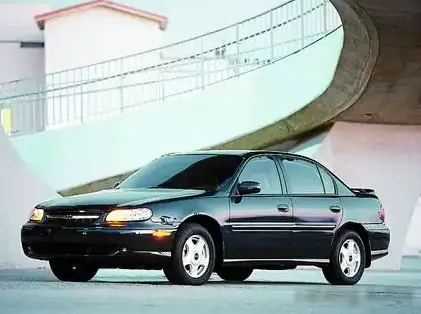
The Chevrolet Malibu V, produced from 1997 to 1999, represented a significant step forward for Chevrolet’s mid-size sedan. This generation, internally designated as the V, aimed to offer a more refined and contemporary alternative to competitors like the Honda Accord and Toyota Camry. The 3.1i V6 model, equipped with a 155 horsepower engine and a four-speed automatic transmission, occupied a middle ground within the Malibu V lineup, offering a balance between performance and affordability. It was positioned above the base 2.3L four-cylinder models and below the more performance-oriented, though less common, supercharged variants.
Technical Specifications
| Brand | Chevrolet |
| Model | Malibu |
| Generation | Malibu V |
| Type (Engine) | 3.1i V6 (155 Hp) Automatic |
| Start of production | 1997 |
| End of production | 1999 |
| Powertrain Architecture | Internal Combustion engine |
| Body type | Sedan |
| Seats | 5 |
| Doors | 4 |
| Fuel consumption (urban) | 11.7 l/100 km (20.1 US mpg) |
| Fuel consumption (extra urban) | 8.1 l/100 km (29 US mpg) |
| Fuel consumption (combined) | 10.2 l/100 km (23.1 US mpg) |
| Fuel Type | Petrol (Gasoline) |
| Weight-to-power ratio | 9.1 kg/Hp |
| Weight-to-torque ratio | 5.6 kg/Nm |
| Power | 155 Hp @ 5200 rpm |
| Power per litre | 49.4 Hp/l |
| Torque | 251 Nm @ 4000 rpm (185.13 lb.-ft. @ 4000 rpm) |
| Engine layout | Front, Transverse |
| Engine Model/Code | L82 |
| Engine displacement | 3135 cm3 (191.31 cu. in.) |
| Number of cylinders | 6 |
| Engine configuration | V-engine |
| Cylinder Bore | 89 mm (3.5 in.) |
| Piston Stroke | 84 mm (3.31 in.) |
| Compression ratio | 9.6:1 |
| Number of valves per cylinder | 2 |
| Fuel injection system | Multi-port manifold injection |
| Engine aspiration | Naturally aspirated engine |
| Valvetrain | OHV |
| Engine oil capacity | 4.3 l (4.54 US qt | 3.78 UK qt) |
| Coolant | 12.9 l (13.63 US qt | 11.35 UK qt) |
| Kerb Weight | 1406 kg (3099.7 lbs.) |
| Trunk (boot) space – maximum | 464 l (16.39 cu. ft.) |
| Fuel tank capacity | 57 l (15.06 US gal | 12.54 UK gal) |
| Length | 4836 mm (190.39 in.) |
| Width | 1763 mm (69.41 in.) |
| Height | 1433 mm (56.42 in.) |
| Wheelbase | 2718 mm (107.01 in.) |
| Front track | 1501 mm (59.09 in.) |
| Rear (Back) track | 1506 mm (59.29 in.) |
| Minimum turning circle | 11.1 m (36.42 ft.) |
| Drivetrain Architecture | Front wheel drive |
| Number of gears and type of gearbox | 4 gears, automatic transmission |
| Front suspension | Independent, type McPherson with coil spring and anti-roll bar |
| Rear suspension | Independent multi-link suspension |
| Front brakes | Ventilated discs |
| Rear brakes | Drum |
| Assisting systems | ABS (Anti-lock braking system) |
| Steering type | Steering rack and pinion |
| Power steering | Hydraulic Steering |
| Tires size | 215/60 R15 |
| Wheel rims size | 6J x 15 |
Powertrain & Engine Architecture
The heart of the Malibu V 3.1i was the L82 3.1-liter (191.3 cu in) V6 engine. This engine, a descendant of Chevrolet’s long-running 3100 V6 family, featured a 90-degree V-angle and an overhead valve (OHV) valvetrain. The L82 utilized multi-port fuel injection, a significant upgrade over earlier throttle-body injection systems, contributing to improved fuel efficiency and smoother power delivery. The engine produced 155 horsepower at 5200 rpm and 185 lb-ft of torque at 4000 rpm. Paired with this engine was a four-speed automatic transmission, a 4T60E, which was a common and generally reliable unit for the time. This transmission was chosen for its smooth operation and ease of use, appealing to a broader range of drivers.
Driving Characteristics
The 3.1L V6 and automatic transmission combination provided adequate, though not exhilarating, performance. Acceleration from 0 to 60 mph was typically in the 9-10 second range. The automatic transmission, while smooth, did contribute to a slightly less responsive feel compared to the available five-speed manual transmission. The gear ratios were tuned for comfortable cruising rather than aggressive acceleration. The engine offered sufficient power for highway merging and passing maneuvers, but it lacked the punch of the supercharged variants. The overall driving experience was geared towards comfort and ease of use, making it a suitable choice for daily commuting and family transportation.
Equipment & Trim Levels
The Malibu V 3.1i typically came standard with features such as air conditioning, power windows and locks, an AM/FM stereo, and cloth upholstery. Optional extras included a power sunroof, upgraded sound systems, alloy wheels, and leather upholstery. The interior design was relatively straightforward and functional, prioritizing practicality over luxury. Trim levels varied slightly depending on regional packages, but generally, the 3.1i model offered a step up in features compared to the base 2.3L models.
Chassis & Braking
The Malibu V utilized an independent front suspension with McPherson struts and a multi-link independent rear suspension. This setup provided a reasonably comfortable ride, absorbing bumps and irregularities in the road surface effectively. Front brakes were ventilated discs, offering good stopping power, while rear brakes were drums. Anti-lock brakes (ABS) were standard, enhancing safety. The steering was rack-and-pinion with hydraulic power assist, providing a responsive and easy-to-use steering feel. The suspension was tuned for a balance between ride comfort and handling, leaning more towards the former.
Market Reception & Comparison
Critics generally viewed the Malibu V 3.1i as a competent and well-rounded mid-size sedan. It was praised for its comfortable ride, spacious interior, and relatively affordable price. However, it was often criticized for its somewhat bland styling and lack of sporty handling. Compared to the base 2.3L models, the 3.1i offered a noticeable improvement in performance, making it a more appealing option for drivers who prioritized power and responsiveness. Fuel economy was average for the class, falling in line with other V6-powered sedans of the era. The supercharged Malibu offered significantly more performance, but at a higher price point and with potentially increased maintenance costs.
Legacy
The Chevrolet Malibu V 3.1i, while not a standout performer, remains a reasonably reliable and affordable used car option today. The L82 V6 engine is known for its durability, and the 4T60E automatic transmission, while requiring occasional maintenance, is generally dependable. Parts availability is good, and repair costs are typically moderate. These cars are often found with relatively high mileage, but many have been well-maintained and continue to provide reliable transportation. The Malibu V represented a crucial step in Chevrolet’s efforts to modernize its mid-size sedan offering and compete more effectively in a crowded market segment.