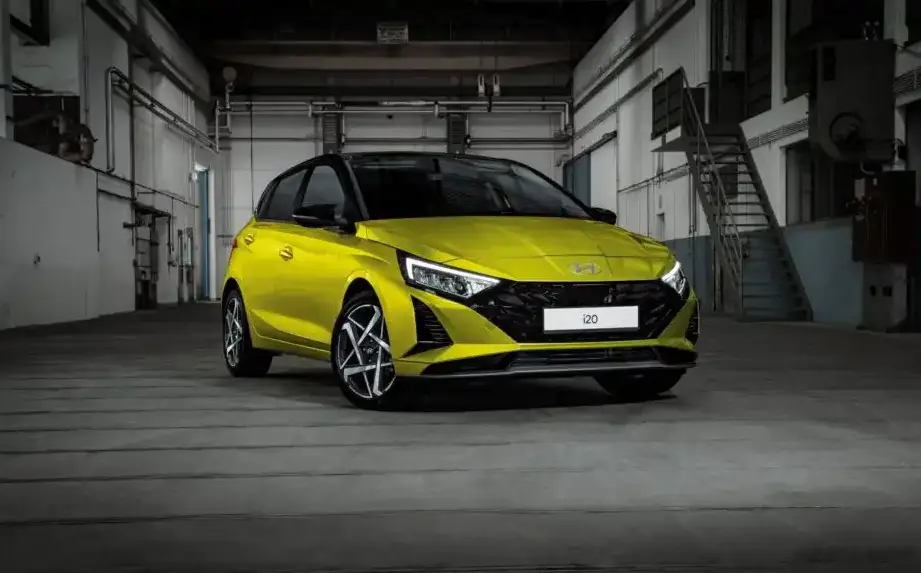
The Hyundai i20 III, specifically the 1.2 MPI (84 horsepower) variant introduced with the 2023 facelift, represents an entry-level offering within the third generation of Hyundai’s popular subcompact hatchback. Production of this configuration spanned from May 2023 to May 2024. Positioned as the most accessible powertrain option, it aimed to provide affordable and efficient transportation, primarily targeting cost-conscious buyers in the European market and other regions where subcompact hatchbacks are highly prevalent. This model is built on the Hyundai-Kia B-platform, shared with models like the Kia Rio.
Technical Specifications
| Brand | Hyundai |
| Model | i20 |
| Generation | i20 III (facelift 2023) |
| Type (Engine) | 1.2 MPI (84 Hp) |
| Start of production | May, 2023 |
| End of production | May, 2024 |
| Powertrain Architecture | Internal Combustion engine |
| Body type | Hatchback |
| Seats | 5 |
| Doors | 5 |
| Combined fuel consumption (WLTP) | 5.2-5.6 l/100 km (45.2 – 42 US mpg, 54.3 – 50.4 UK mpg, 19.2 – 17.9 km/l) |
| CO2 emissions (WLTP) | 117-127 g/km |
| Fuel Type | Petrol (Gasoline) |
| Acceleration 0 – 100 km/h | 13.1 sec |
| Acceleration 0 – 62 mph | 13.1 sec |
| Acceleration 0 – 60 mph | 12.4 sec |
| Maximum speed | 173 km/h (107.5 mph) |
| Emission standard | Euro 6d |
| Weight-to-power ratio | 12.1 kg/Hp, 82.9 Hp/tonne |
| Weight-to-torque ratio | 8.6 kg/Nm, 116.5 Nm/tonne |
| Power | 84 Hp @ 6000 rpm |
| Power per litre | 70.2 Hp/l |
| Torque | 118 Nm @ 4000 rpm (87.03 lb.-ft. @ 4000 rpm) |
| Engine layout | Front, Transverse |
| Engine Model/Code | G4LF |
| Engine displacement | 1197 cm3 (73.05 cu. in.) |
| Number of cylinders | 4 |
| Engine configuration | Inline |
| Number of valves per cylinder | 4 |
| Fuel injection system | Multi-port manifold injection |
| Engine aspiration | Naturally aspirated engine |
| Engine oil capacity | 3.4 l (3.59 US qt | 2.99 UK qt) |
| Coolant | 4.66 l (4.92 US qt | 4.1 UK qt) |
| Kerb Weight | 1013-1123 kg (2233.28 – 2475.79 lbs.) |
| Max. weight | 1550 kg (3417.17 lbs.) |
| Max load | 427-537 kg (941.37 – 1183.88 lbs.) |
| Fuel tank capacity | 40 l (10.57 US gal | 8.8 UK gal) |
| Max. roof load | 70 kg (154.32 lbs.) |
| Length | 4065 mm (160.04 in.) |
| Width | 1775 mm (69.88 in.) |
| Height | 1450 mm (57.09 in.) |
| Wheelbase | 2580 mm (101.57 in.) |
| Front track | 1531-1545 mm (60.28 – 60.83 in.) |
| Rear (Back) track | 1536-1549 mm (60.47 – 60.98 in.) |
| Drivetrain Architecture | The Internal combustion engine (ICE) drives the front wheels of the vehicle. |
| Drive wheel | Front wheel drive |
| Number of gears and type of gearbox | 5 gears, manual transmission |
| Front suspension | Independent type McPherson |
| Rear suspension | Torsion |
| Front brakes | Ventilated discs |
| Rear brakes | Disc |
| Assisting systems | ABS (Anti-lock braking system) |
| Steering type | Steering rack and pinion |
| Power steering | Electric Steering |
| Tires size | 185/65 R15; 195/55 R16; 215/45 R17 |
| Wheel rims size | 15; 16; 17 |
Powertrain & Engine Architecture
The heart of this i20 variant is the Hyundai G4LF 1.2-liter naturally aspirated inline-four cylinder engine. This engine utilizes a multi-point fuel injection system, a relatively simple and cost-effective technology. The G4LF engine is known for its durability and straightforward design, prioritizing reliability over outright performance. It features a single overhead camshaft (SOHC) valvetrain with four valves per cylinder. The engine’s modest output of 84 horsepower and 118 Nm (87 lb-ft) of torque is delivered at 6,000 rpm and 4,000 rpm respectively. This particular model is paired with a five-speed manual transmission, chosen for its affordability and simplicity. The transmission’s gear ratios are tuned for fuel efficiency rather than spirited acceleration.
Driving Characteristics
The 1.2 MPI with a manual transmission delivers a driving experience focused on practicality and economy. Acceleration is modest, taking approximately 13.1 seconds to reach 62 mph (100 km/h). In real-world driving, the engine feels adequate for city commuting and highway cruising, but struggles with quick overtaking maneuvers or when fully loaded with passengers and cargo. The five-speed gearbox provides sufficient ratios for maintaining comfortable cruising speeds, but the lack of a sixth gear can result in a slightly higher engine speed at highway velocities. Compared to higher-spec i20 models equipped with the 1.0 T-GDi turbocharged engine, this 1.2 MPI feels significantly less powerful and responsive. However, the naturally aspirated engine offers a more linear power delivery, which some drivers may find more predictable and easier to modulate.
Equipment & Trim Levels
The 1.2 MPI variant typically served as the base trim level for the i20 III facelift. Standard equipment generally included air conditioning, power windows, central locking, and a basic audio system with Bluetooth connectivity. Safety features such as ABS, Electronic Stability Control (ESC), and multiple airbags were also standard. Interior upholstery was typically cloth, and the dashboard featured a functional but relatively basic design. Optional extras, depending on the market, could include alloy wheels, a touchscreen infotainment system with Apple CarPlay and Android Auto compatibility, and parking sensors. The trim level was designed to appeal to buyers prioritizing value and essential features.
Chassis & Braking
The i20 III utilizes a McPherson strut front suspension and a torsion beam rear suspension. This setup provides a comfortable ride quality, well-suited for everyday driving conditions. The torsion beam rear suspension is a cost-effective solution that prioritizes space efficiency. Braking duties are handled by ventilated discs at the front and solid discs at the rear. The braking system is adequate for the vehicle’s weight and performance, and ABS is standard for enhanced safety. Steering is provided by an electric power steering system, offering light and easy maneuverability.
Market Reception & Comparison
The 1.2 MPI i20 was generally well-received as an affordable and practical city car. Critics praised its fuel efficiency and comfortable ride, but noted its lack of outright performance. Compared to other trims in the i20 lineup, such as the 1.0 T-GDi, the 1.2 MPI offered significantly lower running costs but at the expense of driving enjoyment. In terms of reliability, the G4LF engine has proven to be relatively robust, with few reported major issues. Fuel economy figures of 5.2-5.6 l/100 km (45.2-42 US mpg) were competitive within the subcompact hatchback segment.
Legacy
The Hyundai i20 III 1.2 MPI (84 Hp) represents a significant offering in the subcompact hatchback market, particularly for buyers seeking an economical and reliable vehicle. While not the most exciting option in the lineup, its affordability and fuel efficiency made it a popular choice. On the used car market, these models are generally considered to be good value, offering a practical and dependable mode of transportation. The G4LF engine’s proven reliability contributes to its continued appeal, making it a sensible choice for budget-conscious buyers.