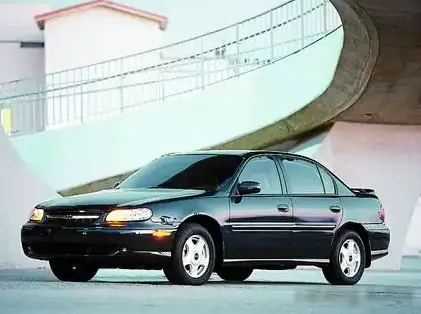
The Chevrolet Malibu V, produced from 1999 to 2003, represented a significant step forward for Chevrolet’s mid-size sedan. The 3.1i V6 variant, equipped with a four-speed automatic transmission, occupied a middle ground within the Malibu V lineup, offering a balance between performance and affordability. This model was part of the seventh generation of the Malibu, internally designated as the V platform, and aimed to recapture market share in a segment increasingly competitive with both domestic and import rivals. It was positioned above the base 2.2L four-cylinder models and below the more powerful supercharged variants.
Technical Specifications
| Brand | Chevrolet |
| Model | Malibu |
| Generation | Malibu V |
| Type (Engine) | 3.1i V6 (170 Hp) Automatic |
| Start of production | 1999 |
| End of production | 2003 |
| Powertrain Architecture | Internal Combustion engine |
| Body type | Sedan |
| Seats | 5 |
| Doors | 4 |
| Fuel consumption (urban) | 11.7 l/100 km (20.1 US mpg) |
| Fuel consumption (extra urban) | 8.1 l/100 km (29 US mpg) |
| Fuel consumption (combined) | 9.8 l/100 km (24 US mpg) |
| Fuel Type | Petrol (Gasoline) |
| Weight-to-power ratio | 8.3 kg/Hp |
| Weight-to-torque ratio | 5.8 kg/Nm |
| Power | 170 Hp @ 5200 rpm |
| Power per litre | 54.3 Hp/l |
| Torque | 244 Nm @ 4000 rpm (179.97 lb.-ft. @ 4000 rpm) |
| Maximum engine speed | 6000 rpm |
| Engine layout | Front, Transverse |
| Engine Model/Code | LG8 |
| Engine displacement | 3129 cm3 (190.94 cu. in.) |
| Number of cylinders | 6 |
| Engine configuration | V-engine |
| Cylinder Bore | 89 mm (3.5 in.) |
| Piston Stroke | 84 mm (3.31 in.) |
| Compression ratio | 9.6:1 |
| Number of valves per cylinder | 2 |
| Fuel injection system | Multi-port manifold injection |
| Engine aspiration | Naturally aspirated engine |
| Valvetrain | OHV |
| Engine oil capacity | 4.3 l (4.54 US qt | 3.78 UK qt) |
| Coolant | 12.9 l (13.63 US qt | 11.35 UK qt) |
| Kerb Weight | 1409 kg (3106.31 lbs.) |
| Trunk (boot) space – maximum | 438 l (15.47 cu. ft.) |
| Fuel tank capacity | 54 l (14.27 US gal | 11.88 UK gal) |
| Length | 4836 mm (190.39 in.) |
| Width | 1762 mm (69.37 in.) |
| Height | 1427 mm (56.18 in.) |
| Wheelbase | 2717 mm (106.97 in.) |
| Front track | 1498 mm (58.98 in.) |
| Rear (Back) track | 1506 mm (59.29 in.) |
| Ride height (ground clearance) | 139 mm (5.47 in.) |
| Minimum turning circle (turning diameter) | 11.1 m (36.42 ft.) |
| Drivetrain Architecture | The Internal combustion engine (ICE) drives the front wheels of the vehicle. |
| Drive wheel | Front wheel drive |
| Number of gears and type of gearbox | 4 gears, automatic transmission Hydra-Matic |
| Front suspension | Independent, type McPherson with coil spring and anti-roll bar |
| Rear suspension | Independent multi-link suspension |
| Front brakes | Ventilated discs |
| Rear brakes | Drum |
| Assisting systems | ABS (Anti-lock braking system) |
| Steering type | Steering rack and pinion |
| Power steering | Hydraulic Steering |
| Tires size | 215/60 R15 |
| Wheel rims size | 6.0J x 15 |
Powertrain & Engine Architecture
The heart of the Malibu V 3.1i was the LG8 3.1-liter (191 cubic inch) V6 engine. This engine utilized a 90-degree V-configuration, employing an overhead valve (OHV) valvetrain with two valves per cylinder. The LG8 featured multi-port fuel injection, delivering fuel directly to each intake port for improved efficiency and responsiveness. The engine’s 9.6:1 compression ratio contributed to its respectable power output. Paired with this engine was the Hydra-Matic 4T60E four-speed automatic transmission, a common and generally reliable unit for its time. This transmission was known for its smooth shifts, but wasn’t particularly geared for maximizing fuel economy compared to later designs. The 4T60E featured electronic control for shift points and torque converter lockup, optimizing performance based on driving conditions.
Driving Characteristics
The 170 horsepower and 244 Nm (180 lb-ft) of torque provided by the 3.1L V6 and 4T60E automatic combination resulted in adequate, though not exhilarating, performance. Acceleration from 0 to 60 mph was typically in the 9-10 second range. The automatic transmission’s gear ratios were tuned for comfortable cruising rather than aggressive acceleration. Compared to the available manual transmission or the later supercharged versions, the 3.1L automatic felt noticeably less responsive. However, it offered a more relaxed driving experience, particularly in city traffic. The torque converter smoothed out power delivery, making it easy to drive for a wide range of drivers.
Equipment & Trim Levels
The 3.1i V6 automatic trim generally included standard features such as air conditioning, power windows and locks, an AM/FM stereo with cassette player, and cloth upholstery. Optional extras included a power sunroof, upgraded sound system, alloy wheels, and leather upholstery. The interior design was fairly conservative, focusing on practicality and comfort. Dashboard materials were typical for the segment, utilizing durable plastics. The base trim level offered fewer frills, while higher trims added more convenience and aesthetic features.
Chassis & Braking
The Malibu V utilized an independent front suspension with McPherson struts and a multi-link independent rear suspension. This setup provided a reasonably comfortable ride, absorbing bumps and irregularities in the road surface effectively. Front brakes were ventilated discs, offering good stopping power, while rear brakes were drums, a cost-saving measure common in this class of vehicle. Anti-lock brakes (ABS) were standard, enhancing safety by preventing wheel lockup during hard braking. The steering was rack-and-pinion with hydraulic power assist, providing a responsive and easy-to-use steering feel.
Market Reception & Comparison
The Malibu V 3.1i was generally well-received by critics as a competent and comfortable mid-size sedan. However, it didn’t necessarily stand out from the competition. Fuel economy was average for the class, with combined figures around 24 mpg. Reliability was generally good, although the 4T60E transmission was known to have some potential issues if not properly maintained. Compared to the four-cylinder models, the 3.1L V6 offered a significant performance upgrade, but at a higher price point. The supercharged variants provided even more power, but were considerably more expensive and less fuel-efficient.
Legacy
The Chevrolet Malibu V 3.1i V6 automatic, while not a groundbreaking vehicle, represents a solid and dependable mid-size sedan from the early 2000s. The LG8 engine proved to be relatively durable, and many examples are still on the road today. The 4T60E transmission, while having some known weaknesses, can provide years of service with regular fluid changes and maintenance. In the used car market, these Malibus are often sought after as affordable and practical transportation, offering a comfortable ride and reasonable reliability. They represent a transitional period for Chevrolet, moving towards more modern designs and technologies.