
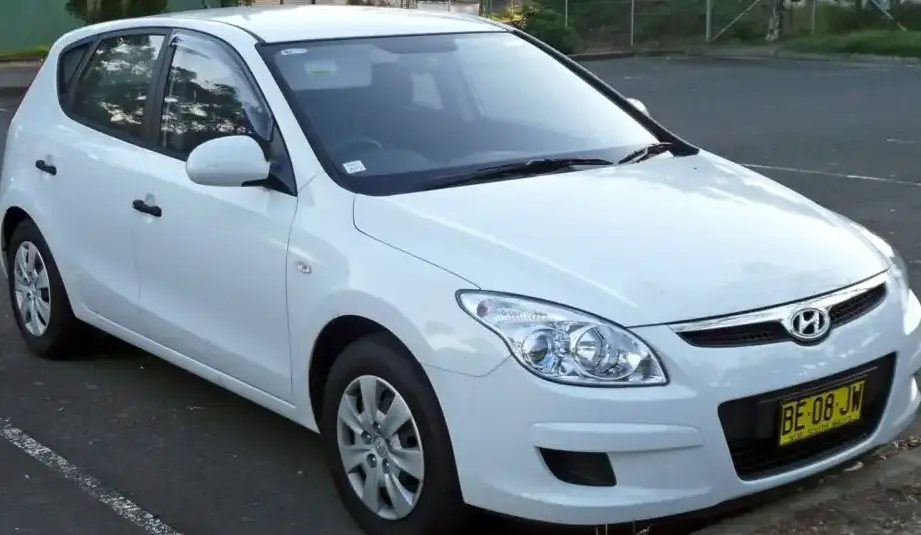
The Hyundai i30, launched in 2007, represented a significant step forward for the Korean automaker in the European compact hatchback market. Designed as a direct competitor to established players like the Volkswagen Golf and Ford Focus, the i30 aimed to offer a compelling blend of style, practicality, and value. The 1.6-liter (122 hp) automatic variant, produced from 2007 to 2010, occupied a middle ground within the i30 lineup, targeting buyers seeking a comfortable and convenient daily driver without prioritizing outright performance. It was part of the first generation i30 (FD), built on the Hyundai-Kia PB platform.
Technical Specifications
| Brand | Hyundai |
| Model | i30 |
| Generation | i30 I |
| Type (Engine) | 1.6 (122 Hp) Automatic |
| Start of production | 2007 |
| End of production | 2010 |
| Powertrain Architecture | Internal Combustion engine |
| Body type | Hatchback |
| Seats | 5 |
| Doors | 5 |
| Fuel consumption (urban) | 9 l/100 km (26.1 US mpg, 31.4 UK mpg, 11.1 km/l) |
| Fuel consumption (extra urban) | 5.7 l/100 km (41.3 US mpg, 49.6 UK mpg, 17.5 km/l) |
| Fuel consumption (combined) | 6.9 l/100 km (34.1 US mpg, 40.9 UK mpg, 14.5 km/l) |
| Fuel Type | Petrol (Gasoline) |
| Acceleration 0 – 100 km/h | 12.1 sec |
| Acceleration 0 – 62 mph | 12.1 sec |
| Acceleration 0 – 60 mph | 11.5 sec |
| Maximum speed | 183 km/h (113.71 mph) |
| Emission standard | Euro 4 |
| Weight-to-power ratio | 10.6 kg/Hp, 94.6 Hp/tonne |
| Weight-to-torque ratio | 8.2 kg/Nm, 121.8 Nm/tonne |
| Power | 122 Hp @ 6200 rpm |
| Power per litre | 76.7 Hp/l |
| Torque | 157 Nm @ 4200 rpm (115.8 lb.-ft. @ 4200 rpm) |
| Engine layout | Front, Transverse |
| Engine Model/Code | G4FC |
| Engine displacement | 1591 cm3 (97.09 cu. in.) |
| Number of cylinders | 4 |
| Engine configuration | Inline |
| Cylinder Bore | 77 mm (3.03 in.) |
| Piston Stroke | 85.4 mm (3.36 in.) |
| Compression ratio | 10.5:1 |
| Number of valves per cylinder | 4 |
| Fuel injection system | Multi-port manifold injection |
| Engine aspiration | Naturally aspirated engine |
| Valvetrain | DOHC |
| Engine oil capacity | 3.3 l (3.49 US qt | 2.9 UK qt) |
| Coolant capacity | 6 l (6.34 US qt | 5.28 UK qt) |
| Kerb Weight | 1289 kg (2841.76 lbs.) |
| Max. weight | 1740 kg (3836.04 lbs.) |
| Max load | 451 kg (994.28 lbs.) |
| Trunk (boot) space – minimum | 340 l (12.01 cu. ft.) |
| Trunk (boot) space – maximum | 1200 l (42.38 cu. ft.) |
| Fuel tank capacity | 53 l (14 US gal | 11.66 UK gal) |
| Length | 4245 mm (167.13 in.) |
| Width | 1775 mm (69.88 in.) |
| Height | 1480 mm (58.27 in.) |
| Wheelbase | 2650 mm (104.33 in.) |
| Drivetrain | Front wheel drive |
| Number of gears | 4 |
| Gearbox type | Automatic transmission |
| Tire size | 185/65 R15 |
INTRODUCTION
The Hyundai i30 1.6 Automatic, launched in 2007, was a key variant in the initial i30 range. Hyundai aimed to establish itself as a serious contender in the competitive C-segment (compact class) with the i30, and the 1.6-liter engine paired with an automatic transmission offered a balance of affordability and ease of use. This model was primarily marketed towards buyers who valued comfort and convenience over sporty driving dynamics. It was positioned below the more powerful 2.0-liter variants and above the base 1.4-liter engine option. The i30 was a departure for Hyundai, as it was the first model designed and engineered entirely in Europe, at Hyundai’s R&D center in Rüsselsheim, Germany.
Powertrain & Engine Architecture
The heart of the i30 1.6 Automatic is the Hyundai G4FC engine, a 1.6-liter inline-four cylinder gasoline engine. This engine utilizes a multi-point fuel injection system and a double overhead camshaft (DOHC) valvetrain with four valves per cylinder. The G4FC is a naturally aspirated engine, meaning it doesn’t employ turbocharging or supercharging. It produces 122 horsepower at 6200 rpm and 157 Nm (115.8 lb-ft) of torque at 4200 rpm. The engine’s design focused on providing adequate power for everyday driving while maintaining reasonable fuel efficiency. The automatic transmission is a conventional four-speed unit. While not the most modern transmission available at the time, it provided smooth shifts and ease of operation, appealing to a broader range of drivers. The transmission’s gear ratios were tuned for comfortable cruising and acceptable acceleration, prioritizing fuel economy over rapid gear changes.
Driving Characteristics
The i30 1.6 Automatic delivers a comfortable, if not particularly exhilarating, driving experience. Acceleration from 0 to 60 mph takes around 11.5 to 12.1 seconds, making it slower than the manual transmission or higher-powered versions of the i30. The four-speed automatic transmission, while smooth, can feel somewhat dated compared to more modern transmissions with more gears. This results in noticeable engine revving during acceleration and potentially less efficient fuel consumption at highway speeds. The power delivery is linear, with a usable amount of torque available from mid-range revs. Steering is light and easy, making it well-suited for urban driving. The suspension is tuned for comfort, absorbing bumps and imperfections in the road reasonably well. Compared to the manual version, the automatic sacrifices some responsiveness and driver engagement.
Equipment & Trim Levels
The i30 1.6 Automatic typically came equipped with a reasonable level of standard features. These included air conditioning, power windows, central locking, and an audio system with CD player. Safety features such as ABS (Anti-lock Braking System) and front airbags were also standard. Higher trim levels offered additional features like alloy wheels, fog lights, a trip computer, and upgraded interior upholstery. Optional extras included a sunroof, leather seats, and a more advanced audio system. Interior materials were generally of good quality for the price point, with a focus on durability and practicality. The dashboard layout was straightforward and user-friendly.
Chassis & Braking
The i30 utilizes a MacPherson strut front suspension and a torsion beam rear suspension. This setup provides a good balance between ride comfort and handling. The torsion beam rear suspension is a cost-effective solution commonly found in vehicles of this class. Braking duties are handled by disc brakes on the front wheels and drum brakes on the rear wheels. ABS is standard, providing enhanced braking performance and stability. The steering system is a power-assisted rack and pinion system, offering light and precise steering feel. Stabilizer bars are fitted to both the front and rear axles to reduce body roll during cornering.
Market Reception & Comparison
The Hyundai i30 1.6 Automatic was generally well-received by automotive critics as a solid and practical hatchback. It was praised for its comfortable ride, spacious interior, and competitive price. However, the automatic transmission was sometimes criticized for being somewhat sluggish and lacking the refinement of some competitors. Compared to the 2.0-liter i30, the 1.6-liter automatic offered lower performance but better fuel economy. Against rivals like the Volkswagen Golf and Ford Focus, the i30 offered a compelling value proposition, often undercutting them in price while providing a similar level of equipment. Fuel economy figures of around 34.1 US mpg combined were respectable for the time, but not class-leading.
Legacy
The Hyundai i30 1.6 Automatic has proven to be a relatively reliable vehicle in the used car market. The G4FC engine is known for its durability, and the four-speed automatic transmission, while not the most sophisticated, is generally dependable. Common issues are relatively minor and often related to routine maintenance items. Today, these i30s represent an affordable and practical option for buyers seeking a dependable compact hatchback. While not a performance icon, the i30 1.6 Automatic played a crucial role in establishing Hyundai as a credible player in the European automotive market, paving the way for future success.
