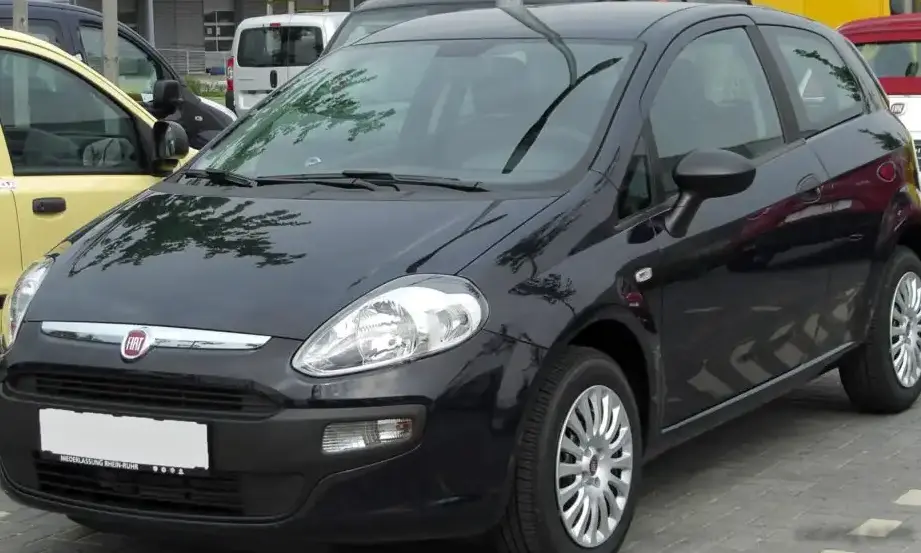
The Fiat Punto Evo 1.2 8V (65 hp) represents the entry-level powertrain option for the 199 series Punto Evo, produced between 2009 and 2010. Positioned as the most economical variant in the range, it aimed to provide affordable transportation within the European small hatchback segment. The Punto Evo itself was a significant refresh of the outgoing 188 series Punto, featuring revised styling, improved interior quality, and updated technology. This 1.2-liter engine and five-speed manual transmission combination was specifically targeted at buyers prioritizing fuel efficiency and low running costs over outright performance.
Technical Specifications
| Brand | Fiat |
| Model | Punto |
| Generation | Punto Evo (199) |
| Type (Engine) | 1.2 8V (65 Hp) |
| Start of production | 2009 |
| End of production | 2010 |
| Powertrain Architecture | Internal Combustion engine |
| Body type | Hatchback |
| Seats | 5 |
| Doors | 3-5 |
| Fuel consumption (urban) | 7.3 l/100 km (32.2 US mpg, 38.7 UK mpg, 13.7 km/l) |
| Fuel consumption (extra urban) | 4.8 l/100 km (49 US mpg, 58.9 UK mpg, 20.8 km/l) |
| Fuel consumption (combined) | 5.7 l/100 km (41.3 US mpg, 49.6 UK mpg, 17.5 km/l) |
| Fuel Type | Petrol (Gasoline) |
| Acceleration 0 – 100 km/h | 14.5 sec |
| Acceleration 0 – 62 mph | 14.5 sec |
| Acceleration 0 – 60 mph | 13.8 sec |
| Maximum speed | 155 km/h (96.31 mph) |
| Emission standard | Euro 4 |
| Weight-to-power ratio | 15.6 kg/Hp |
| Weight-to-torque ratio | 10 kg/Nm |
| Power | 65 Hp @ 5500 rpm |
| Torque | 102 Nm @ 3000 rpm (75.23 lb.-ft. @ 3000 rpm) |
| Engine layout | Front, Transverse |
| Engine Model/Code | 199A4000 |
| Engine displacement | 1242 cm3 (75.79 cu. in.) |
| Number of cylinders | 4 |
| Engine configuration | Inline |
| Cylinder Bore | 70.8 mm (2.79 in.) |
| Piston Stroke | 78.9 mm (3.11 in.) |
| Compression ratio | 11:1 |
| Number of valves per cylinder | 2 |
| Fuel injection system | Multi-port manifold injection |
| Engine aspiration | Naturally aspirated |
| Engine oil capacity | 2.6 l (2.75 US qt | 2.29 UK qt) |
| Coolant capacity | 5.3 l (5.6 US qt | 4.66 UK qt) |
| Kerb Weight | 1015 kg (2237.69 lbs.) |
| Max. weight | 1575 kg (3472.28 lbs.) |
| Max load | 560 kg (1234.59 lbs.) |
| Trunk (boot) space – minimum | 275 l (9.71 cu. ft.) |
| Trunk (boot) space – maximum | 1030 l (36.37 cu. ft.) |
| Fuel tank capacity | 45 l (11.89 US gal | 9.9 UK gal) |
| Length | 4065 mm (160.04 in.) |
| Width | 1687 mm (66.42 in.) |
| Height | 1490 mm (58.66 in.) |
| Wheelbase | 2510 mm (98.82 in.) |
| Front track | 1473 mm (57.99 in.) |
| Rear track | 1466 mm (57.72 in.) |
| Drag coefficient (Cd) | 0.34 |
| Minimum turning circle | 10.0 m (32.81 ft.) |
| Drivetrain | Front wheel drive |
| Number of gears | 5 |
| Gearbox type | Manual transmission |
| Front suspension | Independent, McPherson with coil spring and anti-roll bar |
| Rear suspension | Semi-independent, coil spring |
| Front brakes | Ventilated discs |
| Rear brakes | Drum |
| Assisting systems | ABS (Anti-lock braking system) |
| Steering type | Steering rack and pinion |
| Power steering | Electric |
| Tires size | 175/65 R15; 185/65 R15; 195/55 R16 |
| Wheel rims size | 15; 16 |
Powertrain & Engine Architecture
The heart of this Punto Evo variant is the Fiat 199A4000 1.2-liter inline-four cylinder engine. This engine is a member of Fiat’s long-running small displacement petrol engine family, known for its simplicity and durability. The ‘8V’ designation indicates an eight-valve cylinder head (two valves per cylinder). It utilizes a multi-point fuel injection system, delivering fuel directly into the intake ports. The engine’s relatively low compression ratio of 11:1 contributes to its ability to run on readily available fuel grades. The five-speed manual transmission, a common choice for this class of vehicle, provides a straightforward and reliable means of transferring power to the front wheels. The transmission’s gear ratios are tuned for fuel economy rather than rapid acceleration.
Driving Characteristics
The 1.2 8V Punto Evo, with its 65 horsepower, delivers modest performance. Acceleration is best described as adequate for urban driving and slower country roads. The 0-60 mph time of around 13.8 seconds reflects this. The engine requires frequent downshifting to maintain momentum when overtaking or climbing hills. Compared to the more powerful 1.4-liter variants, or even diesel options, this engine feels noticeably underpowered. However, the lighter engine weight contributes to nimble handling, and the steering is responsive. The five-speed manual transmission is light and easy to use, but the long shift throws aren’t particularly sporty. The focus is clearly on providing a comfortable and economical driving experience.
Equipment & Trim Levels
The 1.2 8V typically represented the base trim level for the Punto Evo. Standard equipment generally included central locking, power steering, front airbags, and an adjustable steering column. Interior upholstery was typically basic cloth. Optional extras included air conditioning, electric windows, and a radio/CD player. Higher trim levels, such as the Dynamic or Eleganza, added features like alloy wheels, fog lights, and upgraded interior trim. The base trim was designed to appeal to budget-conscious buyers, offering essential features at an affordable price point.
Chassis & Braking
The Punto Evo 1.2 8V utilizes a McPherson strut front suspension and a semi-independent torsion beam rear suspension. This setup provides a reasonable balance between ride comfort and handling. The front brakes are ventilated discs, offering adequate stopping power, while the rear brakes are drums, a cost-saving measure common in this segment. ABS (Anti-lock Braking System) was standard, enhancing safety. The suspension tuning is geared towards comfort, absorbing bumps and imperfections in the road surface effectively. Stabilizer bars were fitted to reduce body roll during cornering, but the overall handling is not particularly sporty.
Market Reception & Comparison
The 1.2 8V Punto Evo was generally well-received as an affordable and economical city car. Critics praised its fuel efficiency and low running costs, but noted its lack of outright performance. Compared to other small hatchbacks in the European market, such as the Volkswagen Polo or Renault Clio, the Punto Evo offered a competitive price point but lacked the refinement and driving dynamics of some rivals. The 1.4-liter Punto Evo offered significantly more power and a more engaging driving experience, but at a higher price. The diesel variants provided even better fuel economy, but were more expensive to purchase and maintain.
Legacy
The 1.2 8V Punto Evo, while not the most exciting variant in the range, proved to be a reliable and durable powertrain. The engine is known for its simplicity and relatively low maintenance requirements. On the used car market, these models are often sought after by first-time drivers or those looking for an inexpensive and economical runabout. Parts availability is generally good, and repair costs are relatively low. While not a collector’s item, the 1.2 8V Punto Evo remains a practical and affordable option for those seeking basic transportation.